
BookRags.com Literature Guides Literature
Guides
Criticism & Essays Criticism &
Essays
Questions & Answers Questions &
Answers
Lesson Plans Lesson
Plans
My Bibliography Periodic Table U.S. Presidents Shakespeare Sonnet Shake-Up
Research Anything:        
History | Encyclopedias | Films | News | Create a Bibliography | More... Login | Register | Help

Search "George Eastman"

Biographies Navigation
 

George Eastman Biography

Print-Friendly  Order the PDF version  Order the RTF version
About 2 pages (596 words)
George Eastman Summary

Bookmark and Share Questions on this topic? Just ask!
Name: George Eastman
Birth Date: July 12, 1854
Death Date: March 14, 1932
Place of Birth: Waterville, New York, United States
Place of Death: Rochester, New York, United States
Nationality: American
Gender: Male
Occupations: inventor, industrialist, businessman

Encyclopedia of World Biography on George Eastman

By mass-producing his inventions, the American inventor and industrialist George Eastman (1854-1932) promoted photography as a popular hobby. He was also a benefactor of educational institutions.

George Eastman was born in Waterville, N.Y., on July 12, 1854, and educated in Rochester public schools. He advanced from messenger to bookkeeper in the Rochester Savings Bank by 1877. Frugal with money--his only extravagance amateur photography--he spent his savings on cameras and supplies and went to Mackinac Island. When photographic chemicals ruined his packed clothes, he became disgusted with the wet-plate process.

In the 1870s American photography was still slow, difficult, and expensive. Equipment included a huge camera, strong tripod, large plateholder, dark tent, chemicals, water container, and heavy glass plates. Eastman experimented with dry-plate techniques. He was the first American to contribute to photographic technology by coating glass plates with gelatin and silver bromide. In 1879 his coating machine was patented in England, in 1880 in America. He sold his English patent and opened a shop to manufacture photographic plates in Rochester. To eliminate glass plates, Eastman coated paper with gelatin and photographic emulsion. The developed film was stripped from the paper to make a negative. This film was rolled on spools. Eastman and William Walker devised a lightweight roll holder to fit any camera.

Amateurs could develop pictures after Eastman substituted transparent film for the paper in 1884. Flexible film was created by Hannibal Goodwin of New York and a young Eastman chemist, Henry Reichenback. The long patent dispute between Goodwin and Eastman was the most important legal controversy in photographic history. A Federal court decision on Aug. 14, 1913, favored Goodwin. Goodwin's heirs and Ansco Company, owners of his patent, received $5,000,000 from Eastman in 1914.

In 1888 Eastman designed a simple camera, the Kodak (Eastman's coined word, without meaning), which was easy to carry and eliminated focusing and lighting. With a 100-exposure roll of celluloid film, it sold for $25.00. After taking the pictures and sending the camera and $10 to the Rochester factory, the photographer received his prints and reloaded camera. Eastman's slogan, "You press the button, we do the rest," was well known.

Anticipating photography's increased popularity, in 1892 Eastman incorporated the Eastman Kodak Company. This was one of the first American firms to mass-produce standardized products and to maintain a chemical laboratory. By 1900 his factories at Rochester and at Harrow, England, employed over 3,000 people and by 1920 more than 15,000. Eastman, at first treasurer and general manager, later became president and finally board chairman.

Daylight-loading film and cameras eliminated returning them to the factory. To Eastman's old slogan was added "or you can do it yourself." A pocket Kodak was marketed in 1897, a folding Kodak in 1898, noncurling film in 1903, and color film in 1928. Eastman film was indispensable to Thomas Edison's motion pictures; Edison's incandescent bulb was used by Eastman and by photographers specializing in "portraits taken by electric light."

Eastman's staff worked on abstract problems of molecular structure and relativity, as well as on photographic improvements. During World War I his laboratory helped make America's chemical industry independent of Germany, and finally the world leader.

Concerned with employee welfare, Eastman was the first American businessman to grant workers dividends and profit sharing. He systematically gave away his huge fortune to the University of Rochester (especially the medical school and Eastman School of Music), Massachusetts Institute of Technology, Hampton Institute, Tuskegee Institute, Rochester Dental Dispensary, and European dental clinics.

After a long illness the lonely, retiring bachelor committed suicide on March 14, 1932, in Rochester. He had written to friends, "My work is done. Why wait""

This is the complete article, containing 596 words (approx. 2 pages at 300 words per page).

View More Summaries on George Eastman
More Information
  • View George Eastman Study Pack
  • Search Results for "George Eastman"
  • Add This to Your Bibliography
  • More Products on This Subject
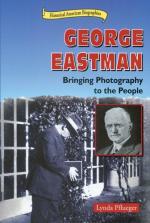
    George Eastman
    Born in Waterville, New York, George Eastman quit school at the age of fourteen to help support his... more

    Eastman, George
    (born July 12, 1854, Waterville, New York, U.S.—died March 14, 1932, Rochester, New York) Ame... more


    Ask any question on George Eastman and get it answered FAST!
    Answer questions in BookRags Q&A and earn points toward
    discounted or even FREE Study Guides and other BookRags products!
    Learn more about BookRags Q&A
    Copyrights
    George Eastman from Encyclopedia of World Biography. ©2005-2006 Thomson Gale, a part of the Thomson Corporation. All rights reserved.

    Join BookRagslearn moreJoin BookRags


    About BookRags | Customer Service | Report an Error | Terms of Use | Privacy Policy

