
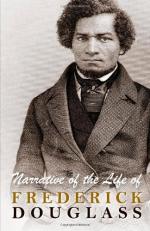
Dictionary of Literary Biography on Frederick Douglass
As a journalist, Frederick Douglass is mainly remembered for establishing the North Star, one of the most highly acclaimed abolitionist newspapers. He also founded and edited Douglass' Monthly, one of the few abolitionist magazines.
Frederick Augustus Washington Bailey was born in Tuckahoe, Talbot County, Maryland, probably in 1817. His mother, Harriet Bailey, could read-an unusual skill for a slave. His father may have been his white master. As a child he escaped the rigors of field labor for a time when he was sent from Lloyd Plantation in Talbot County to Fell Point in Baltimore, where he served as companion to the son of Hugh Auld, the younger brother of the overseer at Lloyd Plantation. Auld's kindhearted wife, Sophia Auld, taught him to read and write. He lived a remarkably unconfined life in Baltimore, cultivating white friends and, to a degree, moving freely in both white and black circles. One result was that he became more aware of the magnitude of social injustice in the United States. By the time he was sent back to Lloyd Plantation he had developed a keen social awareness. At age sixteen he helped establish two black Sabbath schools in Talbot County. Returned to Baltimore to work in a shipyard, he escaped his enslavement in 1838 by impersonating a free black sailor. He immediately went to Philadelphia and then to New York City, where he married a freedwoman, Anna Murray. Adopting the name Douglass to elude pursuers, the couple moved to Massachusetts, where Douglass worked at a series of menial jobs.
By 1839 Douglass was publicly speaking to black groups against the proposed "recolonization" of American blacks in Africa. In 1841 he attended a convention of the Massachusetts Anti-Slavery Society in Nantucket; after impressing the audience with his eloquent speaking and formidable intellect, he was asked to become a spokesman for the society. Douglass agreed and immediately went on tour.
Douglass's autobiography, Narrative of the Life of Frederick Douglass, an American Slave (1845), sold more than thirty thousand copies; the book made him a folk hero to many free northern blacks as well as a prominent figure in the abolitionist cause. In August 1847 he left for a speaking tour of Ireland, Scotland, and England. When he returned to the United States in 1847 he moved to Rochester, New York, and established the North Star. The newspaper's motto was "Right is of no Sex--Truth is of no Color--God is the Father of us all, and we are all Brethren." Although the weekly was an abolitionist journal, Douglass wrote in the first issue that it would be open to discussion of all topics of a "moral and humane character, which may serve to enlighten, improve and elevate mankind." Besides advocating the abolition of slavery, he diligently supported the women's movement.
The North Star was not a financial success, but it was a unique and powerful force in the antislavery movement. Its greatest asset was Douglass, who continually validated his cause through the quality of his work. The North Star was a constant reminder to the white public that the black race was not congenitally inferior. Douglass always insisted on high editorial and stylistic standards; the abolitionist editor William Lloyd Garrison praised the newspaper as one of the best literary journals, antislavery or proslavery, in the country.
Largely because of high illiteracy rates among blacks, five of every six readers of the North Star were white. The paper was well received by women because of its progressive stance concerning the women's movement. Douglass attended the first Women's Rights Convention in 1848 and was a lifelong supporter of woman suffrage. In fact, at one point he thought of changing the name of the newspaper to "The Brotherhood" but rejected the idea because it "implied the exclusion of the sisterhood."
In 1851 Douglass merged the North Star with the floundering Liberty Party Paper and renamed it Frederick Douglass's Paper in hopes that his fame might spark circulation growth, but the paper continued to struggle with financial difficulties. To raise funds for the journal, in 1859 a giftbook of essays, stories, and letters by various abolitionists titled Autographs for Freedom was published by Julia Griffiths, Douglass's business manager. One of the contributions was a short story by Douglass, "The Heroic Slave", about an uprising on a slave ship. The story suggests Douglass was moving away from his earlier stance that abolition might be attained without violence.
In 1858 Douglass established Douglass' Monthly, an abolitionist magazine published both in Great Britain and the United States, but primarily aimed at a British audience in the hope of garnering financial support for the Union. Frederick Douglass's Paper ceased publication in 1860. Douglass' Monthly followed in 1863.
In 1870 Douglass became corresponding editor of the New National Era, a weekly based in Washington, D.C. One year later he purchased the magazine and continued to publish it until 1874. In 1872 he was nominated for vice-president on the Equal Rights party ticket; he was to have run with Victoria C. Woodhull, another noted journalist and women's rights advocate, but he opted instead to campaign for the reelection of President Grant. In 1877 he was appointed United States marshal for the District of Columbia. His first wife died in 1882; in 1884 he married his white secretary, Helen Pitts.
In 1889 Douglass was named consul general to Haiti. He returned to private life two years later. He died of a heart attack on 20 February 1895 and was buried in Rochester, New York.
This is the complete article, containing 908 words
(approx. 3 pages at 300 words per page).

