
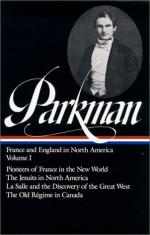
Dictionary of Literary Biography on Francis Parkman, Jr.
FRANCIS PARKMAN, JR. (16 September 1823-8 November 1893), was the eldest son of the Reverend Francis Parkman, pastor of the New York Church and a leader in orthodox Unitarianism in Boston. Young Parkman shared the social prominence and affluence which characterized the Boston Brahmins. His ancestor, Elias Parkman, had come to Massachusetts Bay in 1633, and his grandfather, Samuel Parkman, had been one of Boston's wealthiest merchants. Francis Parkman's mother was a descendant of John Cotton of Boston, grandfather of Cotton Mather. Parkman attended Gideon Thayer's renowned private school at Chauncey Place and entered Harvard College in 1840. Even while studying trigonometry and Greek history, Parkman exercised his passion for outdoor life. Ironically, his recurrent ill health influenced his skill as a woodsman. As a young sickly child, he was sent to his grandfather's farm near Medford. For five years Parkman lived there and acquired a keen interest in woodlore. As a Harvard student, he frequently hiked and hunted in his favorite domain, the Five Mile Woods. During his senior year, nervous exhaustion forced Parkman to suspend his studies for nine months, and he toured Europe to regain his health.
Actually Parkman was plagued with poor health during his entire lifetime. He suffered from a medley of afflictions, including poor eyesight, arthritis, chronic stomach disorders, and severe headaches. By his graduation from Harvard in late 1844, Parkman had repeatedly interrupted his studies for forays into the wilderness areas of New York and New England, where he nurtured an ever-growing interest in Indian culture and the French-Indian War. Also, during his European convalescence, Parkman exhibited his capacity as a diarist by compiling a journal of some 50,000 words. Though his main interest was historical lore and nature, Parkman continued his studies in law, and in 1846 took his degree from Harvard. Ill health and a love for the outdoors moved him to undertake a long trip to the West with his cousin, "Quin" Shaw. Parkman's journey along the Oregon Trail furnished the inspiration for his first important publication, The California and Oregon Trail (1849), which three years later was reissued as Prairie and Rocky Mountain Life: or, The California and Oregon Trail. Parkman's subsequent writing on the Anglo-French struggle for North America reflected not only his love for the outdoors, but his commitment to both the new German history and his New England Protestant heritage. Like George Bancroft and William Prescott, Parkman espoused the Germanic notion that history was not limited by the boundaries of national states, but was a continuing saga of the evolutionary development of civil liberties. And because of his New England religious heritage, Parkman viewed the struggle in the western hemisphere as between individual freedom and Catholic autocracy. Hence the struggle for the New World between France and England was viewed by Parkman as a contest between a New France representative of Old World monarchy and the freedom loving instincts of the Anglo-Saxon in North America. Such was the tone of his first work on the Anglo-French struggle, The History of the Conspiracy of Pontiac (1851), and remained thus until the publication of A Half-Century of Conflict (1892), which was issued the year before his death in Boston.
This is the complete article, containing 531 words
(approx. 2 pages at 300 words per page).

