
 Print
Print Word
Word PDF
PDF|
This section contains 387 words (approx. 2 pages at 300 words per page) |
Encyclopedia of World Biography on Florence Kelley
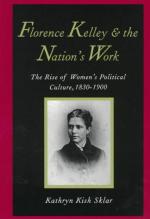
Florence Kelley (1859-1932), American social worker and reformer, fought successfully for child labor laws and improved conditions for working women.
Florence Kelley was born on September 12, 1859, in Philadelphia, Pa., the daughter of U.S. congressman William Darrah Kelley. She entered Cornell University in 1876, but poor health kept her from graduating until 6 years later, as a Phi Beta Kappa. She then studied at the University of Zurich, where she was influenced by Marxist thought. In 1887 she published a translation of Friedrich Engels's The Condition of the Working-class in England in 1844, to which Engels added a preface in 1892.
In 1884 Kelley married a Polish-Russian physician, Lazare Wischnewetzky, and set up housekeeping in New York City. Their marriage was not happy, and she left him in 1889, moving to Chicago with their three children. Although they divorced and she reassumed the name of Kelley for herself and her children, she retained her title of "Mrs."
After 1889 Kelley turned in earnest to the study of social conditions, taking special interest in women and children working in the Chicago trades. In 1891 she joined Jane Addams and her associates at Hull House. Kelley's analyses of sweatshops and slum houses resulted in a new child labor law, and she was appointed chief factory inspector for Illinois. When she found her efforts to enforce the child labor law and the compulsory education law frustrated by uncooperative city attorneys, she decided to study law. She earned her law degree at Northwestern University in 1894. Her reports and legislative achievements were outstanding milestones in social investigation.
In 1899 Kelley returned to New York to become secretary of the National Consumers' League. She lived at the Henry Street Settlement House and worked with numerous reformers and reform organizations for minimum wage laws, woman's suffrage, and Federal aid for mothers and babies. Kelley considered herself a socialist, though she was not involved in the Socialist party. She wrote Some Ethical Gains through Legislation (1905) and helped establish what became known as the "Brandeis brief" (named for Justice Louis D. Brandeis), a process of integrating facts and experiences in legal action to demonstrate the need for changing laws according to human realities.
Kelley later wrote the Modern Industry in Relation to the Family, Health, Education, Morality (1914) and a compilation, The Supreme Court and Minimum Wage Legislation (1925). She died in Germantown, Pa., on February 17, 1932.
|
This section contains 387 words (approx. 2 pages at 300 words per page) |



