
BookRags.com Literature Guides Literature
Guides
Criticism & Essays Criticism &
Essays
Questions & Answers Questions &
Answers
Lesson Plans Lesson
Plans
My Bibliography Periodic Table U.S. Presidents Shakespeare Sonnet Shake-Up
Research Anything:        
History | Encyclopedias | Films | News | Create a Bibliography | More... Login | Register | Help

Search "Festus Claudius McKay"

Biographies Navigation
 

Festus Claudius McKay Biography

Print-Friendly  Order the PDF version  Order the RTF version
About 5 pages (1,362 words)
Claude McKay Summary

Bookmark and Share Questions on this topic? Just ask!
Name: Claude McKay
Birth Date: September 15, 1890
Death Date: May 22, 1948
Place of Birth: Jamaica, American
Place of Death: Chicago, Illinois, United States
Nationality: Jamaican
Gender: Male
Occupations: writer

Dictionary of Literary Biography on Festus Claudius McKay

Claude McKay's poetry and his life display the presence of conflicting forces: his sense of identity as a black man and his desire to write out of a traditional literary heritage. While his poem "If We Must Die" has been heralded as a primary motivator for the Harlem Renaissance movement, McKay made few friends in Harlem during the 1920s, and he resisted characterization as a representative of the Harlem literary community. He was troubled that he was so often identified as a black writer rather than as an individual who was struggling to perfect his poetry, which he wanted to be judged by its merit as verse.

The youngest of eleven children, Festus Claudius McKay was born on 15 September 1889 in south-central Jamaica to Thomas Francis and Ann Elizabeth Edwards McKay, and he spent his earliest years near the hills of Clarendon Parish. When he was six years old he came under the protection of his brother, a schoolteacher and an acknowledged agnostic. This older brother introduced young McKay to literature, science, socialism, and the practice of free thinking. In 1907 McKay was apprenticed to a cabinet maker in order to assist his large and struggling family. He later worked for a wheelwright, and he joined the Jamaican Constabulary in 1909.

While McKay was coming of age, the linguist Edward Jekyll came to the island to study the Jamaican dialect. The two became close friends. Jekyll taught McKay French and introduced him to the literary classics of England, as well as encouraging the young McKay to explore his native dialect and to write poetry. In 1912 McKay published his first poetry: two volumes of dialect verse entitled Songs of Jamaica and Constab Ballads. Songs of Jamaica, in which the poet strongly identifies with earth, nature, and the life of the peasantry, is complemented by Constab Ballads, concerned with the problems of urban life in Kingston. These volumes received positive reviews in London, Glasgow, Dublin, and Sydney.

During 1912 McKay won a local prize for his published poetry and used the money to come to the United States and enroll at Tuskegee Institute, but he disliked the structured life he found there and transferred to Kansas State College. He quickly discovered that he had little interest in his chosen field of agronomy and abandoned his plans for a college education.

In 1914 McKay arrived in New York City, where he lived in Harlem but was associated with the left-wing Greenwich Village community, which shared his own traditional educational background. He lost the remainder of his money in an ill-fated restaurant venture and supported himself in a variety of odd jobs, including those of porter, longshoreman, bartender, and waiter. On 30 July 1914 he married Eulalie Imelda Edwards, but the disastrous marriage ended after only six months. In 1917 McKay published his first American poems under the pseudonym Eli Edwards in Seven Arts magazine. During the year 1919 McKay became acquainted with Frank Harris, the editor of Pearson's Magazine, and Max Eastman, the editor of the Liberator.

Also in 1919 McKay's best-known poem, "If We Must Die," was published in the Liberator. His most-frequently anthologized poem, it was read by Winston Churchill to the British people during World War II. The poem begins, "If we must die, let it not be like hogs/Hunted and penned in an inglorious spot." It ends with the powerful lines, "Like men we'll face the murderous, cowardly pack/Pressed to the wall, dying, but fighting back!" "If We Must Die," which expresses both love for America and hate for racism, became a rallying cry for justice and freedom during the race riots that broke out in several cities in 1919, and, as racial tensions increased in the South, it had a similar impact.

McKay did not know real racial prejudice until he came to America, and his horror can be found in many of his poems, including "Enslaved," which begins:


Oh when I think of my long suffering race

For weary centuries, despised, oppressed

Enslaved and lynched, denied a human place.

In "Tiger" he wrote: "The white man is a tiger at my throat/Drinking my blood as my life ebbs away."

The duality of McKay's themes is mirrored in the poems themselves: although they are charged with strong emotions, most of them are in the traditional sonnet form, and his poetic inspiration comes from the nineteenth-century romantics. A protest poet with strong traditional ties to England, he did, in fact, have his first volume of verse in standard English, Spring in New Hampshire (1920), published in London. The volume is a celebration of nature, and the title poem talks of wasted hours spent indoors "While happy winds go wasting by." McKay was unhappy with most of the reviews because they seemed more concerned with his racial heritage than his skill as a poet. He never again used his native dialect as his poetic language.

In 1920 McKay traveled to London, where he read Karl Marx and supported himself by working for Sylvia Pankhurst's Marxist periodical, Worker's Dreadnought. McKay used the opportunity to learn practical journalism. He returned to the United States the following year and became an editor for Max Eastman's Liberator. It was during this period that his most widely regarded volume of verse, Harlem Shadows (1922), was published, with an introduction by Eastman. He continued to employ the English sonnet form, but his great passion for the plight of black Americans continued to build. This book of poetry heralded the Harlem Renaissance and the literary awakening among black Americans and received glowing reviews from the critics.

McKay traveled to the Soviet Union in 1922 as the spokesman for the American Worker's party and was embraced by the Russian people and Soviet leaders. This journey was the beginning of his wanderings through Europe, a period during which he described himself as an "internationalist." He found himself in Paris during 1923 and supported himself as a nude model until he became ill from pneumonia. He was uncomfortable with the white expatriate world of literary Paris and avoided opportunities to meet Stein, Joyce, and Hemingway. To recuperate from his illness, he went to the Mediterranean coast near Marseilles, where, until 1934, he spent most of his time writing. He completed and destroyed his first novel in 1925, but during these years in the south of France he wrote the novels Home to Harlem (1928) and Banjo (1929).

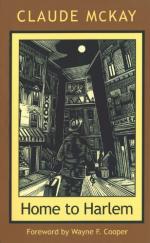
Home to Harlem is McKay's most highly regarded novel, but he was sharply criticized by W.E.B. Du Bois for showing the low life of the black people in Harlem instead of their more noble traits. Yet the novel shows that individuals may prove to be much nobler than their environments, a theme also apparent in his poem "The Harlem Dancer": "But looking at her falsely-smiling face/I knew herself was not in that strange place."

During this period McKay was still struggling with his love and hate for America. In "America" he wrote:


Although she feeds me bread of bitterness

And sinks into my throat her tiger's tooth

Stealing my breath of life I will confess

I love this cultured hell that tests my youth.

When McKay returned to the United States in 1934, during the Great Depression, the energy of the Black Renaissance Movement had dissipated. In 1938 he met Ellen Tarry, a Roman Catholic worker, and he underwent a conversion to conservative Catholicism. Through his new-found religion he was finally able to deal with racism, writing in "The Pagan Isms":


And so I go to make my peace

Where Black nor White can follow to betray

My pent-up heart to him I will release

And surely he will show the perfect way

of life. For he will lead me and no man

can violate or circumvent His plan.

McKay spent the last five years of his life in Chicago working for the National Catholic Youth Organization. After his death in 1948, he was given a memorial service in Harlem and buried in New York City. Several years later his Selected Poems (1953) was published. Although there has been much criticism of McKay's conventional style and his reputation as a poet has never been as strong as his reputation as a novelist, he will always be considered a poet of deep emotion and remarkable poetic skill.

This is the complete article, containing 1,362 words (approx. 5 pages at 300 words per page).

View More Summaries on Claude McKay
More Information
  • View Festus Claudius McKay Study Pack
  • Search Results for "Festus Claudius McKay"
  • Add This to Your Bibliography
  • More Products on This Subject
    Claude McKay
    Claude McKay (1890-1948), Jamaican-born poet and novelist, is often called "the first voice of the ... more

    Festus Claudius McKay
    Once, on being asked his nationality, Claude McKay flippantly answered that he preferred to think o... more


    Ask any question on Claude McKay and get it answered FAST!
    Answer questions in BookRags Q&A and earn points toward
    discounted or even FREE Study Guides and other BookRags products!
    Learn more about BookRags Q&A
    Copyrights
    Penni Cagan, New York, New York. Festus Claudius McKay from Dictionary of Literary Biography. ©2005-2006 Thomson Gale, a part of the Thomson Corporation. All rights reserved.

    Join BookRagslearn moreJoin BookRags


    About BookRags | Customer Service | Report an Error | Terms of Use | Privacy Policy

