
| Name: |
Esther Forbes |
| Birth Date: |
|
| Death Date: |
|
| Nationality: |
|
| Gender: |
|
While Esther Forbes was primarily a writer of adult historical fiction, her two attempts at writing for children. Johnny Tremain (1943) and America's Paul Revere (1948), have won universal critical acclaim and clearly established her as a respected writer for children.
Forbes was well qualified, both by vocation and avocation, to write about the history of her beloved New England. The child of an established and respected New England family (her father was William Trowbridge Forbes, a well-known judge), Forbes grew up learning about the legends and history of that region. As a child she spent hours delving through family manuscripts and reading books of a bygone era. This love of the past, later reflected in her many books, was certainly due in part to the interest of her mother, Harriene Merrifield Forbes, in similar subjects. Her mother, a respected researcher in her own right, was the author of Gravestones of Early New England and the Men Who Made Them (1927).
Forbes's interest in history led her to enroll at the University of Wisconsin during the tenure of such noted historians as Frederick Jackson Turner and Reuben Gold Thwaites. World War I interrupted her studies when Forbes decided to aid the war effort as a farmhand in Harper's Ferry, Virginia.
The end of the war saw her return to her home rather then to the university, and she secured a position on the editorial staff of Houghton Mifflin. She worked at Houghton Mifflin from 1920 to 1926 learning the craft of writing fiction from the editorial side. Forbes considered her discovery of Rafael Sabatini, the author of Scaramouche (1921), Captain Blood (1922), and The Sea Hawk (1915), her most significant contribution while at Houghton Mifflin.
Forbes also began a writing career of her own while at Houghton Mifflin, working in her spare time on the novel O Genteel Lady! (1926). The publication of this work and her marriage to Albert Learned Hoskins in 1926 (they were divorced in 1933) resulted in her leaving Houghton Mifflin to devote her energies to being a full-time writer. The next sixteen years saw the publication of four additional adult novels (A Mirror for Witches , 1928; Miss Marvel, 1935; Paradise, 1937; and The General's Lady, 1938) and one biography (Paul Revere and the World He Lived In, 1942). Her thorough research and writing skills as a novelist clearly established Forbes as a major force in the writing of historical fiction. Yet it was the publication of Paul Revere and the World He Lived In which catapulted her to national prominence and to the winning of the 1943 Pulitzer Prize for History.
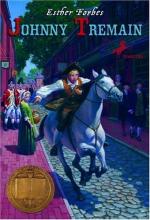
Fortunately for children, her research into silversmithing and the apprenticeship system for the biography of Paul Revere prompted her to write a novel for young people. The result of her labors was the 1944 Newbery Award-winner, Johnny Tremain: A Novel for Young and Old.
Johnny Tremain is set against the panorama of the beginnings of the American Revolution. Johnny is an apprentice silversmith with a promising future. Rivalry and jealousy among the other apprentices result in a serious accident to Johnny's hand which dashes any prospects he may have had as a skilled artisan. Johnny is forced to reevaluate his life and to overcome his handicap. He becomes involved with the Sons of Liberty, carrying messages and gaining intelligence about the British. His maturation from adolescence to manhood, amid personal tragedy and tumultuous events, is the cornerstone of Forbes's novel.
Tumultuous events of the twentieth century also played a part in the writing of Johnny Tremain. Originally Forbes's idea was to have a central character who wished to remain neutral during the Revolution. However, the Japanese attack on Pearl Harbor convinced Forbes that in war, there is no such thing as neutrality. She began work on Johnny Tremain the day after Pearl Harbor.
Forbes's treatment of the universal themes of accepting responsibility and maturation are clearly identified and well developed in her vibrant, lifelike characterizations. Not only Johnny but also other historical figures such as Samuel Adams, Paul Revere, and John Hancock come to life for the reader as flesh and blood individuals rather than cardboard figures. Her skill as a writer and historian as well as her understanding of the psychology of human nature is evidenced throughout Johnny Tremain and is a tribute to her ability to take adult themes and place them on a level of understanding for young people.
Johnny Tremain won critical acclaim at the time of its publication and still serves as a yardstick by which other books of this genre are measured. The quality of writing and historical accuracy are such that Johnny Tremain is used as a supplemental text in junior and senior high school American history courses.
Five years and two adult novels (The Boston Book, 1947, and The Running of the Tide, 1948) were to pass before Forbes ventured again into the realm of juvenile literature. Her subject was Revolutionary Boston and Paul Revere in America's Paul Revere with illustrations by Lynd Ward. This children's biography, dealing with subjects which had won her a Pulitzer Prize for History and a Newbery Award, maintains the lively style and historical veracity of its distinguished predecessors. The book, however, goes beyond the mere biographical data of Paul Revere in pre-Revolutionary, Revolutionary, and post-Revolutionary Boston and conveys the life and times of New Englanders in general during this turbulent period in our history. Like its predecessors, America's Paul Revere won just critical acclaim.
Forbes's books still remain popular reading among their intended audiences. Indeed America's Paul Revere is still a standard juvenile biography and Johnny Tremain has become a modern children's classic. The constant popularity of her work is statement enough of her audiences' appraisal of her work. Her literary honors and her becoming the first woman member of the American Antiquarian Society as well as a member of the Society of American Historians and the American Academy of Arts and Sciences attest to the recognition awarded by her peers. This respect from readers and critics is best summed up in her obituary in the New York Times: "Miss Forbes, a novelist who wrote like a historian and a historian who wrote like a novelist, achieved a reputation as one of the most exciting and knowledgeable authors on the Revolutionary War."
This is the complete article, containing 1,042 words
(approx. 3 pages at 300 words per page).
View More Summaries on Esther Forbes

