Forgot your password?  

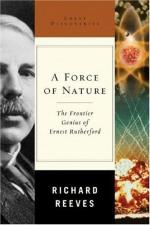
Ernest Rutherford | Biography

This Biography consists of approximately 4 pages of information about the life of Ernest Rutherford.
This section contains 1,136 words
(approx. 4 pages at 300 words per page)

World of Scientific Discovery on Ernest Rutherford

Biographies of Ernest Rutherford are studded with superlatives: "founder of nuclear physics"; "certainly the greatest scientist to emerge from New Zealand"; "a remarkable team leader"; and "one of the greatest experimentalists of all time. " His accomplishments were recognized both by fellow scientists and by his adopted homeland, England. He received the Nobel Prize for chemistry in 1908 and was president of the Royal Society from 1925 to 1930. He was also knighted in 1914, awarded the Order of Merit in 1921, and named Baron Rutherford of Nelson in 1931. After his death in London on October 19, 1937, Rutherford was laid to rest in Westminster Abbey, near the graves of Isaac Newton and William Thomson (Lord Kelvin).

Few scientists had as humble a beginning as did Ernest Rutherford. He was born in Brightwater, near Nelson, New Zealand, on August 30, 1871. His father was a wheelwright and a farmer. Ernest did well in school and earned scholarships first to Nelson College and later to Canterbury College in Christchurch. Rutherford's earliest research at Canterbury involved the effects on iron of rapidly changing magnetic fields. His work led to the development of a magnetic detector of radio waves.

In 1895, Rutherford placed second in the competition for a scholarship to Cambridge University. In a fortunate turn of events, the scholarship winner declined the award, and Rutherford received the Cambridge appointment. At Cambridge, Rutherford worked under J. J. Thomson, then director of the Cavendish Laboratories. Thomson quickly recognized the promise of this brilliant, but somewhat crude student from the colonies.

In his first year at Cambridge, Rutherford worked with Thomson on the electrical conductivity of air in the presence of newly discovered X-rays. Rutherford and Thomson were able to demonstrate that X-rays cause air molecules to break apart into equal numbers of positively and negatively charged particles (ions). The movement of these particles produced the current observed in their experiments.

In 1898, Rutherford accepted an appointment as professor of physics at McGill University in Montreal. This move proved to be a good one for Rutherford for at least two reasons. First, he met Frederick Soddy there. Soddy was a chemist with whom Rutherford collaborated closely over the next half dozen years. Second, McGill had well-equipped laboratories that included one of the world's largest supplies of radioactive materials. In this setting, Rutherford soon launched research on the topic that was to become his major interest for the next 40 years: nuclear physics.

The phenomenon of radioactivity had been discovered by Henri Becquerel in 1896. Almost immediately, that discovery inspired scientists throughout the world to examine the nature of the radiation produced and the changes in matter that result from radioactive decay. Rutherford was at the forefront of both lines of research.

In 1899, for example, he found that radiation from radioactive materials consists of at least two types that differ from each other on the basis of their penetrating power and their behavior in the presence of electrical and magnetic fields. He named the two forms of radiation alpha rays and beta rays. A year later, he identified a third form of radiation that is unaffected by electrical or magnetic fields and that is even more penetrating than alpha or beta radiation. He called this third form of radiation gamma rays.

Working with Soddy, Rutherford was also able to describe the changes in a material that occur when it emits radiation. The two men were able to show that the loss of alpha or beta radiation by one radioactive material results in the formation of a second substance that is also radioactive. The "daughter" substance formed in this process then decays by alpha or beta emission to form yet another radioactive material. This sequence of radioactive "mothers" and "daughters" is now known as a radioactive family.

An important feature of the radioactive decay process is that each substance in the series decays at its own rate. The rates within a particular series may vary from billions or millions of years to fractions of a second. Rutherford invented the concept of half-life as a way of describing the rate at which a specific radioactive material decays.

After 1905, Rutherford turned his attention to the nature of alpha radiation. The deflection of alpha rays by electrical and magnetic fields demonstrated that the rays must consist of some kind of particles. Alpha rays, that is, are actually a stream of alpha particles traveling at very high rates of speed. In an ingenious series of experiments devised with his student, Hans Geiger, Rutherford showed that an alpha particle is identical to a helium atom without its electrons, that is, a helium nucleus.

Rutherford soon learned to use the alpha particle as a tool for the investigation of the fundamental nature of matter. He designed an experiment in which alpha particles were allowed to impact on a very thin sheet of gold. He and his students, Geiger and E. Marsden, found that most alpha particles passed through the gold sheet with no or very small deflection. However, about 1 in 8,000 alpha particles was deflected through very large angles, some more than 90°. Rutherford interpreted these results to mean that the positive charge in gold atoms in the sheet was concentrated in a very small volume, about 10-5 the size of the atom itself. He called this small concentration of charge the atom's nucleus.

Rutherford's work with alpha rays also led him to draw some conclusions about the nature of the nucleus. If the nucleus consists of positive charges, he reasoned, then the simplest nucleus of all elements--that of the hydrogen atom--must consist of a particle carrying only a single positive charge. He suggested the name proton for that particle.

In some of his later research, Rutherford conceived of the idea of using alpha particles to knock protons out of nuclei. For example, during the late 1910s, he bombarded nitrogen gas with alpha particles. He found that protons were produced in the reaction and from that concluded that alpha particles had actually entered the nitrogen nucleus, broken apart, thrown out a proton, and left behind an oxygen nucleus of mass 17. This experiment was, therefore, the first example of a nuclear transformation--the conversion of one element to another--accomplished by synthetic means.

Rutherford's tenure at McGill ended in the summer of 1907 when he accepted a position at Manchester University. He remained at Manchester until 1919 when he replaced Thomson as director of the Cavendish Laboratories and became a professor of physics at Cambridge. During World War II, he worked on methods for detecting submarines. Like Thomson, Niels Bohr, and a few other great physicists, Rutherford's heritage is due not only to his own accomplishments, but to those of his students. One, James Chadwick, discovered the neutron in 1934 while two others, John Douglas Cockroft and Ernest Walton, produced the first synthetic disintegration of a nucleus in 1932.

This section contains 1,136 words
(approx. 4 pages at 300 words per page)
Copyrights
Ernest Rutherford from World of Scientific Discovery. ©2005-2006 Thomson Gale, a part of the Thomson Corporation. All rights reserved.
Follow Us on Facebook
Homework Help