BookRags.com Literature Guides Literature
Guides
Criticism & Essays Criticism &
Essays
Questions & Answers Questions &
Answers
Lesson Plans Lesson
Plans
My Bibliography Periodic Table U.S. Presidents Shakespeare Sonnet Shake-Up
Research Anything:        
History | Encyclopedias | Films | News | Create a Bibliography | More... Login | Register | Help

Search "Ernest Rutherford"

Biographies Navigation
 
Not What You Meant?  There are 23 definitions for Rutherford.  Also try: Ernest.

Ernest Rutherford Biography

Print-Friendly  Order the PDF version  Order the RTF version
About 2 pages (660 words)
Ernest Rutherford Summary

Bookmark and Share Know this topic well? Help others and get FREE products!

World of Mathematics on Ernest Rutherford

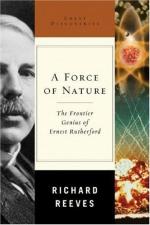
Ernest Rutherford was one of the giants in the field of atomic physics as science was just beginning to understand this world of infinitesimal yet powerful reactions. He did important research on radiation and coined such words as "alpha," "beta," and "gamma" waves, "proton," "half-life," "neutron," and "daughter atom." In addition, Rutherford showed conclusively that, despite the dominant scientific belief of his day that atoms were immutable and indivisible, radioactive elements can shed atoms to become different elements.

The son of successful farmers and one of 12 children, Rutherford was born in Bridgewater, a small town near Nelson, New Zealand. He enjoyed life on the farm and considered making it his livelihood as well, but his intellectual talents were apparent from an early age as he made his way through the local government-run schools. When he won an academic scholarship to Canterbury College in Christchurch, New Zealand in 1889 as he was finishing up at Nelson Collegiate School, Rutherford decided to take that route instead.

Rutherford received a degree from Canterbury in 1893, having majored in mathematics and physics. He stayed on at the college to do research, some of which resulted in a radio wave detector that worked by using iron's magnetic properties. In 1895 he won another scholarship--this time to England's Trinity College at Cambridge University. There he worked as a research student under the famous physicist J.J. Thomson in the Cavendish Laboratory. Rutherford remained at Cambridge for three years, doing research on the conductivity of gas ionized by radiation and discovering the existence of alpha and beta rays in uranium radiation. He left in 1898 to accept the physics chair at Canada's prestigious McGill University. He was only 28 years old.

Once he settled in at McGill, Rutherford continued his research on radioactivity. During this period he identified radiation of the alpha, beta, and gamma varieties. Then, in 1902, introduced and proved the "spontaneous transformation" theory of radioactive decay, showing that an atom of one radioactive substance can become a different atom by emitting radiation. In 1904 Rutherford published his first book on radiation, Radioactivity, which brought his work to the attention of the wider scientific world.

In 1907, Rutherford accepted a new position as professor of physics at the University of Manchester in England, where he soon established a center dedicated to the study of radiation. For his work in that field, he received the 1908 Nobel Prize in Chemistry. It was at the center in 1909 that Rutherford discovered the atomic nucleus and invented a model of the atom that looked something like our solar system, with electrons revolving around the sun-like nucleus. His discovery became the basis of the new nuclear science, and is the basic model that physicists still use today. Rutherford later predicted the presence of an uncharged particle (the neutron) as well.

During World War I (1914-1918), Rutherford assisted the British Navy with developing ways to detect enemy submarines, but afterward he returned to his research at the Manchester radiation lab. His next breakthrough was to cause a nonradioactive atom to fall apart by dislodging a single particle, thus creating the first man-made nuclear reaction. He named the particle "proton," since it had a positive charge.

Rutherford left Manchester to became director of the Cavendish Laboratory and the Cavendish professor of physics in 1919. That year he published Radiation from Radioactive Substances. Rutherford remained active in research until the end of his life, and continued publishing at an energetic pace. In 1926 he released The Electrical Structure of Matter; he published The Artificial Transmutation of the Elements in 1933 and The Newer Alchemy in 1937. Meanwhile, he took an active stance against the Nazis during World War II, serving as president of the Academic Assistance Council, which helped innumerable German refugees.

Married in 1900, Rutherford and his wife had one daughter. His favorite hobbies were golf and driving cars. Rutherford died on October 19, 1937 and is buried at London's Westminster Abbey between Isaac Newton and Lord Kelvin.

This is the complete article, containing 660 words (approx. 2 pages at 300 words per page).

View More Summaries on Ernest Rutherford
More Information
  • View Ernest Rutherford Study Pack
  • 23 Alternative Definitions
  • Search Results for "Ernest Rutherford"
  • Add This to Your Bibliography
  • More Products on This Subject
    Ernest Rutherford
    The British physicist Ernest Rutherford, 1st Baron Rutherford of Nelson (1871-1937), discovered tra... more

    Ernest Rutherford
    Biographies of Ernest Rutherford are studded with superlatives: "founder of nuclear physics"; "cert... more


    Ask any question on Ernest Rutherford and get it answered FAST!
    Answer questions in BookRags Q&A and earn points toward
    discounted or even FREE Study Guides and other BookRags products!
    Learn more about BookRags Q&A
    Copyrights
    Ernest Rutherford from World of Mathematics. ©2005-2006 Thomson Gale, a part of the Thomson Corporation. All rights reserved.

    Join BookRagslearn moreJoin BookRags


    About BookRags | Customer Service | Report an Error | Terms of Use | Privacy Policy