
 Print
Print Word
Word PDF
PDF|
This section contains 3,127 words (approx. 11 pages at 300 words per page) |

|
Dictionary of Literary Biography on Epicurus
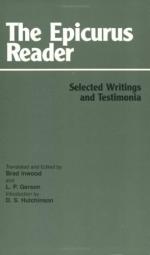
Along with the teachings of Plato, Aristotle, and the Stoics, Epicureanism, named for the philosopher Epicurus, was one of the most important and influential philosophical doctrines in existence during both the Hellenistic and Roman periods. Nevertheless, because of its frankly expressed doctrine of hedonism -- as well as the almost cultlike secrecy that seemed to shroud the activities of the school -- the teachings of Epicureanism were frequently maligned and misunderstood by the members of the rival movements. The fact that Epicurus himself had led a fairly ascetic life and had placed strict limits and qualifications upon the pursuit of pleasure, both for himself and his students, was generally ignored, with the result that the Stoics, in particular -- as well as, later, the Christians -- tended to denounce Epicurus as an immoral voluptuary. In spite of its many detractors, however, the doctrine of Epicureanism remained highly competitive...
|
This section contains 3,127 words (approx. 11 pages at 300 words per page) |
|



