
BookRags.com Literature Guides Literature Guides Criticism/Essays Criticism/Essays Biographies Biographies My Bibliography Periodic Table U.S. Presidents Shakespeare Sonnet Shake-Up
Research Anything:        
History | Encyclopedias | Films | News | Create a Bibliography | More... Login | Register | Help

Search "Emanuel Swedenborg"

Biographies Navigation


Emanuel Swedenborg Biography

Print-Friendly  Order the PDF version  Order the RTF version
About 3 pages (855 words)
Emanuel Swedenborg Summary

Bookmark and Share
Name: Emanuel Swedenborg
Birth Date: January 29, 1688
Death Date: March 29, 1772
Place of Birth: Uppsala, Sweden
Place of Death: London, England
Nationality: Swedish
Gender: Male
Occupations: scientist, theologian, mystic

Encyclopedia of World Biography on Emanuel Swedenborg

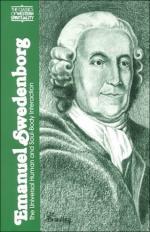
The Swedish scientist, theologian, and mystic Emanuel Swedenborg (1688-1772) founded a religious system known as Swedenborgianism, ideas of which were incorporated in the Church of the New Jerusalem.

Emanuel Swedenborg was born Emanuel Swedberg on Jan. 29, 1688, in Uppsala. His father, Bishop Jesper Swedberg, was a professor at the University of Uppsala. The family name was changed in 1719 to Swedenborg when the family was ennobled. After studies at the University of Uppsala, where he concentrated on mathematics and astronomy, Swedenborg traveled for 5 years throughout Europe (1710-1714). After a 2-year period in which he engaged in scientific journalism, Swedenborg became assessor at the Royal College of Mines in 1716. For the next 30 years, Swedenborg's main work was concentrated in the Swedish metal-mining industry. His engineering skill earned him a wide reputation. From 1747 onward, he devoted most of his time to the acquisition of knowledge through traveling and observation and to the elaboration and publication of scientific and theological theories.

Throughout his career in mining, Swedenborg studied and wrote. In 1718 Swedenborg published the first Swedish work on algebra. In 1721 he issued a voluminous work in which he attempted to demonstrate the geometrical character of physics and chemistry. Swedenborg spent the next 13 years researching and writing a three-volume work on the nature of physics, Opera philosophica et mineralia, published at Leipzig in 1734. He conceived of the atom as a particle vortex, each particle being composed of its own inner motions. This theory approximated the electron-nucleus framework of the atom in modern physics. Swedenborg reasoned from a general principle of matter, in which he thought of the infinite as pure motion. He conceived of pure motion as a tendency to create, and any subsequent molding of creation became a complex of pure motion.

After the publication of his work on physics, Swedenborg's studies and researches focused on man as a physiological and anatomical whole and on man in his relationship to God. His new studies led to the publication of two works: Oeconomia regni animalis (1740-1741) and Regnum animale (1744-1745). Some of Swedenborg's physiological discoveries were important. He was among the first to discover the nature of cerebrospinal fluid. He identified the correspondence between particular parts of the body and certain motor regions of the cerebral cortex. His studies of the physiology of the blood, brain, lung, and heart led him to characterize correctly the relationship between these organs. He also attempted to describe the physiological basis for human perception and thus to find a way to define and describe man's soul.

After these studies Swedenborg devoted his energies to the philosophy of theology. Although not a theologian in the strict sense, he was an outstanding philosopher or theological speculator. Utilizing some basic Christian truths, Swedenborg elaborated--partly on a scientific basis, partly on a philosophical basis--a theory of God, of man, and of divine revelation and redemption. On the basis of these theorizings, the Church of the New Jerusalem was founded in 1784.

Swedenborg did not himself found any church or sect. Although his reputation has been established on his theological theories, his greatness as a scientist and philosopher of nature probably exceeds his greatness as a theological speculator. The basis of Swedenborg's speculations was his assumption that the infinite was an indivisible power, a personal god indivisible in essence or power or person. He rejected the traditional Christian teaching of the Trinity.

A systematic presentation of Swedenborg's theology appeared in 1771 entitled Vera Christiana religio. He viewed all things as created by divine love and according to divine wisdom. Each material thing corresponded to a "spiritual form." Swedenborg thus achieved a modified Neoplatonism: all effects in the material world have spiritual causes and therefore a divine purpose.

Swedenborg analyzed the biblical books of Genesis and Exodus in his Arcana coelestia (1749-1756), and Revelation in his Apocalypsis explicata (1785-1789), the latter published posthumously. He elaborated the purely philosophical aspect of his reasoning in three major works: De coelo et ejus mirabilibus, et de inferno (1758), Sapientia angelica de divino amore et de divina sapientia (1763), and Sapientia angelica de divina providentia (1764).

Swedenborg's theory of redemption rejected any notion that Jesus Christ was in himself a divine person, but it held that the inmost soul of Jesus was divine. This divine soul had taken on a human form from Mary, and Jesus' human nature had been glorified by his exemplary life. By resisting all the temptations and ills of the powers of darkness, Jesus had opened a way for divine life to flow into all mankind. Man had become free to know truth and to be able to obey its dictates. Human salvation lay in this knowledge and obedience.

Swedenborg defended his theological speculation by claiming it resulted from a divine call. He maintained that he had received special light from God. He also maintained that all of his exegetical and philosophical treatises constituted a new revelation from God. Mankind must live according to this revelation in order to usher in a new age of reason and truth.

Swedenborg died in London on March 29, 1772. In 1908 the Swedish government requested that his remains be transferred to Uppsala Cathedral.

This is the complete article, containing 855 words (approx. 3 pages at 300 words per page).

View More Summaries on Emanuel Swedenborg
More Information
  • View Emanuel Swedenborg Study Pack
  • Search Results for "Emanuel Swedenborg"
  • Add This to Your Bibliography
  • More Products on This Subject
    Swedenborg, Emanuel
    SWEDENBORG, EMANUEL (1688–1772), was a multifaceted genius, scientist, and visionary. He was... more

    Emanuel Swedenborg
    1688-1772 Swedish natural philosopher and mystic widely remembered for founding a religious sect th... more


    Copyrights
    Emanuel Swedenborg from Encyclopedia of World Biography. ©2005-2006 Thomson Gale, a part of the Thomson Corporation. All rights reserved.

    Join BookRagslearn moreJoin BookRags


    About BookRags | Customer Service | Report an Error | Terms of Use | Privacy Policy

