|
This section contains 852 words (approx. 3 pages at 300 words per page) |

World of Chemistry on Ellen Swallow Richards
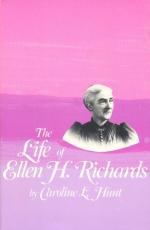
Ellen Swallow Richards was an applied scientist, sanitary chemist, and the founder of home economics . For twenty-seven years she was employed by the Massachusetts Institute of Technology (MIT), where she taught chemistry and developed methods for the analysis of air, water, and consumer products. Her work as a scientist and educator led to improvements in the home and opened the door to scientific professions for women.
Swallow was born on December 3, 1842, in Dunstable, Massachusetts. She was the only child of Peter Swallow, a teacher, farmer, and store keeper, and Fanny Gould Taylor, a teacher. She was educated at home by her parents until the family moved to Westford, Massachusetts, in 1859. There she attended Westford Massachusetts Academy, where she enrolled in mathematics, French, and Latin. In 1863 she graduated from the academy, and the family relocated to Littleton, Massachusetts.
Swallow worked at an assortment of jobs--storekeeping, tutoring, housecleaning, cooking, and nursing--to earn enough money to continue her education. Because of her mother's ill health, she struggled with exhaustion and mental depression for a period of several years.
By 1868 Swallow had saved enough money to attend Vassar college, where she excelled in astronomy and chemistry. Her chemistry professor, convinced that science should be applied to practical problems, contributed to Swallow's developing interest in consumer and environmental science. Receiving a bachelor of arts degree in 1870, Swallow decided to apply to MIT to further her study of chemistry and became one of the first women students at that institution. She received a bachelor of science degree from MIT in 1873. In that same year, after submitting a thesis on the estimation of vanadium in iron ore, she received her masters of arts degree from Vassar. Although she continued her studies at MIT an additional two years, she was never awarded a doctorate.
Swallow married Robert Hallowell Richards, a professor of mining engineering, on June 4, 1875. The couple had no children and were able to devote their full support to each other's professional career. In her leisure time Richards enjoyed gardening, entertaining, and traveling. She also took an active interest in improving her own home. At one time she boasted of having year-round hot water and a telephone.
Richards helped establish a laboratory at MIT for women. While still an undergraduate, she had taught chemistry at the girls high school in Boston through a project funded by the Woman's Education Association. With the help of this association, Richards convinced MIT of the need for a women's lab, and in 1876, armed with the title of assistant, she began teaching chemical analysis, industrial chemistry, mineralogy, and biology to a handful of women students. In addition to their traditional studies, the students assisted in testing a variety of consumer products for composition and adulterations. After seven years, in which four students graduated and the rest were accepted as regular MIT students, the laboratory closed.
In 1884 MIT opened a new laboratory for the study of sanitation, and Richards was appointed assistant and instructor in sanitary chemistry. Her teaching duties included instruction in air, water, and sewage analysis. In addition, she was responsible for completing a two-year survey of Massachusetts inland waters (begun in 1887 for the state board of health). Her success in analyzing nearly forty thousand water samples was attributed to her knowledge of methodology, apparatus, and her excellent supervisory and record-keeping skills. The water survey work and her involvement with environmental chemistry were significant contributions to the new science of ecology.
Richards was a pioneer in the effort to increase educational opportunities for women. She was one of the founders of the Association of Collegiate Alumnae, which later changed its title to the American Association of University Women. She organized the science section for the Society to Encourage Studies at Home, a correspondence school founded in 1887 by Anna Tickenor. Her correspondence with students provided insight into the daily life and problems faced by women in the home. Richards learned that women were seeking help with a wide range of problems, not all of which were scientific in nature, including manners of dress, food preparation, and exercise.
In 1890 Richards opened the New England Kitchen in Boston as a means of demonstrating how wholesome foods could be selected and prepared. In 1899 she organized and chaired a summer conference at Lake Placid, New York, that established the profession of home economics. Conference participants explored new ways of applying sociology and economics to the home and developed courses of study for schools and colleges. Later she helped found the American Home Economics Association and provided financial support for its publication, the Journal of Home Economics.
In addition to her work at the sanitation laboratory, Richards consulted, lectured, authored ten books, and published numerous papers, including bulletins on nutrition for the United States Department of Agriculture. In 1910, in recognition of her commitment to education, she was appointed to supervise the teaching of home economics in public schools by the council of the National Education Association. In that same year she was awarded an honorary doctorate from Smith College. Richards died of heart disease in 1911 at the age of 68.
|
This section contains 852 words (approx. 3 pages at 300 words per page) |