
Forgot your password?  

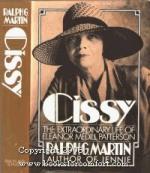
Eleanor Medill Patterson | Biography

This Biography consists of approximately 5 pages of information about the life of Cissy Patterson.
This section contains 1,317 words
(approx. 5 pages at 300 words per page)

Dictionary of Literary Biography on Eleanor Medill Patterson

If a movie or television show were to be made about a successful woman executive in the traditionally male world of American publishing, Eleanor Medill Patterson would be an ideal model for the heroine; her life contained most of the basic dramatic elements needed to capture and keep a contemporary audience. She was a wealthy socialite, playing a leading role on the social stages of Chicago and Washington, D.C.; she was once married to a Polish count and cavalry officer. Her grandfather developed the Chicago Tribune. As a widow, she asked an old friend, William Randolph Hearst, for a job, and he handed her the editorship of a failing Washington, D.C., newspaper, despite her lack of journalistic experience.

Surprisingly, in light of her seeming disinterest in life outside the social scene, Patterson quickly assumed the role of activist editor: she interviewed Al Capone, boosted reader interest by running a gossip box on the front page, and stimulated running feuds with President Franklin Roosevelt and Washington socialite Alice Longworth Roosevelt. In 1940 Patterson was the only woman editor/publisher of a large metropolitan daily newspaper in the United States.

Patterson was born Elinor Josephine Patterson in Chicago on 7 November 1881; she later changed the spelling of her first name to "Eleanor," adopted "Medill" as her middle name, and lied about her age so many times that her obituary listed her birth date as 1884. She was born to Chicago wealth and society: her mother, Elinor, was the daughter of Joseph Medill, owner of the Chicago Tribune; her father, Robert Wilson Patterson, was managing editor of the paper and Medill's designated successor. Her older brother, Joseph Medill Patterson--who was later to found the New York Daily News--nicknamed her "Cissy."

By her own admission, red-haired Cissy was a willful, spoiled child whose socialite mother groomed her solely for an elitist life that included schooling at Miss Hersey's School in Boston and Miss Porter's in Farmington, Connecticut. Cissy's social debuts were in Chicago and Washington. As she grew up, Patterson's home life revolved around an indulgent father and a mother who aimed at becoming Washington's official hostess from the family mansion on Dupont Circle in the capital city.

When Patterson was nineteen, her uncle, Robert Sanderson McCormick, was ambassador to Austria-Hungary, and he introduced her to Viennese society. She met Polish count Joseph Gizycki in Vienna at a ball; they were married in Washington on 14 April 1904. He was thirty-five; she was twenty-two. The marriage was stormy, and the couple separated in 1907. The custody battle over their daughter, Felicia, kidnapped by Count Gizycki, reflected the media sensationalism of the period. President Taft intervened personally, and Patterson recovered the child in 1908. The marriage was officially dissolved in 1917.

During the years before and after her divorce from Gizycki, Patterson led the life of the rich, idle socialite. She spent time in Chicago, New York, Europe, and at her parents' home on DuPont Circle in Washington. She dated a number of prominent men, including the German ambassador, Count von Bernstorff, before he was expelled from the United States during World War I. She appeared in amateur plays, and traveled throughout the country in her custom-built private railroad car. She bought a vacation ranch near Jackson Hole, Wyoming, where she had an affair with a cowboy and former rustler and took up big-game hunting.

In April 1925 she married a Jewish New York lawyer, Elmer Schlesinger, and commenced a career as a novelist. Her first novel, Glass Houses (1926), satirized life in Washington; her second and last book, Fall Flight (1928), is a thinly disguised account of her marriage to Gizycki. Both novels were published under the name Eleanor M. Gizycka (the feminine form of Gizycki). Her second marriage was crumbling, and she had already asked Schlesinger for a divorce, when he died of a heart attack on a golf course in Aiken, South Carolina, in February 1929.

True to her unpredictable nature, a year after her second husband's death, Patterson made a mid-life career change that left its mark on American journalism history. Arthur Brisbane talked Patterson's friend William Randolph Hearst into hiring her to take over his failing Washington Herald. She took the job of editor-publisher seriously and even covered many stories herself, including interviews with Albert Einstein and mobster Al Capone. Patterson crusaded for humane treatment of animals (she had given up hunting), hot lunches for school children, the cleaning up of the Potomac River, and home rule for the District of Columbia. In ten years she hired and fired seven editors, and in six years--by 1936--Patterson doubled the circulation of the Herald. The newspaper featured gossipy items, including a front-page box, "Interesting But Not True." She engaged in a highly publicized feud with Washington Post publisher Eugene Meyer. Journalism historian James Boylan describes the Herald as "exciting, gossipy, unpredictable," and "operating on the standards of yellow journalism and regressive politics."

In 1937 Patterson leased the morning Herald and the afternoon Times from Hearst with an option to buy, and despite warnings of failure from her brother Joseph at the New York Daily News, she combined both papers into the first all-day daily newspaper in the country: the new Washington Times-Herald featured six editions daily. Patterson exercised her option to buy the paper in January 1939. The Times-Herald was showing a profit by 1943; two years later, the paper made a $1,000,000 profit.

The turbulent political climate of the late 1930s to the mid-1940s was reflected in Patterson's dramatic disenchantment with Franklin Roosevelt. She had supported his presidential race in 1940, but his lend-lease policy enraged her. Along with her brother Joseph in New York and her cousin Col. Robert McCormick, publisher of the Chicago Tribune, Patterson was acidly labeled by FDR as part of a "McCormick-Patterson axis." Three days before Pearl Harbor was attacked, on a tip from sources in the armed services, the Times-Herald and the Chicago Tribune published American secret war plans. Government charges of betraying U.S. secrets were later dropped.

Columnists Drew Pearson and Walter Winchell also drew Patterson's wrath over World War II issues. Pearson repeatedly argued with Patterson about his support of Roosevelt's foreign policy; in return, Patterson's nickname for Pearson was "The Headache Boy." (One factor in this animosity may have been the fact that Pearson was married to Felicia Patterson from 1925 to 1928.) Patterson accused Winchell of excessive Nazi-hunting, and often would cancel Winchell and Pearson columns; both columns were finally dropped from the paper.

In 1943 Patterson was described as lonely, fat, and suffering from alcoholism and heart disease. She had six homes with a total of ninety rooms. Her personal and business payroll totaled 1,300 employees. Life in her final years was lonely and friction-filled. In 1945 she formally split from her daughter, Felicia.

On 24 July 1948, Patterson died in her sleep at her estate in Maryland, apparently from a heart attack. She willed $25,000 a year to her estranged daughter and divided the Times-Herald among eight company executives. The will was disputed, with Felicia Patterson's lawyers urging her to claim that her mother was mentally unsound when she died. To avoid tarnishing her mother's reputation, Felicia agreed to settle for $400,000.

During the year following Patterson's death, the Times-Herald was sold to Colonel McCormick. In 1954 he sold it to Eugene Meyer, who merged the paper with the Washington Post.

James Boylan evaluates the mark that Eleanor Medill Patterson left on American journalism: "If the public good of her life had been weighed at age fifty, it might not have been substantial. If she had lived out her days as she had lived her first five decades, she would probably not be remembered much more vividly than, say, her cousin Medill McCormick (who was, after all, a United States senator). But she is remembered, and it is largely because she ran the Herald (later the Times-Herald), the first woman, it is said, to head a major American daily newspaper."

This section contains 1,317 words
(approx. 5 pages at 300 words per page)
Copyrights
Eleanor Medill Patterson from Dictionary of Literary Biography. ©2005-2006 Thomson Gale, a part of the Thomson Corporation. All rights reserved.
Follow Us on Facebook
Homework Help

