|
This section contains 600 words (approx. 3 pages at 300 words per page) |
World of Invention on Edwin Herbert Land
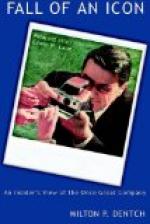
While strolling down Broadway in 1926, Edwin Herbert Land was blinded by the headlights of an oncoming automobile. It occurred to him that there must be a way to develop a polarizing sheet that would reduce glare from light. Born on May 7, 1901, in Bridgeport, Connecticut, Land was the son of a merchant. While attending the Norwich Academy, he excelled in physics and was a member of the debate and track teams. He was attending Harvard University as a freshman when he first had his revelation about the polarizing process. He left Harvard and moved to New York, working secretly at night in a laboratory at Columbia University. In 1929 Land returned to Harvard, this time with his wife, Helen. Although Land would never graduate, he had already developed the first synthetic sheet polarizer by trapping tiny crystals in a thin sheet. By 1932 the sheet was actually being produced and would be used to make camera lens filters and polarizing sunglasses that cut glare from the sun. Land realized that his process could have a more far-reaching effect, but lacked the funds to do the necessary research. With the backing of Wall Street tycoons James P. Warburg, Averell Harriman (1891-1986) and Lewis Strauss, Land founded the Polaroid Corporation in 1937. One of the company's first projects was to persuade Detroit's automobile industry to install polarizing sheets in the headlamps and windshields of all its vehicles. Although Land was never able to sell his ideas to automobile manufacturers, he went on to discover many more uses for his invention.
By the 1940s, the Polaroid Corporation was making its contribution to the United States war effort. Servicemen who fought in World War II reaped the benefits of Land's inventions that resulted in polarizers for rangefinders and gunsights. The development of infrared viewers also aided night vision. By 1945 the Polaroid Corporation received millions of dollars in government contracts to develop military optics, and sales increased from the original $142,000 to $17 million. In 1943 Land got the inspiration for what was to be his most popular invention. While on vacation with his family, he snapped a photograph of his daughter. She asked to see the picture, and while Land was explaining that she would have to wait, he was already developing a plan for a camera that would process the film immediately. After the war Land began working earnestly on his instant camera, and in 1947 he introduced his invention to the Optical Society of America. By Christmas of 1948 the camera and film were available to deliver a finished print in 60 seconds. The first prints were sepia-toned (a warm, brown color), and black and white film went on the market less than a year later. By the 1950s Polaroid photography became a way of life.
In 1963 color film became available, and 1972 saw the introduction of the SX-70 process which eliminated the process of pullingthe film from the camera and peeling off the backing. The SX-70 simply spit out a square photo on which the image slowly appeared. Incredibly, Land even introduced instant home movies in 1977, which could be filmed, developed, and viewed without ever removing the film from its cassette. In 9180, Land founded the Rowland Institute for Science. In spite of all his discoveries and inventions, Land was personally reclusive. Although he never graduated from Harvard, he received many honorary degrees from prestigious colleges and universities. Land was granted more than 160 patents in his lifetime, and in 1963 he was given the Presidential Award of Freedom. Land died on March 1, 1991, in Cambridge, Massachusetts.
|
This section contains 600 words (approx. 3 pages at 300 words per page) |