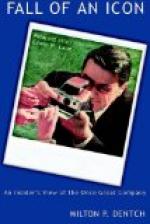
Edwin H. Land was the driving force behind the Polaroid Corporation's engineering and marketing successes. He was the first to figure out how to manufacture practical and useful polarized screens during the 1930s, and he produced revolutionary optics for the military during World War II. But it was the development of the instant camera that made his company famous, and he was able to dominate the instant-photography market with cameras that first produced pictures in sepia tones, then in black and white, and finally in color. One who routinely discarded conventional wisdom, Land believed that market research was not necessary; he claimed that any invention would sell if people believed it was something they could not live without.
An only child, Edwin Land was born to Martha F. and Harry Land on May 7, 1909, in Bridgeport, Connecticut. His father ran a salvage and scrap metal business; the family was well-off and Land had a comfortable upbringing. In his youth he dreamed of being an inventor and idolized Michael Faraday, Thomas Alva Edison, and Alexander Graham Bell . Even as a boy, Land was very interested in polarized light. He entered Harvard at age 17 in 1926. While walking along Broadway in New York City that same year, he was overwhelmed by the glare from headlights and store signs that shone in his eyes. Land perceived safety hazards in all that glare, and he determined that polarized lights could reduce it. He left Harvard at the end of the school year to pursue this idea and did not return for three years.
Land's parents provided an allowance that enabled him to stay in New York and work on this idea. He studied at the New York Public Library and even found a laboratory at Columbia University whose window was habitually unlocked. He would climb in at night and conduct various experiments. During this period Land met Helen Maislen, a graduate of Smith College who began assisting him in his research. They were married in 1929, and Land returned to Harvard that same year. This time the university provided him with a laboratory to conduct his research.
Develops a Commercial Method to Polarize Light
It had been known since the eighteenth century that certain kinds of crystals could affect the direction of light waves. In his effort to develop a method for polarizing light, Land was searching for a crystal that could not only reduce glare but was stable and economical enough to be produced commercially. He conceived of the idea of two plates that would absorb the light waves that were not wanted and transmit those that were. He then succeeded in aligning millions of microscopic iodine crystals in one direction, thus creating the first polarizer. As Mark Olshaker wrote in the Instant Image: "Land's singular achievement was in discovering a way to synthesize a sheet material that could align light waves in the desirable planes of vibration. The invention was a combined achievement of chemistry and optics." Land presented a paper on his discovery at a physics colloquium at Harvard in February 1932. In June he left the university, one semester short of a degree, and never returned.
With a Harvard graduate student named George Wheelwright, who had been one of his teachers, Land formed Land-Wheelwright Laboratories, Inc. in June 1932. The two men worked on developing methods of manufacturing polarized sheets made of crystals trapped in nitrocellulose. On November 30, 1934, Eastman Kodak gave Land-Wheelwright an order for 10,000 dollars worth of polarizing filters. Kodak wanted a polarizer laminated between two sheets of optical glass, but neither Land nor Wheelwright had any idea how to manufacture such an item. Nonetheless, they accepted the order--a decision typical of the way Land would work in the future. Their persistence paid off, and Land-Wheelwright Laboratories invented what they dubbed "Polaroid," with which they fulfilled their contract with Eastman Kodak.
Land had a flair for the dramatic that he put to good use in marketing his inventions. For example, when he was trying to sell his polarizers for use as sunglasses, he rented a room at a hotel and invited executives from the American Optical Company to meet him there. The late afternoon sun produced a glare on the windowsill; Land put a fishbowl there and the glare rendered the goldfish inside it invisible. When the executives arrived, Land handed them each a sheet of polarizer and they were able to see the fish instantly. Land told them that from now on their sunglasses should be made with polarized glass, and the company bought the idea.
Land gave his first press conference on polarization on January 30, 1936, at the Waldorf Astoria Hotel. He repeated it for the National Academy of Sciences and the New York Museum of Science soon after that. The press coverage Land expected from this last presentation was overshadowed by the abdication of King Edward VIII in England. But his sales ability once again came through. On August 10, 1937, a group of investors, impressed with Land-Wheelwright's accomplishments, put up 375,000 dollars to fund the Polaroid Corporation. Furthermore, they gave Land controlling interest in the company.
With the money Land purchased some competing patents on polarization and decided that the 1939 New York World's Fair would be an excellent way to demonstrate to automakers and the American public the virtues of polarized headlights. Chrysler rented Polaroid space in one of its booths, and Land played a three-dimensional movie he had invented that graphically illustrated how much improved polarized headlights were. The 12-minute film was well-received by the public; 150,000 people saw it.
This is the complete article, containing 926 words
(approx. 3 pages at 300 words per page).