
BookRags.com Literature Guides Literature
Guides
Criticism & Essays Criticism &
Essays
Questions & Answers Questions &
Answers
Lesson Plans Lesson
Plans
My Bibliography Periodic Table U.S. Presidents Shakespeare Sonnet Shake-Up
Research Anything:        
History | Encyclopedias | Films | News | Create a Bibliography | More... Login | Register | Help

Not What You Meant?  There are 8 definitions for Mawson.

Douglas Mawson, Sir Biography

Print-Friendly  Order the PDF version  Order the RTF version
About 2 pages (667 words)
Douglas Mawson Summary

Bookmark and Share Know this topic well? Help others and get FREE products!

Encyclopedia of World Biography on Douglas Mawson, Sir

Sir Douglas Mawson (1882-1958) was an Australian scientist and explorer of the Antarctic. His intellectual boldness and skill were matched by a practical initiative and courage which confirms his place among the world's greatest explorers.

Douglas Mawson was born in Yorkshire on May 5, 1882. His parents took him to Sydney, New South Wales, when he was 4 years old, and he was educated at Fort Street High School and the University of Sydney. A student of the famous geologist Sir Edgeworth David, Mawson early showed high forensic capability in the field as well as a meticulous scholarly talent. In 1902 he graduated in mining engineering and taught briefly at the University of Sydney.

In 1903 Mawson was invited to accompany the team which made the first intensive geological survey of the New Hebrides Islands in the Pacific. From 1905 he held the lectureship and later the professorship of mineralogy and petrology (geology) at the University of Adelaide. He quickly gained the reputation of an outstanding teacher as well as that of a fine scientist and man of action.

Antarctic Explorations

By 1907 Mawson had turned his mind and energies toward Antarctica. Hitherto Britain, Sweden, and Germany had been engaged in surveying the land mass of the continent. Ernest Shackleton, a member of Robert F. Scott's team, had determined that year to reach the South Pole. Mawson accompanied the expedition as physicist and surveyor, and Edgeworth David joined the party. During 1908, together with Dr. A. F. MacKay, Mawson and David conquered the summit of Mt. Erebus--an ice-covered volcanic cone 11,400 feet high--for the first time. Among other notable achievements they observed, also for the first time, the shifting position of the magnetic pole. It was a thorough and successful introduction to the life and labor demanded of Antarctic scientists and explorers. Mawson had earned an invitation to join Scott in his forthcoming voyage of discovery.

In January 1911 the Australian and New Zealand Association for the Advancement of Science initiated a government-aided expedition under Mawson's leadership to survey the unknown and unmapped ice plateau west of the magnetic pole. When the expedition sailed from Hobart, Tasmania, in December, Mawson had already earned the utmost affection and respect of his crew.

During the course of the survey Mawson found himself, after the death of two companions, alone, without supplies, on foot, and a hundred miles from safety. His courage and ingenuity enabled him to survive a most terrible journey through blizzards and across frightening crevasses. At one stage the soles of his feet separated from the flesh. Yet by 1914 the objects of the scientific research had been triumphantly achieved.

In 1929 Mawson was asked to lead a combined British, Australian, and New Zealand expedition to Antarctica and to explore that huge part of the continent which lay to the south of Australia. Scott's old ship, the Discovery, was fitted out for them, and on the voyage from Cape Town Mawson carried out research on the unexplored islands of the Crozets and also on Kerguelen and Heard islands. The phenomenon of the shallowing of the ocean depths toward the Antarctic was observed carefully.

Mawson named Mac-Robertson Land and, in the 1930 season, Princess Elizabeth Land. Notable was his use of an airplane for scientific purposes. As an outcome of this expedition and of Mawson's work, Britain made over to Australia its claims in Antarctica, and in 1936 the present Australian sector of the continent was annexed. The chief Australian Antarctic base was named after Mawson, and he firmly established his country's status as an Antarctic power.

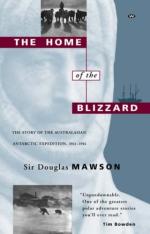
In addition to many scientific papers and reports, Mawson wrote a remarkable two-volume book on his experiences, The Land of the Blizzard (1915).

Though Mawson is chiefly remembered for his Antarctic exploration, his geological work at the University of Adelaide was outstanding. He was a pioneer in research on uranium and other minerals connected with radioactivity. In 1914 he was knighted for his services and later filled many high official positions in the scientific world. He died on Oct. 14, 1958.

This is the complete article, containing 667 words (approx. 2 pages at 300 words per page).

View More Summaries on Douglas Mawson
More Information
  • View Douglas Mawson, Sir Study Pack
  • 8 Alternative Definitions
  • Search Results for "Douglas Mawson, Sir"
  • Add This to Your Bibliography
  • More Products on This Subject
    Douglas Mawson
    1882-1958 Australian researcher and Antarctic explorer who was one of the first to observe the chan... more

    Douglas Mawson
    Sir Douglas Mawson OBE FRS (5 May 1882 – 14 October 1958) was an Australian Antarctic explorer and... more


    Ask any question on Douglas Mawson and get it answered FAST!
    Answer questions in BookRags Q&A and earn points toward
    discounted or even FREE Study Guides and other BookRags products!
    Learn more about BookRags Q&A
    Copyrights
    Douglas Mawson, Sir from Encyclopedia of World Biography. ©2005-2006 Thomson Gale, a part of the Thomson Corporation. All rights reserved.

    Works by Author
    Join BookRagslearn moreJoin BookRags


    About BookRags | Customer Service | Report an Error | Terms of Use | Privacy Policy

