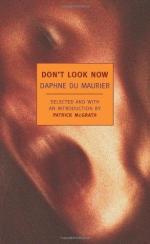
Some critics, including Richard Kelly in his book-length critical analysis,
Daphne du Maurier, suggest that short stories such as "The Birds" and "Don't Look Now," both of them successfully and quite terrifyingly filmed, are among the author's best work in a literary sense. Kelly noted that in addition to
Rebecca, "The Birds" and "Don't Look Now," "stand out among her works as landmarks in the development of the modern gothic tale." Writing in
Dictionary of Literary Biography, Wayne Templeton commented, "Some of du Maurier's most accomplished works of fiction are to be found in her short-story collections."
Reading du Maurier was long considered less than a literary pursuit. John Raymond, writing in the New Statesman, once called her "a kind of poor woman's Charlotte Bronte." Kelly, writing in 1987 before du Maurier's death, declared, "The literary establishment clearly wants nothing to do with Daphne du Maurier. There are no critical essays or books about her. . . . The fact that millions of people read her novels certainly works against her approval by literary critics, who are not inclined to prize what the popular audience does." In Daphne du Maurier: Haunted Heiress, a critical/biographical analysis of the author by Nina Auerbach, the noted critic titled her first chapter "Reading Furtively, by Flashlight," and began her book, "All books seem better when I'm not supposed to be reading them. I never should read Daphne du Maurier, but I regularly do." Such guilty delight in the work is part of the du Maurier charm, but Templeton noted a sea change in du Maurier's critical assessment. "Du Maurier was most proficient in creating psychological or Gothic thrillers," he noted, "often having some connection to the past or set in the past, that focus on the struggle or an individual against an oppressive environment." Such books, according to Templeton, "are strong on characterization, setting, and plot." Yet despite the fact that du Maurier was able to live comfortably on the earnings from her books, and despite honors such as being made a dame of the British empire in 1969 for her literary contributions, "du Maurier did not occupy a place in the literary canon during her lifetime--much to her disappointment." However, Templeton went on to point out that a "reassessment of the canon has led in recent years to the 'discovery' of several previously neglected figures in British literature, most of them women. This list includes Daphne du Maurier." Since du Maurier's death, there have been several full-scale biographies and more critical analyses in the works. Like the heroine of one of her own Gothic thrillers, du Maurier has persevered on her own terms.
Daughter of a Theatrical Family
Daphne du Maurier's life in the arts was, in many ways, determined by her parentage. Du Maurier was the granddaughter of George du Maurier, a painter/illustrator and author of the novels Peter Ibbetson, Trilby, and The Martian. She was also the great-great-granddaughter of Mary Anne Clarke, mistress of the son of King George III, "strong, courageous, and capable of dealing with a man's world on her own terms," according to Templeton, writing in Dictionary of Literary Biography. More importantly, she was one of three daughters of the stage actor, Gerald du Maurier, famous for such roles as the gentleman burglar, Raffles, and the detective, Bulldog Drummond. So popular and well known was Gerald du Maurier, that in 1929 he leased his family name to a tobacco company for one of its elegant brand of cigarettes. Muriel Beaumont, her mother, was also an actress. Daphne du Maurier thus grew up in the rarified environment of the arts, but also in thrall to her theatrical father, at once a gadfly and a puritanical bully. The family lived a comfortable existence in a house in Cumberland Terrace, with a nursery at the top of the house "staid and traditional," according to Forster in her biography, Daphne Du Maurier: The Secret Life of the Renowned Storyteller. Forster went on to note, however, "downstairs was the ever-thrilling presence of Gerald, who would swoop and enfold [the three daughters] and draw them into his own exciting existence. He played marvelous imaginative games with them, read to them, took them with him to the theater, involved himself in their lives totally when he was with them, and they saw themselves blessed with such a father. As indeed, until adolescence, they were." Muriel Beaumont, however, was not included in such fun and games. "Poor darling M[other] was I a trial to her"" du Maurier wondered in her 1977 autobiographical sketch, Myself When Young: The Shaping of a Writer. "Never ill mannered, never rude, of that I am sure, but perhaps I made some unfortunate remark that caught her in an off mood. She was not an easy person to understand, both as a child and as a growing adolescent I could never feel quite sure of her, sensing some sort of disapproval in her attitude towards me. Could it be that, totally unconscious of the fact, she resented the ever growing bond and affection between [father] and myself"" Du Maurier went on to note that the child "who cannot rush to his or her mother in moments of stress, telling all, will look elsewhere for comfort, or become a loner."
In Daphne's case, the child sought comfort in her father's attention, in that of her maternal grandparents, and in the servants' hall below stairs at the sprawling Queen Anne house in fashionable Hampstead, where the family moved when Daphne was still a young girl. Also at this time and through her adolescence, Daphne began wishing she were born a boy, and as a teenager even took on a male persona, Eric Avon. Much has been made of this by some critics, such as Templeton, who posited this was the "awakening of lesbian tendencies," in the teenager. Others attribute it to a strong sense of gender inequality at the time and to her father's disappointment in not having a male heir to carry on the du Maurier name. But du Maurier seemed to have the usual schoolgirl crushes on both men and women. At fourteen she was strongly attracted to a much older male cousin whom she met while on summer holiday at the seashore; at eighteen as a student at a finishing school near Paris, she was infatuated with one of the female teachers. An introspective youth, du Maurier felt that her sisters Angela and Jeanne were much more popular than she, always surrounded by friends and filled with fun. In fact, those around the young du Maurier felt that if she was alone, it was by her choice, for outwardly she was self-assured and quite attractive.
Throughout her adolescence and teenage years one other passion existed as well: writing. Du Maurier began writing light verse and short stories while still a student; her prose was strongly inspired by the work of Somerset Maugham. "All of these early works," according to Templeton, "are filled with disgust and pessimism concerning the human condition." During her time in France, from 1925 to 1926, du Maurier was influenced by the writings of Katherine Mansfield and Guy de Maupassant, and continued her own writing in letters, journals, and short stories. Forster, writing in Daphne du Maurier, described three early short stories written by the nineteen-year-old as having "one striking thing in common: the male characters are thoroughly unpleasant. They are bullies, seducers and cheats. The women, in contrast, are pitifully weak creatures, who are endlessly dominated and betrayed, never capable of saving themselves and having only the energy to survive."
Returning to England in 1926, du Maurier took up writing in earnest, and when the family bought a home in the West country, in Cornwall, the young woman suddenly discovered a real sense of freedom and liberation from the endless social pressures of London. Here the women all seemed to live in pants and rubber boots, and the outdoor life suited du Maurier well. "Here was the freedom I desired, long sought-for, not yet known," du Maurier later wrote in Myself When Young. "Freedom to write, to walk, to wander, freedom to climb hills, to pull a boat, to be alone. . . . I remembered a line from a forgotten book, where a lover looks for the first time upon his chosen one--'I for this, and this for me.'" The house, Ferryside, in the village of Fowey on Cornwall's south coast, afforded du Maurier the opportunity to learn to live with the water, and she became proficient at handling a small boat on her own.
Increasingly, du Maurier spent more and more time in Cornwall, less and less in London. University was not, at the time, thought fashionable for a young woman of her standing, so du Maurier continued her own education, working daily on her writing and reading extensively. In addition, she was learning the ways and the lore of the people of Cornwall. In particular, she was learning about the history of Fowey and of the old Rashleigh family and their seat, Menabilly. Coming across that house one day, she immediately fell in love with it and formed an obsession that would last until she finally occupied it herself during the Second World War.
Meanwhile, her stories continued in a dark vein, despite the seemingly charmed life she led. In truth, however, life at home in London with father Gerald, was becoming increasingly difficult. Once so affectionate and adoring with his daughter, he had become possessive of them once they reached their teens. He was jealous of their friends and suitors; his affairs with other women were more injurious to his wife than ever before; and as his career went on the downslide, he drank to forget rather than to enjoy. Life in Hampstead was intolerable for Daphne; she tried to stay full time in Cornwall, but in order to do this she had to have an independent source of income. With publication of her first story, "And Now to God the Father" in the Bystander magazine, she felt for the first time that she might actually be able to make a living writing.
Early Novels
Desperate to become independent of her family's allowance, du Maurier holed herself up in Cornwall and began writing her first novel in late October, 1929. Inspired by a local family of boat builders whose history she had researched, her novel quickly took form as an historical romance. In ten weeks she had completed the manuscript titled The Loving Spirit, the story of Janet Coombe, a resourceful and courageous woman who fears the bonds of domesticity yet longs for the security of marriage. Once married, however, she finds that she is unable to tame her continual restlessness; she does, however, find fulfillment in her son, Joseph. He, like his mother, displays the Coombe spirit of the title. After Janet's death, the book continues to detail the lives of subsequent generations of the Coombe clan, with Joseph becoming captain of a ship built in his mother's honor, then focusing on Christopher, one of Joseph's sons, and finally, with Christopher's daughter, Jennifer.
Du Maurier had the book typed up and sent it off to an agent friend of the family who miraculously placed it with the publisher Heinemann only two months after she had finished the writing. The book did well upon publication, becoming something of a mini-best seller in England. A reviewer for the Spectator felt the work was "gracious," but also noted that "When Miss du Maurier gains firmer artistic control of her emotions, and ceases to write 'literary' Cornish, her work will be admirable indeed." With publication in the United States, H. C. Harwood noted in the Saturday Review that The Loving Spirit "has the right stuff in it for which a better form may easily be found, by an author obviously possessing and enjoying a love of romantic fiction." "All in all, however, the reviews were favorable and predicted a bright future for the young novelist," noted Kelly in his critical study. "It would take a few more years for du Maurier to perfect her form." Kelly noted that du Maurier instinctively tapped into the need in her audience for fantasy and escape from reality, something that is supplied in over-abundance in modern-day literature, but which at the time of du Maurier's first book was relatively new. Here was a new formula for novels: a romantic history for women--though not restricted to that audience alone--and written by a woman.
Even before publication of her first novel, du Maurier had completed her second, I'll Never Be Young Again, a novel, like many of hers, narrated by a man. Here the struggle is for Dick, who aspires to be a great writer, to break free of the control of his despised father, a famous poet. Later, in middle age, he realizes he does not have the stuff to become great and accepts his mediocrity. Published in 1932, this book was less successful mechanically, but, as Kelly remarked, it was "an important one in du Maurier's development as a writer, and it laid the groundwork for her next novel, The Progress of Julius," the first of her psychological thrillers.
Meanwhile du Maurier's personal life was also undergoing a revolution. Having lived something of a wild life as a young woman, in 1931 she met and three months later married Major Frederick Arthur Browning. Together the couple had three children, Tessa, Flavia, and Christian, and for the next twenty years the family followed the frequent moves of Browning, who eventually reached the rank of lieutenant general in the army. In 1934, du Maurier's father died at the relatively young age of sixty-one following an operation for cancer. Du Maurier's fourth book, Gerald: A Portrait, was a biography of her father.
This period of du Maurier's creative life is capped off with her fourth novel, Jamaica Inn, a "haunting tale," according to Kelly, set on Cornwall's Bodmin Moor in 1835 and featuring a strong, assertive heroine, Mary Yellan. This was the novel, according to Templeton in Dictionary of Literary Biography, that "finally persuaded the critics that [du Maurier] was a writer of talent." Templeton went on to describe the novel as a "tightly crafted Gothic horror story, much more quickly paced than her previous novels." Jamaica Inn was also a commercial success, selling in three months more copies than her previous three novels together.
Somewhat reminiscent of Jane Eyre and Wuthering Heights, the novel follows young Mary who, after the death of her mother, is sent to her aunt and uncle who run the isolated inn of the title. Here Mary falls under the spell of Jem, her uncle's brother, and also uncovers a Druidic cabal which includes her aunt, uncle, and the local vicar. The vicar masterminds a plot whereby passing ships are decoyed onto the rocks and then robbed. But when Mary's aunt and uncle are about to repent and go to the police, the mad vicar kills them. In turn, the vicar is murdered by the enigmatic Jem. "The novel's strength," according to Templeton, "derives not so much from this plot as from the vivid characters and the dramatic landscape." Reviewing the novel in the Spectator, the writer Sean O'Faolain commented, "Jamaica Inn [makes] one realise how high the standard of entertainment has become in the modern novel. I do not believe R. L. Stevenson would have been ashamed to have written [it]. . . ." So popular was the novel that Alfred Hitchcock turned it into a film version several years later, securing du Maurier's name and reputation.
Rebecca
As usual, du Maurier did not rest on her laurels but started a new book. Posted in Alexandria, Egypt with her husband, she started a fifth novel in 1936, one with which her name would thereafter become almost synonymous. Beginning with the famous opening sentence, "Last night I dreamt I went to Manderley again," the novel Rebecca plumbs fully the genre of Gothic romance. The manuscript was eventually finished once du Maurier and her husband returned to England and was published in 1938.
The novel, something of an updated Cinderella story, tells of a working-class woman who falls in love with the lonely and mysterious Maxim de Winter, whom she meets in Monte Carlo while in the service of a rather gauche old social climber. The aristocratic Maxim is recently widowed and the two fall in love and are soon married, much to the surprise and disgust of the old woman upon whom the heroine was dependent. Now the second Mrs. De Winter, the young woman returns with Maxim to his family mansion, Manderley, in the south of England. Once there, however, the nameless heroine of the novel finds that she is forever in the shadow of the first wife, Rebecca, and that the malevolent housekeeper, Mrs. Danvers, wants only to protect the memory of this dead woman. Jealousy grips the new mistress of the house, but finally the bride discovers that such jealousy is unnecessary: Maxim in fact hated his wayward first wife and indeed may have killed her. Now Rebecca's miscreant cousin, Favell, is blackmailing Maxim, who is finally charged with Rebecca's murder. At the last minute, new evidence comes up that exonerates him at trial, but there is no happy homecoming, for Mrs. Danvers burns Manderley down to avenge her beloved Rebecca. Yet for Maxim and his new wife, this is a blessing in disguise; they are now free to start their life together anew.
This tale with, its echoes of Charlotte and Emily Bronte, was an instant success throughout the English-speaking world and remains in print over sixty years after its initial publication. The novel had 45,000 copies in print just a month after publication in England and has run to forty-two printings and sold in the millions worldwide. Reviewing the novel in the Christian Science Monitor, the English writer V. S. Pritchett set the tone for the critical response to most of du Maurier's best work. One the one hand, the critic praised the novel: "Many a better novelist would give his eyes to be able to tell a story as Miss du Maurier does, to make it move at such a pace and to go with such mastery from surprise to surprise. . . . From the first sinister rumors to the final conflagration the melodrama is excellent." But "melodrama" is the operative word here. Pritchett went on to complain about the "very morbid side to this apparently harmless fairy tale," and also to point out the "crude unreality of the tale." Many of the other reviews at the time replicated this left-handed praise. A reviewer for the Times Literary Supplement, for example, also noted, "The conventions of a story of this kind are not the conventions of the so-called realistic novel, and it would be absurd to reproach Miss du Maurier for her fine, careless rapture. In its kind, Rebecca is extraordinarily bold and confident, eloquent and accomplished to a degree that merits genuine respect." This reviewer's insistence on the phrase "of its kind" again is operative here; the same writer further called Rebecca "dope literature" in comparison with Tolstoy or Proust. As Kelly pointed out, "The assumed canon of literary saints, the snobbery, and the sexism that lie behind these reviews are fairly common features of the male literati that ruled the journals and newspapers during the past hundred years and that, to this day, have denied du Maurier her proper place in modern European and American culture. . . ."
The film version of Rebecca, starring Joan Fontaine and Lawrence Olivier, won Academy Awards for best picture and for cinematography in 1940, further popularizing both the novel and its author. Writing in The Rebecca Notebook and Other Memories over forty years after publication of Rebecca, du Maurier was still trying to figure out why it was such a success: "Although I had then written four previous novels. . . . the story of Rebecca became an instant favourite with readers in the United Kingdom, North America, and Europe. Why, I have never understood! It is true that as I wrote it I immersed myself in the characters, especially in the narrator, but then this has happened throughout my writing career; I lose myself in the plot as it unfolds, and only when the book is finished do I lay it aside. I may add, finally and forever." Writing in Books, not long after publication of Rebecca, John Patton attributed the novel's success to the fact that it was, "first and last and always a thrilling story." Patton further commented, "Du Maurier's style in telling her story is exactly suited to her plot and her background, and creates the exact spirit and atmosphere of the novel. The rhythm quickens with the story, is always in measure with the story's beat. And the writing has an intensity, a heady beauty, which is itself the utterance of the story's mood." Whatever the reason for its tremendous success, the fact is that the book has enjoyed very robust health with both the reading public and viewers: there was a remake for a television mini-series in 1979. As Kelly concluded, "Rebecca is the classic gothic romance of the twentieth century and as such will be around long after the high priests and priestesses of the current literary establishment have perished."
A Quartet of Romantic Suspense Novels
Du Maurier basked in the delight of her sudden fame for a time, and then went back to what she knew best, writing. Frenchman's Creek was published in 1941, My Cousin Rachel in 1951, The Scapegoat in 1957, and Flight of the Falcon in 1965. According to Jane S. Bakerman, writing in And Then There Were Nine . . . More Women of Mystery, these books are, in addition to Jamaica Inn and Rebecca, the six novels on which du Maurier's "auctorial reputation rests most firmly." There were certainly a bevy of others, including The King's General, Hungry Hill, and The House on the Strand, but the core of her work can be seen in these six.
The war, which began in 1939, did not stop du Maurier's output. She did her part, yet still found time for her fiction. Frenchman's Creek is, according to Templeton, "a dark tale of Cornwall during the reign of Charles II." With the protagonist, Lady St. Columb, du Maurier presents another female caught between the twin poles of a desire for independence and a need for domestic security. The Lady leaves her husband for a French rogue who has, himself, fled domestic non-bliss and temporarily turned pirate. Though Lady St. Columb does return to her husband in the end, her relationship with the genial scoundrel, Jean-Benoit Aubrey, allows her to explore her duality--her "boy in the box" as du Maurier called the same notion in herself. It was the sense that another, male and stronger, self was buried deep within. "As with du Maurier's best works in this genre," commented Templeton, "Frenchman's Creek is enlivened by a dramatic landscape and the avoidance of stereotypes." Another popular novel like Rebecca, film rights to Frenchman's Creek were purchased and a movie came out during the war, in 1944.
In 1943 a dream of nearly two decades was fulfilled when du Maurier and her children moved into Menabilly, leased from the Rashleigh family for twenty years. The lease was ultimately extended and du Maurier much improved the place at her own expense, but in the late 1960s she was forced to move when one of the Rashleigh heirs chose to live there. Du Maurier was made Lady Browning in 1946 when her husband was knighted, and after the war Browning became comptroller of the treasurer to the then Princess Elizabeth, a position that kept him in London most of the time, with only infrequent trips home to Cornwall.
In 1943 du Maurier published Hungry Hill, a dynastic saga and one of her least successful novels, filmed for a movie in 1947 with a screenplay co-authored by du Maurier. This was followed in 1946 by The King's General, memorable, according to Kelly, for its female protagonist, Honor Harris, one of du Maurier's new "independent and fearless" heroines, and in 1949 by The Parasites, a semi-autobiographical novel that deals with a theatrical family and their art-minded children. Out of the usual du Maurier mold, The Parasites did not do well critically.
Du Maurier revived her plucky-heroine formula for a book that outsold even Rebecca at the time, My Cousin Rachel. Narrated by the insecure orphan, Philip Ashley, the story tells a sort of gender-switch gothic tale in which Philip's guardian and cousin, Ambrose Ashley, on vacation in Italy, falls in love with and marries their mutual cousin, Rachel, whose husband has recently died. Appraised of the wedding in Italy, Philip is at first jealous. But when cousin Ambrose urges him to come to Italy, Philip rushes to his guardian, fearful for his life at the hands of Rachel, only to find him dead of a supposed brain tumor. Cousin Rachel is nowhere to be found initially, and Philip vows revenge. When they meet, Philip falls in love with her. Playing a deadly double game, he tries to find out if he will be her next victim, but instead Rachel herself is the next to die, and the end of the novel comes with the reader not knowing if the mysterious Rachel is guilty or not of Ambrose's death. Filmed in 1952, the resulting movie version of My Cousin Rachel starred Richard Burton and Olivia de Haviland.
In the 1954 novel, Mary Anne, du Maurier wrote a fictionalized portrait of her great-great grandmother, and in 1957 she published The Scapegoat, a novel that dealt more directly with the doppelganger theme that crops up throughout du Maurier's fiction. In this case, two men, doubles for each other physically, trade places. John, a history teacher doing research in France, takes the place of Jean de Gue, whom he meets in Le Mans. Over drinks, it is de Gue who proposes the switch and before John can agree or disagree, he passes out. When he awakens in the morning, he finds himself in de Gue's dysfunctional home. There is a mother addicted to morphine, a suicidal daughter and wife, and himself up to his elbows in trouble for having murdered his sister's fiance. Reluctant at first, John soon takes on his new role of Jean with verve, working to save the family business and give meaning to the lives of those around him. When the real Jean de Gue writes that he is coming back, John realizes that he does not want to trade places. He waits for his double with a gun, but is thwarted in his murder attempt by a priest. John reluctantly leaves this new life, but cannot return to the old. As the novel ends, John is driving toward a monastery.
Reviewing the novel in the New York Times Book Review, Anthony Boucher remarked, "The concept of the impostor . . . is one of the most absorbing premises in fiction; and Miss du Maurier's John . . . joins a succession of great maskers. . . ." Boucher went on to describe the book as "a mystery novel plus," and one that gives "a subtly disturbing Pirandellian hint that truth may be simply what it seems to you." This novel was also filmed, starring Alec Guinness and Betty Davis.
With his retirement in 1959, Browning came to live full time once again with his wife at Menabilly. He died in 1965. In 1969, du Maurier was honored by being named a Dame Commander of the Order of the British Empire. That same year she was forced to move to another house, Kilmarth, only half a mile distant from her beloved Menabilly.
Du Maurier novels from the 1960s include The Glassblowers, a book that traces her own family line back to an eighteenth-century family of glassblowers, and The House on the Strand. This novel deals with time travel and the powers of hallucinogenic drugs in which a twentieth-century narrator finds himself in the fourteenth century after taking an experimental drug. There he falls in love with Isolda. The Flight of the Falcon was published in 1965 and is, as Templeton described it, "a nightmarish tale of the quest for power" and "one of du Maurier's most psychologically complex novels." Armino Fabbio is an Italian tour guide in this novel in which "[I]llusion and reality, fiction and fact . . . blend together," according to Kelly. In flashbacks, Armino remembers and researches his long dead brother Aldo, a mysterious blend of both good and evil, who loved to dominate both men and women. He identified himself with a fifteenth-century duke called the Falcon who threw himself from the walls of his castle believing that he was the son of God and could therefore fly. Armino, in the present, attempts to unravel the real story of his brother, and as he does, the novel takes on "the form of a mystery," according to Kelly. But suddenly Armino is confronted with a living Aldo, returned as it were, from the dead, and now leading a small band of disaffected students. In the culminating scene, Aldo straps on a set of wings and dives to his death from a tower, just as his historical alter ego had done. Armino is left to pick up the scattered remnants of his life and find a meaning in the present.
The critics took particular glee in pillorying The Flight of the Falcon. Patricia MacManus, writing in Book Week, called the book a "little fire-sale item" in du Maurier's "brand name . . . popular fiction field," while a reviewer for the New Yorker called it an "extraordinarily dull book." However Kelly pointed out that it was difficult to understand the critics. They "fell for the superficial psychology of a basically conventional, sentimental novel like The Scapegoat," while they "chose to ignore the complex and compelling study of a demonic mind and of an insane quest for power and sexual domination in The Flight of the Falcon." As Kelly noted, this novel "explores the theme of lost innocence."
Du Maurier's final novel, Rule Britannia, published in 1972, is a story of the American invasion of England and the resistance put up by the Cornish people. Much below the par of her usual entertainments, the book was panned by most critics. Templeton, for example, dismissed it as a "jingoistic satire," while Joseph Kanon, writing in the Saturday Review, called it "a slight piece of writing so ephemeral that it defies categories."
The Short Stories and Beyond
As has been noted, many critics believe that du Maurier's best work is to be found in her short fiction, in such collections as The Apple Tree, The Breaking Point, and Not after Midnight and Other Stories. From the first volume is the story "The Birds," about a small town attacked by thousands of birds. This story was filmed by Hitchcock for the popular 1963 movie of the same title. Reviewing the first collection of stories, republished as Kiss Me Again, Stranger, John Barkham noted in the New York Times Book Review that du Maurier "is a firm believer in keeping her readers on tenterhooks," and that "The Birds" was a "hair-raising battle against the winged warriors that darken the sky." Other notable stories from the same collection include "The Motive" and the title story, "Kiss Me Again, Stranger." The collection "explores horror in a variety of forms," according to Sylvia Berkman, reviewing Kiss Me Again, Stranger in the New York Herald Tribune Book World: "in the macabre, in the psychologically deranged, in the supernatural, in the fantastic, [and] most painfully of all, in the sheer cruelty of human beings in interrelationship." Berkman also praised du Maurier for her "sense of shock-timing" which is "exceptionally skilled." Forster, writing in her biography, Daphne Du Maurier, pointed out that the novella included in the collection, "Monte Verita," was a statement by du Maurier of the belief that "there is something wrong with sex between men and women--it spoils relationships, it drains energy, it gets in the way of self-fulfillment." For Forster, this story was one more clue to what she saw as du Maurier's "secret life" of bisexuality if not lesbianism.
Reviewing her second collection of short stories, The Breaking Point, in the Saturday Review, Margaret Hurley lauded du Maurier for her sense of scene and atmosphere. "She takes the reader by the icy hand and leads him behind the curtain to view the characters on their way to their own breaking points." Drawing particular attention to "The Pool" and "The Menace," Hurley commented, "the suspense is shattering," and further remarked that with these stories du Maurier "demonstrates her talent in ferreting out and describing the subtleties and foibles of human nature." "The Alibi," from the same collection, portrays a middle-aged man who finds a sense of power and escape from his dull life in fantasizing about murder. However, when he is accused of a murder that he only fantasized about, such daydreams become all too real.
Du Maurier's third major collection of stories was published in the United States as Don't Look Now, after its title story, adapted for a successful and quite terrifying film in 1973, starring Julie Christie and Donald Sutherland. John and Laura, an English couple, are vacationing in Venice in an attempt to distract themselves from the grief at the loss of their daughter, Christine, who drowned. However, their vacation is anything but restful. John is plagued by the continual image of a small figure dressed in a red coat who he becomes convinced is his daughter. His wife Laura, meanwhile, has befriended a couple of elderly sisters who are equally convinced that they have made contact with the dead Christine who says her parents are in grave danger and must leave Venice immediately. John, however, ignores this warning and finally is able to corner the figure in red, which turns out to be a deranged dwarf on a killing spree, and who kills John by slashing his throat. Kelly noted that the "gothic setting of decaying Venice, the mad dwarf, the recurring glimpses into the future, the suspense, and the violence all go to make up an exciting story." Kelly also drew attention to "A Border-Line Case," another story in the same collection, "a curious story of romantic incest," as he described it, as well as to "The Rendezvous," from the 1980 collection of previously published short stories, The Rendezvous and Other Stories. In this tale, an older writer falls in love with a beautiful young woman only to be tormented by the fact of her love for a sexually attractive but vacuous young man.
Du Maurier wrote mostly nonfiction in her last years, including a work on the Brontes, a biography of Francis Bacon, and books about Cornwall, in addition to autobiographical pieces. She died at her home, Kilmarth, on April 19, 1989, and her death was met with tributes from around the world. A critical reassessment of her work followed not long thereafter. One example of such a renewed look at du Maurier comes in the introduction to Avril Horner's and Sue Zlosnik's 1998 study, Daphne du Maurier: Writing, Identity and the Gothic Imagination. The authors wrote: "Daphne du Maurier's public identity as a romantic novelist and a story-teller who can spin a good yarn has eclipsed for too long her versatility as a writer. In her published works, which span the years 1931 to 1989, she experimented with several genres including the family saga, biography, women's romantic fiction, the Gothic novel, and the short story."
For too long, du Maurier was considered to be merely the precursor, if not founder of women's romantic fiction, which now burdens the racks at supermarkets. "Perhaps du Maurier wrote too much," remarked Kelly, "catered too cynically to the popular taste of her audience, but she created the classic gothic novel of the twentieth century, setting the state for hundreds of imitators." This in itself is no mean feat. Robert Louis Stevenson once noted, "The great creative writer shows us the realization and the apotheosis of the day-dreams of common men. His stories may be nourished with the realities of life, but their true mark is to satisfy the nameless longings of the reader, and to obey the ideal laws of the day-dream." By those criteria, du Maurier is a master. As Forster concluded in her biography, "[Du Maurier's] novels and stories gave pleasure to millions, and among them were at least three worthy of a place in the literary canon. . . . It was the fire of her imagination which warmed and excited her millions of readers, and still does."
This is a free page. This page contains 6,143 words. This
biography contains 6,475 words (approx. 22 pages at 300
words per page).
Read the rest of this Biography with our Daphne du Maurier Access Pass.