
Forgot your password?  

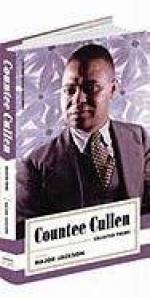
Countee Cullen | Biography

This Biography consists of approximately 3 pages of information about the life of Countee Cullen.
This section contains 692 words
(approx. 3 pages at 300 words per page)

Dictionary of Literary Biography on Countee Cullen

Born Countee Leroy Porter on 30 May 1903, Countee Cullen was orphaned while still a child and subsequently adopted, though the relationship was never made legal, by Frederick Asbury Cullen. While an air of mystery--apparently maintained by the poet himself--surrounds the earliest years of Cullen's life, the facts of his biography following adoption by the Reverend Mr. Cullen are well-documented. Study at DeWitt Clinton High School in New York City where Cullen first began to write poetry, was followed by attendance at New York University, from which he graduated in 1925. In the fall of 1925 Cullen enrolled for graduate work at Harvard and finished an M.A. in literature the following summer, having already published his first book, Color (1925). After a brief episode as an assistant editor of Opportunity , Cullen received a Guggenheim fellowship in 1928 for a year of study and writing in Paris, and his lifelong fascination with French language and culture began. By 1934 Cullen's career as a writer had declined, and he took a position teaching French in Frederick Douglass High School in New York, which he held until his death in 1946.

France appears to have been a special place for Countee Cullen as evidenced both in the few poems he wrote about Paris and in the fact that he chose to finish out his life as a teacher of the French language. A recurring idea in Cullen's work is his determination that he be regarded primarily as a poet, not as a black poet. In his language, themes, and forms, he sought to base his work upon the major traditions of European literature, and he bitterly resented the parochialism which encouraged Negro poets to limit their interests to subjects reflecting black experience. In France, Cullen sought the freedom to be just a poet. As he wrote in his poem "To France,"


  I have sought in you that alchemy

That knits my bones and turns me to the sun;

And found across a continent of foam

What was denied my hungry heart at home.

Unfortunately for Cullen, France did not have the positive effect on his work he had hoped for. Before leaving for his Guggenheim year in Paris, he had married Yolande DuBois, daughter of W.E.B. DuBois, who joined him there. Yolande discovered that the marriage was a "tragic mistake," and returning home, she sued for divorce, which was granted in 1929. Perhaps as a result of this disaster, the love poems in The Black Christ and Other Poems (1929), the work Cullen completed in Paris, reflect bitterness and anguish that seem more self-indulgent than tragic. Even the title poem, which draws an analogy between a lynching and the Crucifixion, lacks the poignance of Cullen's strongest racially oriented work.

While in Paris, Cullen was associated with a group of black artists and writers whose focal point was the studio of the sculptress Augusta Savage. Prominent among this group, in addition to Cullen and Savage, were painters Palmer Hayden and Hale Woodruff, and the Jamaican novelist Eric Walrond. He was also close to Steve and Sophie Green, an American couple who generously provided him a quiet place to work in their home on the rue du Dounaier near Montsouris Park. In addition to his writing, he continued at the Sorbonne the study of French literature he had begun at New York University.

With the publication of The Black Christ, Cullen's life as a poet was essentially finished. The Medea and Some Other Poems (1935), also partially written in Paris and containing two of his translations from Baudelaire as well as "To France," did little to enhance his declining reputation. France, however, continued to occupy a central place in his consciousness, and he returned each year until 1939 when World War II ended his visits to the land where he once dreamed of finding, in old age, a place "among a fair and kindly folk," where he might


  breathe my latest days,

With those rich accents falling on my ear

That most have made me feel that freedom's

  rays

Still have a shrine where they may leap and

   sear,

Though I were palsied there, or halt, or blind,

So I were there, I think I should not mind.

This section contains 692 words
(approx. 3 pages at 300 words per page)
Copyrights
Countee Cullen from Dictionary of Literary Biography. ©2005-2006 Thomson Gale, a part of the Thomson Corporation. All rights reserved.
Follow Us on Facebook
Homework Help

