
BookRags.com Literature Guides Literature
Guides
Criticism & Essays Criticism &
Essays
Questions & Answers Questions &
Answers
Lesson Plans Lesson
Plans
My Bibliography Periodic Table U.S. Presidents Shakespeare Sonnet Shake-Up
Research Anything:        
History | Encyclopedias | Films | News | Create a Bibliography | More... Login | Register | Help

Not What You Meant?  There are 6 definitions for Cornel.

Cornel West Biography

Print-Friendly  Order the PDF version  Order the RTF version
About 4 pages (1,197 words)
Cornel West Summary

Bookmark and Share Questions on this topic? Just ask!
Name: Cornel West
Birth Date: June 2, 1953
Place of Birth: Tulsa, Oklahoma, United States
Nationality: American
Ethnicity: African American
Gender: Male
Occupations: philosopher

Encyclopedia of World Biography on Cornel West

An American philosopher, Cornel West (born 1953) quickly won recognition as a critic of culture, an interpreter of African American experience, an advocate of social justice, and an analyst of Post-Modern art and philosophy.

Cornel West, born in Tulsa, Oklahoma, in 1953, lived most of his childhood and youth in segregated working-class neighborhoods in Oklahoma, Kansas, and California. In high school he excelled in scholarship and athletics. He earned his A.B. at Harvard University, then completed his doctorate in philosophy at Princeton in 1980. While a graduate student, he was a teaching assistant in humanities and ethics at Harvard and in philosophy at Princeton.

In 1977 he joined the faculty of Union Theological Seminary in New York, teaching classical and contemporary philosophy. From 1984 to 1987 he taught at the Yale University Divinity School, then returned to Union in 1987-1988. In 1988 Princeton University tapped him to be the director of its African American Studies Program and as professor of religion. In the former program he drew together a multi-disciplinary group of literary artists and scholars who interpreted the African American experience in history and literature.

West earned an early reputation as a scholar of infectious enthusiasm, sharp insight, and wide-ranging interests. Within a decade of earning his doctorate, he accepted visiting appointments at Barnard College, Williams College, Princeton Theological Seminary, Haverford College, City University of New York (Center for Worker Education), Harvard Divinity School, and the University of Paris. In addition, he lectured at more than a hundred colleges and universities in the United States. He taught philosophy to inmates of a federal prison, an unusual distinction for an academic philosopher. Within the same decade he produced dozens of essays and reviews, published in books and in journals, both scholarly and popular.

In an age of scholarly specialization, West cultivated widely diverse interests. His nimble mind danced from one subject to another with dazzling virtuosity. On one side of his thought he was a social philosopher, drawing much from the Marxist tradition but uninhibited by allegiance to any Marxist orthodoxies. His scholarship was closely related to active involvement in movements for social and racial justice. He was simultaneously an interpreter of African American experience to white Americans, of American philosophy to Europeans, of democratic beliefs to South Africans, of religious insights to secularists, and of secular themes to the religious. As a philosopher, he showed special interest in pragmatism, Post-Modern thought, and philosophy of religion. His artistic interests included literature (he had published one short story and friends predicted that he would write a novel), opera (he was seen occasionally at Salzburg), cinema (he was a fellow at the British Film Institute), and architecture (he lectured at the School of Architecture at Milan, Italy).

The unifying center for these diverse interests was a concern for cultural criticism: intellectual, esthetic, ethical, and religious. Whatever area of human interest he entered, from the arts to the most technical philosophy, he soon related to its expressions in contemporary society and its meaning for human self-understanding and justice. West appreciated culture as an expression of human creativity; he also saw that culture often oppresses human beings, especially marginalized people. He united intellectual analysis and social involvement, scholarship and action, the academic world and political life.

Even as he boldly acknowledged his roots in the African American church, West made trenchant criticisms of religious belief and practice, and he asked no favoritism for religion in the intellectual discussions of universities and society. He drew inspiration from the prophetic tradition of the Bible, and the words "prophetic" and "prophecy" appear often in his writings.

West was an eloquent lecturer, whose lithe and energetic body was totally involved in the torrent of words and ideas that tumbled from his mouth. He asked his listeners not only to hear what he said, but to enter into his thought processes and share his enthusiasms or generate their own thoughts and enthusiasms. His speaking style was symbolic of his convictions, which rejected the divorce of body from mind, of emotion from intellect, characteristic of much philosophy since Descartes. In a time when many philosophers would be horrified to be called preachers, West (although not an ordained minister) was not embarrassed to preach an occasional sermon. For him a passion for social justice was as intellectually respectable and demanding as the most rigorous intellectual analysis of propositions, and the two were never far apart in his philosophy.

West wrote and co-authored numerous books on philosophy, race and sociology. His Race Matters won a Critics Choice Award and was listed as a New York Times Notable Book of the Year in 1992. Other works included Keeping the Faith: Philosophy and Race in American (1993) and Jews and Blacks: Let the Healing Begin (1995), co-authored with Michael Lerner. In 1996 he co-authored The Future of Race with his Harvard colleague, Henry Louis Gates, Jr.

West has been a frequent guest lecturer on university campuses nationwide. He joined the Harvard Faculty in 1994 as professor of Religion and African American Studies. During the 1996 Fall Semester he was a visiting professor at the University of Arizona. West was a featured speaker during the 1997 Martin Luther King, Jr./ Human Rights Week Celebration at Boise State University. At Harvard, West has become known for his electrifying presentations that inspire students to critically analyze their own beliefs on race, culture, and class. Gates once described West as "the pre-eminent African American intellectual of our generation."

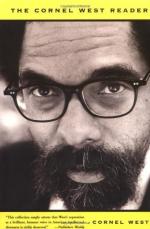
West's most recent book, The Cornel West Reader (2000), has been billed as tracing "the development of West's extraordinary career as an academic, intellectual, and activist." But writer and social critic David Horowitz severely took West to task in his review of the book in Salon.com. Arguing that West's writing ("My Chekhovian Christian viewpoint is idiosyncratic and iconoclastic. My sense of the absurdity and incongruity of the world is closer to the Gnosticism of Valentinus, Luria or Monoimos ... My intellectual lineage goes more through Schopenhauer, Tolstoy, Rilke, Melville, Lorca, Kafka, Celan, Beckett, Soyinka, O'Neill, Kazantzakis, Morrison and above all, Chekhov ... And, I should add, it reaches its highest expression in Brahms's 'Requiem' and Coltrane's 'A Love Supreme.'") in that book is baffling to say the least, Horowitz concluded out that West is "almost incapable of writing a concrete sentence," and added that "looking for tangible meaning in West's prose is a terminally discouraging quest, a bit like looking for a breath of fresh air at the bottom of the sea." Horowitz doesn't blame West entirely for this shortcoming, however. Noting that West attended Harvard at a time that traditional disciplines were being broken down and destroyed, even as new, politically correct, disciplines that rejected the tried and tested rules of scholarship were being created, Horowitz argues that West's scholarship is symptomatic of the "intellectual vacuum that a progressive education creates."

In 2001, West released a spoken-word CD entitled Sketches of My Culture, partly in response to the popularity of hip-hop music. West reportedly finds in hip-hop the nihilism of the black underclass, and in its suburban popularity, the "Afro-Americanization of American youth." West had by then been promoted to university professor at Harvard University, a title held by only 14 of that university's 2,200 faculty members.

This is the complete article, containing 1,197 words (approx. 4 pages at 300 words per page).

View More Summaries on Cornel West
More Information
  • View Cornel West Study Pack
  • 6 Alternative Definitions
  • Search Results for "Cornel West"
  • Add This to Your Bibliography
  • More Products on This Subject
    Cornel (Ronald) West
    One of the most prolific academics to come to prominence in the 1990s, Cornel West is professor of ... more

    West, Cornel
    (born June 2, 1953, Tulsa, Oklahoma, U.S.) American philosopher, scholar of African American studie... more


    Ask any question on Cornel West and get it answered FAST!
    Answer questions in BookRags Q&A and earn points toward
    discounted or even FREE Study Guides and other BookRags products!
    Learn more about BookRags Q&A
    Copyrights
    Cornel West from Encyclopedia of World Biography. ©2005-2006 Thomson Gale, a part of the Thomson Corporation. All rights reserved.

    Join BookRagslearn moreJoin BookRags


    About BookRags | Customer Service | Report an Error | Terms of Use | Privacy Policy

