
 Print
Print Word
Word PDF
PDF|
This section contains 5,068 words (approx. 17 pages at 300 words per page) |

|
Dictionary of Literary Biography on Clive Barker
Clive Barker was born on 5 October 1952 in Liverpool, England. His father, Len Barker, was in industrial relations; his mother, Joan Barker, was a teacher, and both were amateur artists. As a schoolboy, he studied a wide range of arts: illustration, drama, and narrative. He enjoyed a special reputation among his friends for his ability to tell disturbing stories. The fantastique (fantasy, epic, horror, science fiction), especially its darker side, always engaged him, especially the Royal Shakespeare Peter Pan productions and the tales of Edgar Allan Poe, Arthur Machen, Henry James, and Ramsey Campbell.
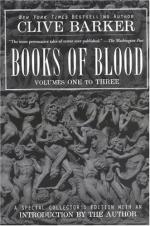
Throughout his college years and until his writing The Books of Blood in 1984, Barker was a dramatist. Collaborating in an ensemble with a syncretic technique and a highly eclectic vision, Barker acted, wrote, and directed largely in an off-campus context while earning degrees in philosophy and English at the University of Liverpool. Upon his graduation...
|
This section contains 5,068 words (approx. 17 pages at 300 words per page) |
|



