BookRags.com Literature Guides Literature
Guides
Criticism & Essays Criticism &
Essays
Questions & Answers Questions &
Answers
Lesson Plans Lesson
Plans
My Bibliography Periodic Table U.S. Presidents Shakespeare Sonnet Shake-Up
Research Anything:        
History | Encyclopedias | Films | News | Create a Bibliography | More... Login | Register | Help

Not What You Meant?  There are 15 definitions for The Story of My Life.

Clarence Seward Darrow Biography

Print-Friendly  Order the PDF version  Order the RTF version
About 3 pages (838 words)
Clarence Darrow Summary

Bookmark and Share Know this topic well? Help others and get FREE products!
Name: Clarence Seward Darrow
Birth Date: April 18, 1857
Death Date: March 13, 1938
Place of Birth: Farmdale, Ohio, United States
Place of Death: Chicago, Illinois, United States
Nationality: American
Gender: Male
Occupations: lawyer

World of Criminal Justice on Clarence Seward Darrow

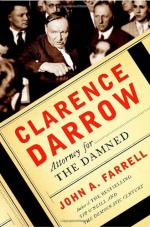
Clarence Seward Darrow is one of the most famous attorneys in U.S. history. A complex man, Darrow defended many labor union and political radicals between 1894 and 1914, yet also made enormous fees representing corporations. His defense of Leopold and Loeb for the 1924 murder of a young boy brought modern psychology into the courtroom, while his defense of John Scopes for teaching evolution in a Tennessee public school has entered popular culture as the famous "Monkey Trial."

Darrow was born on April 18, 1857, in Kinsman, Ohio. He spent only one year in college before becoming a country schoolteacher. However, he soon tired of teaching and enrolled at the University of Michigan Law School. When he could no longer afford law school, Darrow "read the law" with a Youngstown, Ohio law firm, serving as a legal apprentice. After studying law with the firm and performing clerical duties, Darrow passed the Ohio bar exam in 1878. He tried his hand at law in several Ohio towns before leaving for Chicago in 1887. Within a year he was the mayor's assistant and the following year the mayor appointed him to head the city's legal department.

In 1892, Darrow accepted an offer to become chief counsel for the Chicago and Northwestern Railway. However, he resigned in 1894 when he agreed to defend Eugene V. Debs, the national leader of the American Railway Union. The union had struck the Pullman Company, triggering a nationwide strike of railroad workers. President Grover Cleveland sent in Army troops to protect the trains and insure that the mails were not obstructed. Debs was charged with violating an injunction that ordered the union to end the strike. It took the government two trials to convict Debs, with Darrow appealing unsuccessfully to the United States Supreme Court.

In 1907, the former governor of Idaho, Frank Steunenberg, was killed by a bomb outside his home. Because he had defended the mining industry against the miners union while in office, the police suspected that William "Big Bill" Haywood, head of the Western Federation of Miners union, was involved. Pinkerton agents abducted Haywood and several other union leaders and brought them to Boise to stand trial for conspiracy to murder. Darrow led the defense and through effective cross-examination destroyed the credibility of the state's chief witness, the man who actually planted the bomb. After the jury acquitted Haywood and the other defendants, Darrow had cemented his reputation as the defender of labor unions.

One of Darrow's most controversial cases involved the 1910 bombing of the Los Angeles Times Building, in which 21 people were killed and 40 were injured. Otis Chandler, the newspaper's publisher, was anti-union and suspicion fell on union organizers. The brothers James and J.J. McNamara, both union men, confessed to the bombings, but Darrow was persuaded by union leaders to represent them. After examining the evidence, Darrow had his clients plead guilty to avoid the death penalty. Although he saved their lives, union leaders believed Darrow had betrayed the movement. As a result, Darrow refused to take any major labor cases the rest of his career.

Darrow reemerged on the national scene in the 1920s. In 1924, two Chicago teenagers, Richard Loeb and Nathan Leopold, Jr., were charged with murdering Bobby Franks, a fourteen-year-old acquaintance. They had killed Franks to see if they could commit the perfect crime but their careful planning had come unraveled and they were soon apprehended. As in the Los Angeles bombing case, both suspects had confessed. Darrow agreed to represent Leopold and Loeb, who came from very wealthy families, but quickly concluded that the best he could do was to prevent their executions. In an unusual move, Darrow waived a jury and presented expert witnesses who testified to the psychological defects of Leopold and Loeb. In the end the judge spared the pair, handing down life sentences because of their mental illness. This was the first major American case where modern psychology was used to prove mental impairment.

Darrow's legal career culminated with the so-called Monkey Trial. In 1925, the Tennessee legislature passed a law making it illegal to teach anything that contradicted the account of the Creation portrayed in the Bible's book of Genesis. A young biology teacher, John Scopes, was charged with violating the law after teaching his class about Charles Darwin and the theory of evolution. The case escalated into a national event when former presidential candidate William Jennings Bryan agreed to prosecute the case and Darrow agreed to defend Scopes. The trial drew national media attention to the small town of Dayton, Tennessee. With thousands wanting to see the trial, the judge moved it to an outside platform. The clashes between Bryan and Darrow soon went beyond the guilt or innocence of Scopes to large issues of free speech and religious interpretations of the Bible. In the end Scopes was convicted and fined $100, but the trial itself has been retold many times since in novels, plays and movies.

Darrow continued to represent a variety of clients. He died on March 13, 1938, in Chicago.

This is the complete article, containing 838 words (approx. 3 pages at 300 words per page).

View More Summaries on Clarence Darrow
More Information
  • View Clarence Seward Darrow Study Pack
  • 15 Alternative Definitions
  • Search Results for "Clarence Seward Darrow"
  • Add This to Your Bibliography
  • More Products on This Subject
    Clarence Seward Darrow
    As an American labor lawyer and as a criminal lawyer, Clarence Seward Darrow (1857-1938) helped sha... more

    Clarence (Seward) Darrow
    Clarence Darrow is best known as the attorney who defended John Thomas Scopes, the schoolteacher br... more


    Ask any question on Clarence Darrow and get it answered FAST!
    Answer questions in BookRags Q&A and earn points toward
    discounted or even FREE Study Guides and other BookRags products!
    Learn more about BookRags Q&A
    Copyrights
    Clarence Seward Darrow from World of Criminal Justice. ©2005-2006 Thomson Gale, a part of the Thomson Corporation. All rights reserved.

    Join BookRagslearn moreJoin BookRags


    About BookRags | Customer Service | Report an Error | Terms of Use | Privacy Policy