
BookRags.com Literature Guides Literature
Guides
Criticism & Essays Criticism &
Essays
Questions & Answers Questions &
Answers
Lesson Plans Lesson
Plans
My Bibliography Periodic Table U.S. Presidents Shakespeare Sonnet Shake-Up
Research Anything:        
History | Encyclopedias | Films | News | Create a Bibliography | More... Login | Register | Help

Search "Chuang Tzu"

Biographies Navigation
 

Chuang Tzu Biography

Print-Friendly  Order the PDF version  Order the RTF version
About 2 pages (543 words)
Zhuangzi Summary

Bookmark and Share Know this topic well? Help others and get FREE products!
Name: Chuang Tzu
Birth Date: c. 369 B.C.
Death Date: c. 286 B.C.
Place of Birth: China
Place of Death: China
Nationality: Chinese
Gender: Male
Occupations: philosopher, writer

Encyclopedia of World Biography on Chuang Tzu

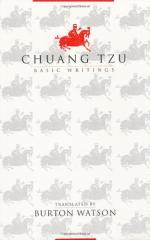
The Chinese philosopher Chuang Tzu (ca. 369-ca. 286 BC), also known as Chuang Chou, was the most brilliant of the early Taoists and the greatest prose writer of his time.

Not much is known of the life of Chuang Tzu. The Shih Chi (Historical Records, written about 100 BC) tells us that he was a contemporary of King Hui of Liang (370-319) and King Hsüan of Ch'i (319-301). Thus Chuang Tzu seems to have been a contemporary of Mencius (372-289), but neither was mentioned by the other in his extant writings. The Shih Chi also says that Chuang Tzu was born in Meng on the border of Shantung and Honan and that he held a petty official post for a time in Ch'iyüan. However, he seems to have lived most of his life as a recluse, "to be intoxicated in the wonder and the power of Nature."

Legend has it that Chuang Tzu declined the honor of being prime minister to King Wei of Ch'u (339-329), saying that he much preferred to be a live tortoise wagging its tail in the mud than a dead one venerated in a golden casket in a king's ancestral shrine. (The story is apocryphal, but it is highly illustrative of the mentality of the Taoist mystic, who cared more for personal freedom than for high office.)

Chuang Tzu's greatness lay in his bringing early Taoism to its full completion. While he was true to the Taoist doctrine of wu-wei (refraining from action contrary to Nature), he extended the Taoist system and carried out metaphysical speculations never heard of by the early Taoists. The philosophy of Chuang Tzu, as characterized by its emphasis on the unity and spontaneity of the Tao, its assertion of personal freedom, and its doctrine of relativity of things, is essentially a plea for the "return to Nature" and free development of man's inherent nature. It is in fact a kind of romantic philosophy that favors anarchistic individualism and condemns Confucian virtues and institutions--a philosophy, in short, that idealizes the state of natural simplicity marked by no will, no consciousness, no knowledge.

All these ideas are well illustrated in the book bearing Chuang Tzu's name. The Chuang Tzu as it stands today contains 33 chapters, in 3 sections: 7 "inner chapters," 15 "outer chapters," and 11 "miscellaneous chapters." It was probably compiled by Kuo Hsiang (died A.D. 312), the great commentator of the Chuang Tzu. As in the case of the Lao Tzu (also known as the Tao Te Ching), there has been much controversy over the authorship of the Chuang Tzu. The first section is generally regarded as the work of the man called Chuang Tzu. Some of the best chapters of the Chuang Tzu representing the naturalistic aspects of Taoism are not included in the first section, and no definite answer has so far been given as to who else would have written them. In view of the frequent repetitions, many interpolations, and differences of styles in the various parts of the work, most scholars agree that the Chuang Tzu is a compilation of Taoist writings from various hands. However this may be, the Chuang Tzu, which consists of beautiful allegories and lively anecdotes, has rarely been surpassed for beauty of style and felicity of expression.

This is the complete article, containing 543 words (approx. 2 pages at 300 words per page).

View More Summaries on Zhuangzi
More Information
  • View Chuang Tzu Study Pack
  • Search Results for "Chuang Tzu"
  • Add This to Your Bibliography
  • More Products on This Subject
    Zhuangzi
    (born &circa; 369, Meng, China—died 286 &BCE;) Most significant early Chinese interpreter of ... more

    Zhenren
    ZHENREN. The term zhenren ("real person") is first encountered in parts of the Zhuang... more


    Ask any question on Zhuangzi and get it answered FAST!
    Answer questions in BookRags Q&A and earn points toward
    discounted or even FREE Study Guides and other BookRags products!
    Learn more about BookRags Q&A
    Copyrights
    Chuang Tzu from Encyclopedia of World Biography. ©2005-2006 Thomson Gale, a part of the Thomson Corporation. All rights reserved.

    Join BookRagslearn moreJoin BookRags


    About BookRags | Customer Service | Report an Error | Terms of Use | Privacy Policy

