
 Print
Print Word
Word PDF
PDF|
This section contains 9,009 words (approx. 31 pages at 300 words per page) |

|
Dictionary of Literary Biography on Charles (John) Olson
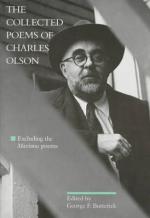
Charles Olson shaped postmodern American writing through his poetry and his essays. As the successor to Ezra Pound and William Carlos Williams and the inheritor of Herman Melville's prophetic voice, he was the leading voice of the Black Mountain Poets--which included Robert Creeley, Robert Duncan, Edward Dorn, and Joel Oppenheimer. He has claimed a dominant place in literary history with his epic series, The Maximus Poems (1953-1975); the theoretical manifesto "Projective Verse" (1950); essays such as "Human Universe" (1951); the lecture/essays published after his death as The Special View of History (1970); his study of Melville, myth, and America, Call Me Ishmael (1947); and his acknowledged influence on an entire generation of poets. He caused the reconsideration of poetic structures and reengaged contemporary poetry with its American traditions after the flirtation with European sources in the high modernist movement of the first part of the century. Warren Tallman in his preface...
|
This section contains 9,009 words (approx. 31 pages at 300 words per page) |
|



