
 Print
Print Word
Word PDF
PDF|
This section contains 8,260 words (approx. 28 pages at 300 words per page) |

|
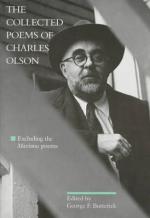
Dictionary of Literary Biography on Charles (John) Olson
Charles Olson has come to be recognized in the few years since his death as a major shaper of a postmodern American poetry, the chief successor to Ezra Pound and William Carlos Williams. He was a leading voice of the so-called Black Mountain Poets (which included Robert Creeley, Robert Duncan, Edward Dorn, and Joel Oppenheimer among others), named for the experimental college with which all were at one time or another associated. His place in literary history seems assured by such achievements as his epic series, The Maximus Poems (1953-1975), the theoretical manifesto "Projective Verse" (1950), essays such as "Human Universe" (1951), his deeply felt study of Herman Melville, myth and America, Call Me Ishmael (1947), his energetic letters, as well as his acknowledged influence on an entire generation of poets. Indeed, one critic--Warren Tallman in his preface to The Poetics of the New American Poetry (1973)--speaks of "Olson's generation" the...
|
This section contains 8,260 words (approx. 28 pages at 300 words per page) |
|



