| Name: |
Karl Friedrich Gauss |
| Birth Date: |
|
| Death Date: |
|
| Place of Birth: |
|
| Nationality: |
|
| Gender: |
|
| Occupations: |
|
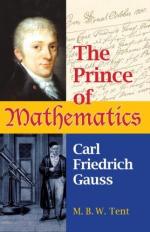
Carl Friedrich Gauss was as eccentric as he was brilliant. Known primarily for his work in mathematics, he also made contributions in physics, astronomy, and magnetism.
Born at Brunswick, Germany, on April 30, 1777, Gauss was a bona fide genius, able to make calculations before he was able to talk. At the age of three he was making corrections to his father's additions. He taught himself to read and regularly kept lists of numerical data, including such useless tables as how many days various famous men had lived. Gauss not only lived for numbers, he was consumed by them.
Gauss's father, recognizing the boy's talent with mathematics, encouraged his son. At the age of fourteen, Gauss was able to obtain a stipend from Duke Ferdinand of Brunswick to devote himself to science. Gauss eventually went on to the University of Göttingen in 1795 and obtained his doctor's degree in 1799.
Gauss made numerous mathematical discoveries while still in his teens. He advanced the work of Adrien-Marie Legendre by working out the method of least squares. His work in geometry went beyond the work of the ancient Greeks. In 1796 he showed how to construct an equilateral polygon with seventeen sides using just a ruler and compass. In addition, he showed that only polygons with a certain number of sides could be constructed with those two tools. The inverse of this logic meant that there were certain geometric constructions that were impossible.
At the age of only twenty-four, Gauss calculated an orbit for Ceres, the first asteroid that Giuseppe Piazzi (1746-1826) had discovered in 1801 and then lost when it passed behind the sun. The asteroid was recovered just where Gauss predicted it would be, and this remarkable calculation made his reputation. He also calculated theories of perturbations between the larger planets that helped Jean Urbain Leverrier (1811-1877) and John Couch Adams in their independent discovery of Neptune.
Eventually, Gauss came to be recognized as one of the greatest mathematicians of all times. He went on to work with Pierre de Fermat's theory of numbers and also worked out a non-Euclidian geometry that was based on axioms different from those of Euclid. Unfortunately, Gauss often tended to keep some of the results of his work secret for awhile, and two other mathematicians received the credit for the discovery by publishing first. In 1799 Gauss proved that every polynomial has a complex root of the form a + bi, which is one of algebra's fundamental theorems.
In 1807 Gauss was appointed director of the Göttingen Observatory, a position which he retained for the rest of his life. There, in 1821, he invented a device called a heliotrope, which afforded a more accurate way to survey locations on the earth. He became interested in the earth's magnetic field and established the first observatory to specialize in its study. Making geomagnetic observations with Wilhelm Weber (1804-1891), who would become famous for his work with electricity, Gauss was able to make a calculation which accurately located the earth's magnetic poles. They established the standard unit of measurement of magnetic influence, which was later named the gauss. Gauss and Weber became interested in electromagnetism and, making use of Michael Faraday's 1831 discovery of magnetic induction, invented a telegraph. Their version differed from that of American physicist Joseph Henry, who was in the process of inventing his own telegraph at the same time. Henry's receiver used a metal arm which clicked up and down; Gauss's version consisted of a large coil over a magnet to create the current which deflected a magnetic needle at the receiver. In 1833 Gauss and Weber ran a wire across Göttingen from the physics laboratory to the observatory, but abandoned the project when they were unable to gain support for additional development. Ironically, in 1837 Charles Wheatstone patented his telegraph in England, and in 1840 Samuel Morse did the same in the United States, much to the chagrin of Henry.
On February 23, 1855, Gauss died at Göttingen. His name has been honored twice: first with the standard unit of magnetic influence, which the metric system has since replaced with the tesla in honor of another eccentric genius, Nicola Tesla (1856-1943), and second with asteroid number 1,001, which is known as Gaussia.
This is the complete article, containing 703 words
(approx. 2 pages at 300 words per page).
View More Summaries on Carl Friedrich Gauss