BookRags.com Literature Guides Literature
Guides
Criticism & Essays Criticism &
Essays
Questions & Answers Questions &
Answers
Lesson Plans Lesson
Plans
My Bibliography Periodic Table U.S. Presidents Shakespeare Sonnet Shake-Up
Research Anything:        
History | Encyclopedias | Films | News | Create a Bibliography | More... Login | Register | Help

Not What You Meant?  There are 10 definitions for Gauss.

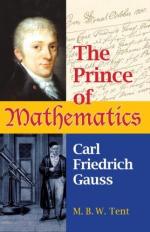
Carl Friedrich Gauss Biography

Print-Friendly  Order the PDF version  Order the RTF version
About 2 pages (521 words)
Carl Friedrich Gauss Summary

Bookmark and Share Know this topic well? Help others and get FREE products!
Name: Karl Friedrich Gauss
Birth Date: April 30, 1777
Death Date: February 23, 1855
Place of Birth: Brunswick, Germany
Nationality: German
Gender: Male
Occupations: mathematician

World of Invention on Carl Friedrich Gauss

A true child prodigy, Carl Gauss was a mathematical genius. Born into an extremely poor family in Brunswick, Germany, on April 30, 1777, Gauss amazed his parents by learning to add numbers and make calculations before he was able to talk. He was correcting his father's addition at the age of three. Gauss taught himself to read and, when fourteen years old, received a stipend from Duke Ferdinand of Brunswick to study science. He eventually entered the University of Göttingen in 1795 and obtained his doctorate degree in 1799. Gauss is best known for his mathematical advances. He devised the method of least squares while a teenager; calculated the orbit of the asteroid Ceres , permitting it to be rediscovered after it had been lost; calculated theories of perturbations between the planets, which led to the discovery of Neptune; constructed an equilateral polygon of seventeen sides; and established a non-Euclidean geometry . Unfortunately Gauss tended to keep some of his work secret; two others who also had devised non-Euclidean geometry received the credit when they published first. No matter; his contemporaries hailed Gauss as one of the greatest mathematicians that ever lived; up until this time only Archimedes and Isaac Newton (1642-1727) had been so honored. In 1807 Gauss was appointed director of the Göttingen Observatory and he became interested in geodesy, which involves surveying large areas of the earth. This was necessary to pinpoint the exact location of the observatory and led him to create a new, improved method of surveying.

In 1821 he invented a device called the heliotrope , an instrument that could reflect sunlight over long distances. With it, parallel rays of light could be used to mark straight lines on the curved earth, allowing for precise trigonometric calculations. Next Gauss became involved in magnetism and established the first observatory to specialize in that field. Working with colleague Wilhelm Weber (1804-1891), Gauss began making a worldwide magnetic survey, the results of which allowed the accurate determination of the earth's magnetic poles. Gauss and Weber became interested in electromagnetism and, making use of Michael Faraday's 1831 discovery of magnetic induction, invented a telegraph. Their version differed from that of American physicist Joseph Henry, who was in the process of inventing his own telegraph at the same time. Henry's receiver used a metal arm which clicked up and down; Gauss's version consisted of a large coil over a magnet to create the current which deflected a magnetic needle at the receiver. In 1833 Gauss and Weber ran a wire across Göttingen from the physics laboratory to the observatory, but abandoned it when they were unable to gain support for additional development. Ironically, in 1837 Charles Wheatstone patented his telegraph in England, and in 1840 Samuel Morse did the same in the United States, much to the chagrin of Henry. After 1840 Gauss's scientific work slowly began to decline. On February 23, 1855, Gauss died at Göttingen. His name was honored when the standard unit of measurement of magnetic influence, which he and Weber had established, was named the gauss. When asteroid number 1,001 was discovered it was christened Gaussia.

This is the complete article, containing 521 words (approx. 2 pages at 300 words per page).

View More Summaries on Carl Friedrich Gauss
More Information
  • View Carl Friedrich Gauss Study Pack
  • 10 Alternative Definitions
  • Search Results for "Carl Friedrich Gauss"
  • Add This to Your Bibliography
  • More Products on This Subject
    Karl Friedrich Gauss
    The German mathematician Karl Friedrich Gauss (1777-1855) made outstanding contributions to both pu... more

    Carl Friedrich Gauss
    Carl Friedrich Gauss was as eccentric as he was brilliant. Known primarily for his work in mathemat... more


    Ask any question on Carl Friedrich Gauss and get it answered FAST!
    Answer questions in BookRags Q&A and earn points toward
    discounted or even FREE Study Guides and other BookRags products!
    Learn more about BookRags Q&A
    Copyrights
    Carl Friedrich Gauss from World of Invention. ©2005-2006 Thomson Gale, a part of the Thomson Corporation. All rights reserved.

    Join BookRagslearn moreJoin BookRags


    About BookRags | Customer Service | Report an Error | Terms of Use | Privacy Policy