
BookRags.com Literature Guides Literature Guides Criticism/Essays Criticism/Essays Biographies Biographies My Bibliography Periodic Table U.S. Presidents Shakespeare Sonnet Shake-Up
Research Anything:        
History | Encyclopedias | Films | News | Create a Bibliography | More... Login | Register | Help
Not What You Meant?  There are 47 definitions for Byron.


Byron R. White Biography

Print-Friendly  Order the PDF version  Order the RTF version
About 3 pages (983 words)
Byron White Summary

Bookmark and Share
Name: Byron R. White
Birth Date: June 8, 1917
Place of Birth: Fort Collins, Colorado, United States
Nationality: American
Gender: Male
Occupations: supreme court justice, lawyer

Encyclopedia of World Biography on Byron R. White

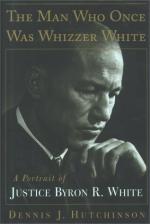
Byron R. White (born 1917) was a football star, a successful lawyer, a deputy U.S. attorney general, and a U.S. Supreme Court justice. On the high court, he was considered an independent and often served as a swing vote in close decisions, though he most often sided with the conservatives.

Byron R. White was born on June 8, 1917, in Fort Collins, Colorado, and grew up in Wellington, a small farming and trading town in northern Colorado. His father was a branch manager for a local lumber supply company. From their early youth White and his brother worked long hours at hard-labor jobs in sugar beet fields or on section crews for the railroad, their income vital to the family during the bleak years of the Great Depression of the 1930s. Though neither of White's parents had gone through high school, they valued academics and sports, and Byron was accomplished at both. He graduated from high school first in his class and won an academic scholarship to the University of Colorado.

Glory Days

In college White excelled in sports and academics, winning numerous varsity letters in football, basketball, and baseball and being elected Phi Beta Kappa. Nicknamed "Whizzer" for his speed, White as a junior received national attention as Colorado's star running back. Graduating with one of the highest averages in the university's history, White accepted a prestigious Rhodes scholarship to study at Oxford University. Before going to Oxford, he played the 1938-1939 season with the Pittsburgh Steelers, receiving what was at the time the highest salary ever paid to a professional football player. White led the National Football League in rushing, the first rookie ever to lead the league in any department.

After a short time studying at Oxford, White returned to the United States in the fall of 1939 to enter Yale University Law School. He won the Edgar Cullen Award for receiving the highest grades of the freshman class and was appointed to a coveted job on the Law Review. But he declined in order to "play football and make some money instead," he later recalled. White played the 1940-1941 season with the Detroit Lions, then continued law study during the summer at the University of Colorado. White signed another pro football contract for 1941-1942, but after the Japanese attack on Pearl Harbor he enlisted in the Navy. During World War II White was a naval intelligence officer in the South Pacific, winning two bronze stars for courage in action. He also renewed his acquaintance with another decorated officer, PT-boat commander John F. Kennedy, whom he first had met at Oxford.

To the Supreme Court

After the war White married his college sweetheart, Marion Stearns. He then returned to Yale and finished the final year of law school, graduating in November 1946 magna cum laude. During the 1946-1947 term White held a prestigious law clerkship at the U.S. Supreme Court under Chief Justice Fred Vinson. Again he met Kennedy, who was then a freshman congressman. Although he received offers from leading Washington law firms, White returned to Colorado to begin practice in Denver.

In the 1950s White established a successful legal career, achieving recognition throughout the state. When Kennedy began his campaign for the presidency in 1959, White organized local Colorado-for-Kennedy clubs and successfully gained the bulk of the state's delegate votes for his old friend at the 1960 Democratic convention. White helped Kennedy in his national campaign as well, and the new president named him deputy attorney general. White served capably, especially during the civil rights struggles in the South. In March 1962, to fill the vacancy created by the resignation of Justice Charles E. Whittaker, Kennedy nominated White to the Supreme Court. Six months later Justice Felix Frankfurter also resigned, and the president called on Arthur J. Goldberg to fill that seat.

The two new justices came on the Court at a tumultuous time. Under the leadership of Chief Justice Earl Warren during the 1950s and 1960s, the Supreme Court was leading the nation in an effort to improve the lot of dispossessed minorities and other disadvantaged groups. A majority of the justices embraced an activist role as civil rights confrontations, student anti-war protests, and other struggles shook America. A minority of the Court urged greater restraint. Goldberg aligned himself with the activists, and White tended to side with the proponents of judicial self-restraint.

By the 1970s and 1980s, a new conservative Court majority emerged, with White often a part of it. He did not adhere rigidly to any ideological position and often represented a vital swing vote in close decisions. But on key issues, he tended to side with the conservatives. He was one of two dissenters in the Court's landmark decision approving a woman's right to abortion, Roe v. Wade (1977) and remained a consistent foe of abortion rights in subsequent cases. White opposed broad use of affirmative action, favored closer ties between church and state, and strongly sided with law enforcement officials on law-and-order issues. He rarely ventured to overturn laws passed by Congress. In his most personal opinion, in Bowers v. Hardwick (1986), he argued that states are free to ban sodomy and oral sex because there is a long tradition of intolerance against homosexuality.

White's pragmatic approach to law did not sit well with critics. "White was uninterested in articulating a constitutional vision," author Jeffrey Rosen wrote in The New Republic of April 12, 1993. "Despite his ability as a first-rate legal technician, White never transcended his initial incarnation as the jock justice....White's jurisprudence...was essentially reactive and obsessed with scoring points....Despite his reputation for independent voting, White's lack of an independent vision reduced him to defining himself in relation to those with more coherent views."

In 1993 White retired after 31 years on the Supreme Court. His career as athlete, attorney, and justice was unique in American history. He died on April 15, 2002, in Denver, Colorado, from complications from pneumonia. He was 84.

This is the complete article, containing 983 words (approx. 3 pages at 300 words per page).

View More Summaries on Byron White
More Information
  • View Byron R. White Study Pack
  • 47 Alternative Definitions
  • Search Results for "Byron R. White"
  • Add This to Your Bibliography
  • More Products on This Subject
    Byron White
    Byron Raymond White ( June 8 , 1917 – April 15 , 2002 ) won fame both as a football running back ... more

    Byron White
    Byron Raymond White (June 8, 1917 – April 15, 2002) won fame both as a football running back a... more


    Copyrights
    Byron R. White from Encyclopedia of World Biography. ©2005-2006 Thomson Gale, a part of the Thomson Corporation. All rights reserved.

    Join BookRagslearn moreJoin BookRags


    About BookRags | Customer Service | Report an Error | Terms of Use | Privacy Policy

