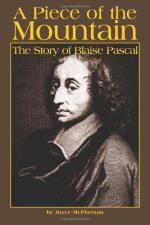
Although Blaise Pascal can be seen in retrospect as an important scientist in his time, he was a controversial figure to his contemporaries. There is no doubt that Pascal was of a superior intelligence, but he was a modest man, embarrassed by his own genius. The reason for his contemporaries' doubt was perhaps in part due to the fact that much of his work was not published in his lifetime, which limited how his accomplishments could be viewed. Still, Pascal gave the world, mathematical and otherwise, many things: he opened up new forms of calculus, projective geometry, probability theory, and he designed and manufactured the first calculating machinerun by cogs and wheels.
Pascal was born in Clermont (now known as Clermont-Ferrand), Auvergne, France, on June 19, 1623. He was the son of a mathematician and civil servant Ètienne and Antoinette (nee Bégon) Pascal. His mother died when Pascal was three. With his two sisters, Gilberte (Madame Périer after marrying Florin Périer in 1641) and Jacqueline, Pascal was educated at home, primarily by his father. Pascal was part of a very tightly knit family, and he was especially close to his sisters. Pascal's sister Jacqueline was a child literary prodigy, and, despite being sickly all his life, Pascal was also a gifted child. In 1631, the family moved to Paris, where Pascal began his mathematical education when he was 10 or 11. His father insisted that his education start with the study of ancient languages, before learning geometry.
Publishes First Paper at 16
At age 13, Pascal and his father began attending discussions in Paris with a group of scientists and mathematicians, such as René Descartes, called the Académie Parisienne. By the time he was 16 years old, Pascal had already done a significant amount of his mathematical ground work. He continued his studies in Rouen where the family moved in 1639, when his father was appointed to the tax office there. Pascal continued to go to Paris occasionally while living in Rouen, and it was on one of these trips that he presented one of his important mathematical discoveries.
Published in 1640 as a pamphlet, Essai sur les coniques was a vital step in the development of projective geometry and it contained what came to be known as Pascal's mystic hexagram. Pascal began writing this treatise on conic sections to clarify the 1639 publication of Gérard Desargues' Brouillon project d'une atteinte aux evenements des rencontres du cone avec un plan ("Experimental project aiming to describe what happens when the cone comes into contact with a plane"). Desargues had written his book in a manner that was very difficult to understand, even for other mathematicians.
But as Pascal began to work with the propositions that Desargues made, he went beyond what Desargues accomplished. Pascal developed his own theorem which he used to deduce some 400 propositions as corollaries. His theorem, describing a figure known as Pascal's mystic hexagram, states that the three points of intersection of the pairs of opposite sides of a hexagon inscribed in a conic are collinear. When he presented his findings to the Académie Parisienne, Descartes could not believe a 16-year-old boy had written this work. Only part of the manuscript was published in the 1640 essay, but a whole manuscript did exist at one time.
Develops Calculator
Soon after this pamphlet was published, in 1641, Pascal's health began to decline. He suffered from headaches (perhaps caused by a deformed skull), insomnia, and indigestion but he continued his work. To help with his father's lengthy tax work in Rouen, Pascal worked on what became the first manufactured calculator from 1642 to 1644. This machine could automatically add and subtract, using cogged wheels to do the calculations. The invention was patented and Pascal received a monopoly by a royal decree dated May 22, 1649. He wanted to manufacture these machines as a full scale business enterprise but it proved too costly. The basic principle behind Pascal's calculator was still used in this century before the electronic age.
The year 1646 was key in Pascal's life. He became part of an anti-Jesuit Catholic sect called Jansenism, which believed in predestination and that divine grace was the only way to achieve salvation. He persuaded his family to join him, and the influence of Jansenism played a dominant role in the rest of the life.
Pascal also began doing work in physics, conducting experiments in atmospheric and barometric pressure, and vacuums. Pascal used the theories of Evangelista Torricelli as a starting point for his work. In Pascal's experiments, he had his brothers-in-law climb Puy de Dôme with tubes filled with different liquids to test his theories. The results were not just more information about atmospheric pressure, for Pascal invented the syringe and the hydraulic press based on them. More importantly, he delineated what came to be known as Pascal's principle, which says that pressure will be transmitted equally throughout a confined fluid at rest, regardless of where the pressure is applied.
Pascal published his some of his results in 1647 under the title Experiences nouvelles touchant le vide, and in 1648 as Récit de la grande experience sur l'equilibre des liqueurs. He completed the work already done on hydrostatics theory, bringing together the mechanics of both fluids and rigid bodies. His whole treatise on this subject was not published until a year after his death.
Retreats from Secular World
The Pascal family returned to Paris in 1647. His father died there in 1650, and his sister Jacqueline entered the Jansenism Convent at Port-Royale. Pascal himself had a profound religious experience four years later on the night of November 23, 1654. That night, Pascal was nearly killed in a riding accident. A few months later, Pascal left the secular world to live in the Port-Royal Convent. He did a little more work in mathematics and science, but primarily published religious philosophy.
Before Pascal's religious experience, earlier in 1654, he and Pierre de Fermat began writing each other about problems on dice and other games of chance. This correspondence laid the foundation for the mathematical theory of probability.
During his work on probability, Pascal made a comprehensive study of the arithmetictriangle. Although this triangle of numbers was more than 600 years old, Pascal used it so ingeniously in his probability studies that it became known as Pascal's triangle. His work on the binomial coefficients that make up the triangle helped to lead Isaac Newton to his discovery of the general binomial theorem.
Pascal's last mathematical work was on the cycloid, the curve traced by the motion of a fixed point on the circumference of a circle rolling along a straight line. This curve was known as far back as the early 16th century, but in 1658, over the course of eight intensive days of effort, Pascal solved many of the remaining problems about the geometry of the cycloid. The "theory of indivisibles," a forerunner of integral calculus, allowed him to find the area and center of gravity of any segment of the cycloid. He also computed the volume and surface area of the solid of revolution formed by rotating the curve around a straight line. As was customary in those days, once having found these solutions, Pascal proposed a challenge to other mathematicians to solve a set of problems about the cycloid and offered two prizes. Neither prize was ever awarded and Pascal eventually published his own solutions.
The fruition of Pascal's correspondence with Fermat came in 1658, when he was trying to forget the pain of a toothache. Pascal came up with solutions to problems related to the curve cycloid, also known as roulette. He solved the problems using what became known as Pascal's arithmetic triangle (also known as the triangle of numbers) to calculate probability. His results were published in 1658 as Lettre circulaire relative a la cycloïde . This work played a major role in the development of calculus, both differential and integral. With this framework, areas and volumes could be calculated, and infinitesimal problems could be solved.
Though Pascal had been sickly all his life, his health became much worse later in 1658. His last project was developing a public transportation system of carriages in Paris in the first part of 1662. He did not live to see the system running. He died in his sister Gilberte's home on August 19, 1662, probably of a malignant stomach ulcer. Before his death, he may have parted company with his Jansenist friends.
Pascal was often underestimated in his time, and the bulk of his work was published posthumously. For example, Traité de la pesanteur de la masse de l'airwas published in 1663, and Traité du triangle arithmétique in 1665, although these are only two of many.
This is the complete article, containing 1,438 words
(approx. 5 pages at 300 words per page).