Forgot your password?  

Benjamin Siegel Biography

This Biography consists of approximately 4 pages of information about the life of Bugsy Siegel.
PDFPDF
Download:
Bookmark and Share
This section contains 1,088 words
(approx. 4 pages at 300 words per page)

World of Criminal Justice on Benjamin Siegel

Benjamin "Bugsy" Siegel was born on February 28, 1906, in Brooklyn, New York. His poor Jewish parents lived in a crime-ridden slum known as Hell's Kitchen--the breeding ground for many criminals of that era. Among Siegel's boyhood friends were George Raft, who later established a movie career playing gangster roles, and Bo Weinberg, later a top aide to gangster Dutch Schultz.

In a manner similar to fellow gangster Louis Lepke, Siegel began his criminal career by preying upon pushcart peddlers on the Lower East Side with a sidekick named Morris "Moey" Sedway.Unlike Lepke, Siegel did not usually beat the vendors he was trying to convince to buy protection from him. Rather he would simply have Sedway pour kerosene(a fuel oil) over the vendors' merchandise and then light it on fire. It usually only took a vendor one lesson to decide to pay the "insurance."

By the time he was fourteen-years-old, Siegel was in charge of his own gang of criminals. He joined forces with Meyer Lansky, another rising young New York gangster, to create the Bugs-Meyer Mob. Members of the mob hired their services as enforcers for the large bootlegging mobs. Less than ten years later, the enforcement arm of the mob known as "Murder,Inc." took over responsibility for gangland killings. The Bugs-Meyer Mob was involved in a number of other activities as well. The young mobsters ambushed rival gangsters and took their liquor shipments. They also dealt in stolen cars, prostitution, drug trafficking, and gambling rackets in New York, New Jersey, and Pennsylvania.

Throughout the 1920s and 1930s, Siegel continued to climb up the underworld ladder. At the same time, Luciano and a number of other Italian gangsters began to organize criminal mobs into a national organization, or syndicate. Siegel and Lansky--who were both Jewish--were included in the organization.The mob's reorganization required some "housecleaning"--the killing of veteran gangsters who stood in the way of the syndicate's progress. Siegel was an eager participant in the new mob's clean-up jobs. In 1931,he was one of the hit men who assassinated Joe "the Boss" Maseria--an old-guard gangster--at a restaurant in Coney Island, New York.Siegel was often accompanied by killer Frankie Carbo, who later became the head of the mob's prizefighting (boxing) racket.

Not all of Siegel's killings were ordered by the national syndicate.In 1935, the government charged syndicate member Dutch Schultz with income tax evasion. Certain Schultz's career would be cut short by imprisonment, fellow syndicate members Luciano and Vito Genovesetook over the "Dutchman's" profitable numbers rackets in Harlem. They did this with the help of Schultz's top lieutenant, Bo Weinberg. Tried in upper New York State, Schultz managed to avoid conviction. When he returned to New York City, he found his empire sacked. Aware that his former aide had turned traitor, he ordered Weinberg's assassination. Siegel--who had grown up with Weinberg--was the hit man.

A near hit took place during a trip to Italy with Countess Dorothy Dendice Taylor DiFrasso, one of the gangster's many girlfriends. On the trip Siegel met German Nazi leaders Hermann Göring and Goebbels. He despised both men--for personal reasons. According to rumor, Siegel would have killed the two Germans--who later became involved in Nazi crimes during World War II--if DiFrasso had not stopped him.

Few people called Benjamin Siegel "Bugsy" to his face. The gangster hated the nickname--which he had acquired for his sometimes crazy behavior and cold-blooded willingness to kill.

Eventually, Siegel became the target of numerous attempts against his life. With the heat turned up, he reportedly approached syndicate leaders regarding a plan to combine criminal undertakings in California with Jack Dragna, who at the time controlled the underworld in that state. With Dragna's help, Siegel operated various gambling establishments, including a floating casino.

The gangsters' other activities included drug smuggling. Using a series of relay points, they were able to transport narcotics from Mexico into the United States without being detected by legal authorities. They also employed a relay system to establish a bookmaking wire service. The wire service transmitted the results of West Coast horse races to bookies who collected bets in the East and elsewhere.

In California, Siegel contacted his boyhood friend, actor George Raft,who reportedly liked the gangster and was happy to introduce him to various actors and studio directors. A well-dressed, handsome man, Siegel had a boyish, charming personality. He rubbed elbows with many Hollywood stars, including Clark Gable, Jean Harlow, Cary Grant, and Gary Cooper.

By the mid-1940s, Lansky had gained a reputation as the "chairman of the board" of the national crime syndicate. In 1945, Lansky and Siegel decided to establish a gambling hotel in a small town called Las Vegas, Nevada. According to reports, Siegel borrowed $3 million from the syndicate and eventually spent $6 million in building the Flamingo Hotel. (Flamingo was the nickname of one of Siegel's girlfriends, Virginia Hill.) As the first legalized gambling casino in the United States, the Flamingo became famous nationwide, and Siegel drew enormous profits from it.

But the syndicate members suspected--with good cause--that Siegel was pocketing money that was not his. They believed that the money--which came from building funds and gambling income--had been stashed in Swiss bank accounts (which were difficult to trace) by Siegel's mistress, Hill.

On behalf of the syndicate, Luciano contacted Siegel and instructed him to meet with syndicate members in Havana, Cuba. Havana was at that time one of the gambling centers of the world and a gangster haven. At the Havana meeting in December of 1946, Siegel denied that he had stolen mob money. Apparently syndicate members did not believe him.

On June 20, 1947, as Siegel sat in the living room of Hill's Beverly Hills mansion, he was gunned down by shotgun fire. (Hill was in Europe at the time.) Struck three times, he died instantly. When law enforcement officials arrived at the scene of the slaying, they found the gangster's right eye in the dining room, five yards from the corpse. The forty-one-year-old mobster was buried in a closed casket.

Although Lansky and Luciano denied involvement in the hit, there is little doubt that Siegel was murdered on syndicate orders. Carbo is commonly believed to have been the gunman who fired into the living room of Hill's mansion on Linden Drive. Shortly after Siegel's assassination, Sedway and several syndicate members appeared at the Flamingo Hotel and informed the manager that they were taking over.

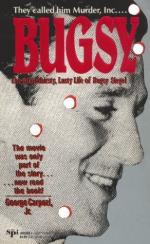
In the 1991 movie Bugsy, Warren Beatty plays Siegel and Annette Bening plays Virginia Hill, Siegel's girlfriend. The film was adapted from a novel by Dean Jennings,We Only Kill Each Other: The Life and Bad Times of Bugsy Siegel.

This section contains 1,088 words
(approx. 4 pages at 300 words per page)
Copyrights
Benjamin Siegel from World of Criminal Justice. ©2005-2006 Thomson Gale, a part of the Thomson Corporation. All rights reserved.
Follow Us on Facebook
Homework Help