|
This section contains 1,442 words (approx. 5 pages at 300 words per page) |

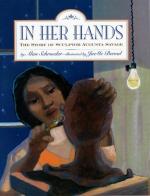
Authors and Artists for Young Adults on Augusta Savage
A talented sculptor, Augusta Savage battled racism, sexism, and poverty to become one of the most distinguished members of the Harlem Renaissance, the effervescence of African-American creativity in the 1920s and 1930s in New York and elsewhere. As artist, educator, and tireless fighter for the civil rights of blacks, Savage is remembered for her indomitable spirit as much for her tragically few remaining works of art. Savage suffered from a chronic lack of funds so that many of her statues never made it past the plaster-cast stage. Her huge sculpture for the 1939 World's Fair, for example, "Lift Every Voice and Sing," was in fact destroyed at the close of the event.
Born in 1892 (some sources say 1900), Savage was the seventh of fourteen children born to Edward and Cornelia Fells. Her birthplace, Green Cove, Florida, was renowned for its red clay topsoil, which was used in the local brick-making industry. But in the young Savage's hands, this clay was used to model all sorts of forms, from birds to pigs. "At the mud pie age, I began to make `things' instead of mud pies," she wrote in an autobiographical sketch for Crisis. Frequently playing hooky, Savage would spend days at the local clay pit fashioning animals out of the red material. Her father, a house painter and part-time minister, hoped to discourage his daughter from making what he termed "graven images." According to Romare Bearden and Harry Henderson, writing in Six Black Masters of American Art, Savage once recalled, "My father licked me five or six times a week and almost whipped all art out of me." In the end, however, her father only succeeded in forcing his daughter to keep her art obsession to herself.
At age fifteen, Savage and her family moved to West Palm Beach, Florida, where their financial situation improved somewhat. At her new school, Savage's artistic talents were soon discovered and it was not long before she was being paid a dollar a day to give clay-modeling classes. In 1907 or 1908, she married her first husband, John T. Moore, and the following year the couple had a daughter. Several years after they were married, Moore died. Savage remarried in about 1915, to James Savage, a carpenter and laborer. Though that marriage ended in divorce and there were no children, the artist thereafter used the surname of her ex-husband.
The Making of an Artist
Savage continued her artwork during these years, and soon, adopting religious subjects including a statue of the Virgin Mary, Savage's father even accepted her work. Exhibiting her work at a county fair, she won a special prize of twenty-five dollars for her sculptures, and sold enough at her booth to finance a trip to Jacksonville, Florida, to do busts of wealthy black residents. The Jacksonville venture unfortunately did not work out as expected because as Savage mentioned Crisis, the "rich folks refused to be `done.'" After a year at a teacher's training college in Tallahassee, Florida, Savage was encouraged to go to New York by the superintendent of the county fair where she had such a success, George Graham Currie, who wrote a personal recommendation for her. This recommendation--to Solon Borglum, father of the Mount Rushmore sculptor Gutzon Borglum--was not enough to get her accepted. Borglum's studio was for paying students only, but he in turn recommended Savage to the tuition-free Cooper Union where she studied with sculptor George Brewster.
While at the Cooper Union, Savage initially supported herself working as a caretaker in an apartment building, but when she lost that position the Cooper Union offered her a scholarship for the 1921-1922 academic year. Savage also began selling her clay sculptures and portraits, including one of the black leader W. E. B. Du Bois, to the 135th Street branch of the New York Public Library. According to Elton C. Fax, writing in Dictionary of American Negro Biography, Savage's "handling of the planes of Du Bois's finely formed head clearly expressed the resolute militancy and intelligence of the scholar." Other commissions followed, including one for the leader of the United Negro Improvement Association, Marcus Garvey. Savage married for a third time in 1923, to the journalist Robert L. Poston, a Garvey associate. But again, Savage was unlucky in love: Poston died the following year.
Years of Struggle
An experience in 1923 did much to radicalize Savage's views on race relations. Finishing her studies at Cooper Union in three years, she applied for a study scholarship to France. However, when the committee discovered she was African American, her application was denied. Stung personally by this insult, and angered for her people in general, Savage went public with complaints of racism, and soon the New York papers were full of the scandal. A further chance for study abroad came in 1925 with an offer of education in Italy. However, Savage, who had saved up money from working in a laundry, had to use her funds for family matters instead.
Undaunted, Savage continued to work and exhibit her clay models, showing twenty-two of them in 1926 at the Baltimore Federation of Parent Teacher Clubs. Then in the late 1920s she created one of her best known sculptures, "Gamin," the likeness of a black youth--in actuality her nephew, Ellis Ford. The bust in clay "caught the vitality, the humanity, the tenderness, and the wisdom of a boy child who has lived in the streets," according to Bearden and Henderson. Fax noted that Savage "brought her earliest experiences to full flower" in this work. Gracing the cover of Opportunity magazine, the sculpture caught the eye of many, including the Julius Rosenwald Fund, which granted Savage a fellowship to study in France largely on the basis of this piece.
On a scholarship of $1,800, Savage set off in 1930 at long last for study abroad. Her first year in Paris was successful enough to earn Savage a second fellowship for 1931, displaying her work at the Grand Palais in Paris and winning citations as well. An additional Carnegie grant allowed her to extend her studies in 1931 to Belgium and Germany before returning to New York.
An Educator and Role Model
The Great Depression had descended upon the United States and much of the rest of the world by 1931, making sculpting and art a more precarious job than ever. Savage created busts of prominent and famous blacks, such as the poet James Weldon Johnson, the abolitionist Frederick Douglass, and the composer W. C. Handy, among others, and continued to show her work at exhibitions. Among her groundbreaking statues and busts of the 1930s is the woodcarving "Envy," the marble head "A Woman of Martinique," and the bronze model on granite "After the Glory," erected in a tiny park in New York.
However, much of Savage's work in the 1930s and 1940s was in education. She founded the Savage Studio of Arts and Crafts, and led the way in enrolling black artists in the Works Progress Administration's Federal Art Project. Later becoming a director of that program. She worked with and promoted her students at both her own studio and at the YWCA, becoming a Harlem fixture and leader of the artistic community. Appointed first director of the Harlem Art Center in 1937, she continued to promote the education and work of black artists.
Her final significant commission, "Lift Every Voice and Sing," was for the 1939 World's Fair, and inspired by a line from a song known as the "Negro National Anthem." Her sculpture, cast in plaster and finished in black basalt, was a sixteen-foot harp made up of an assortment of African Americans tapered from head to foot and representing strings of the harp itself. Each figure has his or her face raised, voices lifted in song. The piece was subsequently destroyed, but photos as well as smaller copies attest to its strength and vitality.
In 1940 Savage left New York City and the art world behind, moving to the Catskill Mountains, teaching art to local children, and working on the farm where she resided. A final well-known statue, "The Pugilist" from 1942, shows Savage still at work and undaunted far way from America's art capital. The figure stands, arms folded, head upraised, in a defiant stance, ready to take on the challenges that life throws his way.
The last two decades of Savage's life were passed in relative obscurity, and when her health began to fail, she moved back to New York City to be with her daughter. Savage died of cancer on March 26, 1962, all but forgotten by the art world she had done so much to foster. In the end, her most lasting achievement was not her individual works, but the students she trained and inspired.
|
This section contains 1,442 words (approx. 5 pages at 300 words per page) |