
 Print
Print Word
Word PDF
PDF|
This section contains 1,600 words (approx. 6 pages at 300 words per page) |

|
Encyclopedia of World Biography on Aristotle
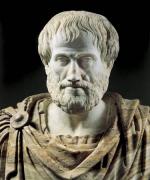
The Greek philosopher and scientist Aristotle (384-322 BC) organized all knowledge of his time into a coherent whole which served as the basis for much of the science and philosophy of Hellenistic and Roman times and even affected medieval science and philosophy.
Aristotle was born in the small Greek town of Stagiros (later Stagira) in the northern Greek district of Chalcidice. His father, Nicomachus, was a physician who had important social connections, and Aristotle's interest in science was surely spurred by his father's work, although Aristotle does not display a particularly keen interest in medicine as such. The events of his early life are not clear, but it is possible that his father served at the Macedonian court as physician to Amyntas II and that Aristotle spent part of his youth there.
At the age of 17 Aristotle joined Plato's circle at the Academy in Athens. There he remained...
|
This section contains 1,600 words (approx. 6 pages at 300 words per page) |
|



