
Forgot your password?  

Not What You Meant?  There are 109 definitions for Aristotle.  Also try: The Master or Phantasia or Aristotelian or Physiognomics.

Aristotle Biography

Print-Friendly   Order the PDF version   Order the RTF version
About 5 pages (1,593 words)
Aristotle Summary

Bookmark and Share Purchase our Aristotle
Name: Aristotle
Birth Date: 384 B.C.
Death Date: 322 B.C.
Place of Birth: Chalcidice, Greece
Place of Death: Chalcis, Greece
Nationality: Greek
Gender: Male
Occupations: philosopher, scientist

Encyclopedia of World Biography on Aristotle

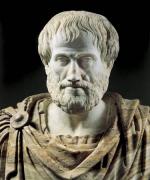
The Greek philosopher and scientist Aristotle (384-322 BC) organized all knowledge of his time into a coherent whole which served as the basis for much of the science and philosophy of Hellenistic and Roman times and even affected medieval science and philosophy.

Aristotle was born in the small Greek town of Stagiros (later Stagira) in the northern Greek district of Chalcidice. His father, Nicomachus, was a physician who had important social connections, and Aristotle's interest in science was surely spurred by his father's work, although Aristotle does not display a particularly keen interest in medicine as such. The events of his early life are not clear, but it is possible that his father served at the Macedonian court as physician to Amyntas II and that Aristotle spent part of his youth there.

At the age of 17 Aristotle joined Plato's circle at the Academy in Athens. There he remained for 20 years, and although his respect and admiration for Plato was always great, differences developed which ultimately caused a breach.

This page contains 151 words.

Purchase our Aristotle biography Aristotle biography
Read the rest of this biography.
This biography contains 1,593 words (approx. 5 pages at 300 words per page).
More Information
  • View Aristotle Study Pack
  • 109 Alternative Definitions
  • Search Results for "Aristotle"
  • Add This to Your Bibliography
  • More Products on This Subject
    Aristotle
    Aristotle was born in 384 B.C. at Stagira, a small coastal town in northern Greece. His father, Nic... more

    Aristotle
    While he is highly regarded as a philosopher and father of logic and reasoning, Aristotle is also k... more


    View all | View only answered questions | View only unanswered questions
    In what sense is it true that ''the good is that at which all things aim?" Is this an empirical claim about what, in fact, everything aims at?is this necessary truth or could not be refuted by evidenc
    5

    What Points Mean

    The best answer to this question will earn 5 points. All other answers will earn 1 point.

    Click for more information.

    In College Courses & Majors | Asked by jennifer420 | 0 answers | Open to the public
    Asked from the Aristotle study pack
    (2 questions)
    Ask any question on Aristotle and get it answered FAST!
    Answer questions in BookRags Q&A and earn points toward
    discounted or even FREE Study Guides and other BookRags products!
    Learn more about BookRags Q&A
    Copyrights
    Aristotle from Encyclopedia of World Biography. ©2005-2006 Thomson Gale, a part of the Thomson Corporation. All rights reserved.

    Join BookRagslearn moreJoin BookRags

