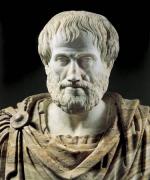
| Name: |
Aristotle |
| Birth Date: |
|
| Death Date: |
|
| Place of Birth: |
|
| Place of Death: |
|
| Nationality: |
|
| Gender: |
|
| Occupations: |
|
While he is highly regarded as a philosopher and father of logic and reasoning, Aristotle is also known for accomplishments in and contributions to other sciences. Throughout his life, he wrote several biological works which laid the foundations for comparative anatomy, taxonomy (classification), and embryology.
Aristotle was born in the northern Greek village of Stagira. His father was the court physician to the king of Macedonia, and it was at the Macedonian court where Aristotle spent much of his early boyhood. His father died before Aristotle was ten years old and the boy was raised by friends of the family.
At age seventeen, Aristotle was sent to the Academy of Plato in Athens where he plunged wholeheartedly into Plato's pursuit of truth and goodness, and soon became Plato's best pupil, earning the nickname "intelligence of the school." Twenty years after Aristotle's arrival, Plato died; Aristotle then left the Academy to travel. His journeys led him through the Greek empire and Asia Minor for twelve years during which he began his research into natural history and biology.
In 342 B.C., Philip II invited Aristotle to return to the Macedonian court and teach his son, Alexander. Aristotle's student later became known in history as Alexander the Great.
After the death of Philip and Alexander's rise to the throne, Aristotle left the court for a brief visit to his hometown; he soon returned to Athens to resume his scientific studies. In 335 B.C., he founded a university called the Lyceum. He had renounced some of Plato's theories and began his own style of brilliant teaching at the newly-established school. In the mornings, he would stroll through the Lyceum gardens, discussing problems and theories with his advanced students. Because he walked about while teaching, Athenians nicknamed his school the Peripatetic--the Greek term meaning "to walk about." Like their headmaster, Lyceum pupils performed research in nearly every existing field of knowledge. They dissected animals and studied the habits of insects, helping Aristotle to compile data for his classification system.
The school became the basic building block for the great library and museum in the area. Unfortunately, in about the year 323 B.C., the ruling emperor Alexander died, forcing Aristotle to leave Athens due to anti-Macedonian sentiment and accusations of impiety. He went to his mother's homeland of Chalcis where he died a year later.
He contributed much to the field of biology, especially through his early work on classification. In helping devise a classification system, he established the basic principles of dividing and subdividing plants and animals. At that time, only about a thousand species were known and he was able to group them into simple categories of animals with red blood (with backbones), and animals with no red blood(without backbones). Plants were divided into different categories that dealt more with size and appearance.
Aristotle's classification system remained intact for almost 2,000 years, until in the 1500s, scientists recognized that the growth of knowledge called for an expanded system. Modification came slowly, with great debate, and it revealed the complexity of the process. In the late 1700s, the Aristotelian classification system was finally replaced by a much more comprehensive and systematic one developed by Swedish naturalist, Carl Linnaeus.
Aristotle's work on classification was not accidental. He was a painstaking observer, believing nature never created anything without a reason. He was particularly fascinated by sea creatures, often dissecting them and studying their natural habitats. This approach to anatomy led him to look for correlations between structure and function and to a belief that each biological part has its own special uses.
Ultimately, he established a teleological approach through constant inquiry about the ultimate purpose of things. This approach persisted in biological thinking well into the twentieth century.
Besides classifying animals and plants in nature, Aristotle also was the first to define and classify the various branches of knowledge. He sorted them into physics, metaphysics, rhetoric, poetics, and logic. In doing so, he laid the foundation of most of the sciences.
This is the complete article, containing 654 words
(approx. 2 pages at 300 words per page).
View More Summaries on Aristotle