BookRags.com Literature Guides Literature Guides Criticism/Essays Criticism/Essays Biographies Biographies My Bibliography Periodic Table U.S. Presidents Shakespeare Sonnet Shake-Up
Research Anything:        
History | Encyclopedias | Films | News | Create a Bibliography | More... Login | Register | Help

Search "Aristotle"

Biographies Navigation
 

Aristotle Biography

Print-Friendly  Order the PDF version  Order the RTF version
About 2 pages (663 words)
Aristotle Summary

Bookmark and Share
Name: Aristotle
Birth Date: 384 B.C.
Death Date: 322 B.C.
Place of Birth: Chalcidice, Greece
Place of Death: Chalcis, Greece
Nationality: Greek
Gender: Male
Occupations: philosopher, scientist

World of Biology on Aristotle

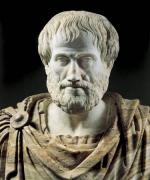
Aristotle is counted among the greatest of philosophers for his inquiries into almost every branch of knowledge, including ethics, aesthetics, physics, and biology. In particular, his empirical research into aspects of nature and history, including a lengthy classification of animals, was a truly new phenomenon in the Greek world.

The son of Nichomachus, a physician of Stageira in Thrace who served the Macedonian king Amyntas II, Aristotle went to Athens in 368 B.C. when he was about 17 years old to study at the philosopher Plato's Academy. He studied there for 20 years, but left after Plato died and went to Assos on the coast of Asia Minor to found a branch of the Academy. It was here that he married Pythias. Three years later he went to the island of Lesbos where he met Theoph rastus, who became his most celebrated disciple. In 343B.C., King Philip of Macedon invited Aristotle to supervise the education of his 13 year old son, Alexander, who later became known as Alexander the Great. During his military campaigns in the East, Alexander is said to have sent biological specimens to Aristotle and to have provided funding for some of his research. When Alexander ascended the throne in 336 B.C., Aristotle returned to his native city Stageira where he stayed until returning to Athens in 335 B.C. to establish his own school, the Lyceum, where research was conducted and lectures were given. In 323 B.C. Alexander the Great died, and Athenians, who opposed Macedonian suzerainty, looked upon Aristotle suspiciously because of his former relationship of teacher to Alexander. Aristotle left Athens and went to Chalcis in illness in 322 B.C..

Aristotle's writings are grouped into exoteric works intended for the general public and pedagogical works that formed the basis of his lectures at he Lyceum. Only fragments of the exoteric works exist, but a large number of the pedagogical writings survive. They were first collected in an edition published by Andronicus of Rhodes in the first century B.C. The writings fall into three main periods: the period of his relationship with Plato; the years when he taught at Assos and before he established the Lyceum; and the years when he headed the Lyceum. To the first period belong such works as the earliest parts of On the Soul, which is dominated by Plato's doctrine of Ideas and the soul's immortality, and parts of the Physics, which discusses nature, change, time, infinity, and the proof that an eternal Prime Mover exists. Aristotle's On the Soul briefly touches on lower activities of the soul, such as bodily motion and functions, that he later investigated more fully in four biological treatises. In his second period, Aristotle began to depart from Plato's teachings, publishing, for instance, On Philosophy, which contains Platonic influences but also criticizes Plato's theories. Aristotle's third period includes his major logical works, such as the Prior Analytics and Posterior Analytics, his works on ethics and politics, such as Nichomachean Ethics and Politics, and his biological treatises, including History of Animals, a lengthy classification of animals based on the similarities and differences in their parts, organs, and functions, and On the Parts of Animals, On the Progression of Animals, On the Generation of Animals.

While largely known today for his ethical and political philosophical writings, Aristotle is also recognized for his extensive empirical research into the natural world. He collected huge amounts of information about living creatures and systematically classified animal life. He emphasized the necessity for theories to rely on facts, noting, for instance, after giving a theory about the generation of bees, that "the facts have not been sufficiently ascertained" and stating that "credence must be given to the direct evidence of the senses more than to theories." Although some have credited Aristotle with originating the scientific method, Humanists and others have accused him of enslaving the human mind for two thousand years by establishing physical and biological laws and philosophical terminology that became dogma in western philosophy and Latin Christianity.

This is the complete article, containing 663 words (approx. 2 pages at 300 words per page).

View More Summaries on Aristotle
More Information
  • View Aristotle Study Pack
  • Search Results for "Aristotle"
  • Add This to Your Bibliography
  • More Products on This Subject
    Aristotle
    Aristotle was born in 384 B.C. at Stagira, a small coastal town in northern Greece. His father, Nic... more

    Aristotle
    The Greek philosopher and scientist Aristotle (384-322 BC) organized all knowledge of his time into... more


    Copyrights
    Aristotle from World of Biology. ©2005-2006 Thomson Gale, a part of the Thomson Corporation. All rights reserved.

    Join BookRagslearn moreJoin BookRags


    About BookRags | Customer Service | Report an Error | Terms of Use | Privacy Policy