
BookRags.com Literature Guides Literature Guides Criticism/Essays Criticism/Essays Biographies Biographies My Bibliography Periodic Table U.S. Presidents Shakespeare Sonnet Shake-Up
Research Anything:        
History | Encyclopedias | Films | News | Create a Bibliography | More... Login | Register | Help
Not What You Meant?  There are 7 definitions for Mabini.

Search "Apolinario Mabini"

Biographies Navigation
 

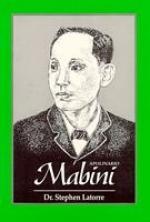
Apolinario Mabini Biography

Print-Friendly  Order the PDF version  Order the RTF version
About 2 pages (548 words)
Apolinario Mabini Summary

Bookmark and Share
Name: Apolinario Mabini
Birth Date: July 22, 1864
Death Date: May 13, 1903
Place of Birth: Talaga, Batangas, Philipines
Place of Death: Guam
Nationality: Philipine
Gender: Male
Occupations: political philosopher

Encyclopedia of World Biography on Apolinario Mabini

Apolinario Mabini (1864-1903) was a Filipino political philosopher and architect of the Philippine revolution. He formulated the principles of a democratic popular government, endowing the historical struggles of the Filipino people with a coherent ideological orientation.

Apolinario Mabini was born in Talaga, Tanauan, Batangas, on July 22, 1864. His parents belonged to the impoverished peasantry. He studied at the Colegio de San Juan de Letran in 1881 and at the University of Santo Thomas, where he received the law degree in 1894. During this time he earned his living by teaching Latin and then serving as copyist in the Court of First Instance in Manila.

In 1896 Mabini contracted an illness, probably infantile paralysis, that deprived him of the use of his legs. When the Katipunan revolt broke out late that year, the Spanish authorities arrested him. Unknown to many, Mabini was already a member of José Rizal's reformist association, the Liga Filipina. And though as a pacifist reformist, he was at first skeptical of Andres Bonifacio's armed uprising, Mabini later became convinced of the people's almost fanatical desire for emancipation. Subsequently, he turned out subversive manifestos appealing to all Filipinos to unite against Spain.

In May 1898 Emilio Aguinaldo summoned Mabini to act as his adviser. Mabini formulated the famous decree of June 18, which reorganized the local government under Filipino control. His policy throughout the struggle can be epitomized by a statement in that decree: "The first duty of the government is to interpret the popular will faithfully." Mabini was also instrumental in supervising the proper administration of justice, the election of delegates to the revolutionary congress, and the establishment of the mechanism of the revolutionary government itself.

When the revolutionary congress was convoked in Barasoain, Malolos, Bulacan, on Sept. 15, 1898, Mabini found himself opposed to the plans of the wealthy bourgeoisie to draft a constitution. He believed that, given the emergency conditions of war, the function of the congress was simply to advise the president and not to draft a constitution. Defeated by the majority, Mabini then submitted his own constitutional plan, based on the Statutes of Universal Masonry. It was rejected in favor of a composite draft submitted by Felipe G. Calderon, which became the basis of the Malolos Constitution of the first Philippine Republic.

Mabini's conflict with the conspiracy of property owners and the landlord class in the congress led to his eclipse in 1899 as Aguinaldo's trusted adviser--the only competent thinker and theoretician in the Aguinaldo Cabinet. Mabini succeeded in exposing the vicious opportunism of the Paterno-Buencamino clique, who were trying to gain control over, and to profit from, the financial transactions of the revolutionary government. When the Aguinaldo camp fled from the advancing American forces, Mabini was captured on Dec. 10, 1899. Still refusing to swear an oath of allegiance to the U.S. government and continuing to support the insurgents in their ideological struggle, he was deported to Guam in 1901. He died on May 13, 1903.

Mabini's chief work, La Revolution Filipina, a reasoned analysis and cogent argument concerning the ideological implications of the revolution against Spain and the resistance to the American invaders, reveals the progressive and democratic impulse behind his thinking. He always tried to mediate between the people's will and the decisions of their leaders. He was a selfless and dedicated patriot.

This is the complete article, containing 548 words (approx. 2 pages at 300 words per page).

View More Summaries on Apolinario Mabini
More Information
  • View Apolinario Mabini Study Pack
  • 7 Alternative Definitions
  • Search Results for "Apolinario Mabini"
  • Add This to Your Bibliography
  • More Products on This Subject
    Apolinario Mabini
    Apolinario Mabini y Maranan (July 23, 1864—May 13, 1903), also known as the "Sublime Paralytic... more


    Copyrights
    Apolinario Mabini from Encyclopedia of World Biography. ©2005-2006 Thomson Gale, a part of the Thomson Corporation. All rights reserved.

    Join BookRagslearn moreJoin BookRags


    About BookRags | Customer Service | Report an Error | Terms of Use | Privacy Policy

