
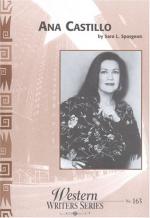
Dictionary of Literary Biography on Ana (Hernandez Del) Castillo
Ana Castillo is a prominent and prolific Chicana poet, novelist, editor, and translator whose work has been widely anthologized in the United States, Mexico, and Europe. Beginning in 1977 with her first poetry chapbook, Otro Canto (Other Song), Castillo's literary credits include the Before Columbus Foundation American Book Award for her first novel, The Mixquiahuala Letters (1986), a nomination for the 1986 Pushcart Prize, and a 1988 nomination for the Western States Book Award for the manuscript of her novel Sapogonia (published in 1990).
Born on 15 June 1953 and raised in Chicago, where she lived with her parents, Raymond and Raquel Rocha Castillo, Ana Castillo attended public schools there and became involved with the Chicano movement in high school when she was seventeen. She credits her Mexican heritage with providing a rich background of storytelling and remembers writing her first poems at the age of nine after the death of her grandmother. Castillo received a B.A. in liberal arts in 1975 from Northern Illinois University and an M.A. in Latin-American and Caribbean studies from the University of Chicago in 1979. In 1985 Castillo moved to California, then later relocated in Albuquerque in 1990 with her young son, Marcel Ramón Herrera, born on 21 September 1983.
In addition to creative writing, Castillo has taught a wide range of subjects--including U.S. and Mexican history, the history of pre-Columbian civilizations, Chicano literature, and women's studies--at various universities. She has been invited to lecture not only at U.S. universities but also at the Sorbonne in Paris and at schools in Germany, where she completed a university reading tour hosted by Germany's Association of Americanists in June 1987. In 1989 and 1990 Castillo was a dissertation fellow in the Department of Chicano Studies at the University of California, Santa Barbara.
Her awards include a National Endowment for the Arts Fellowship for poetry (1990) and a California Arts Council Fellowship for fiction (1989), and she was an honoree of the Women's Foundation of San Francisco annual celebration of women in the arts for "pioneering excellence in literature" (1988). She is the first Hispanic to be honored with a collection, the Archives of Ana Castillo, at the University of California, Santa Barbara. In Chicago she has served as writer in residence for the Illinois Arts Council and in San Francisco as a board member of Aztlán Cultural / Centro Chicano de Escritores.
Castillo's poetic voice speaks for all women who have at one time or another felt the unfairness of female existence in a world designed by men primarily for men. In Otro Canto this voice is raised in protest against "The heavy pressure of it all" in a poem that questions the way things are:
i see it all the way
god should and I'm
wonderin' why
he doesn't.
Her first collection of poems, Women Are Not Roses (1984), includes selections from Otro Canto and her second chapbook, The Invitation (1979), along with sixteen new poems in which Castillo continues to examine the themes of sadness and loneliness in the female experience.
The Mixquiahuala Letters, an epistolary novel based on forty letters written by the character Teresa to her friend Alicia, is a provocative examination of the relationship between the sexes. A farranging social and cultural exposé, the novel examines Hispanic forms of love and gender conflict. The conclusion of the novel leaves the reader with the distinct impression that the narrator's crusade for sexual freedom and self-determination is far from an unqualified success. In her 1989 study "The Sardonic Powers of the Erotic in the Work of Ana Castillo," Norma Alarcón suggests an interesting connection between Castillo's earlier poetry (in Otro Canto and The Invitation) and her epistolary novel in that "both reveal the intimate events in the life of the speaker, combined with the speaker's emotional response to them, thus exploring the personal states of mind at the moment of the event or with respect to it." Alarcón sees the epistolary novel as "Castillo's experimentations with shifting pronouns and appropriative techniques for the purpose of exploring the romantic/erotic" and suggests that the female narrator "is betrayed by a cultural fabric that presses its images of her upon her, and her response is to give them back to us, albeit sardonically."
In Sapogonia, Castillo hits her full-fledged and sophisticated stride in an intricately woven tale of the destructive powers of male-female relationships. Told from the viewpoint of the male narrator, Máximo Madrigal, whom critic Rudolfo Anaya has described (on the book cover) as "an anti-hero who relishes his inheritance as Conquistador while he agonizes over his legacy as the Conquered," the novel traces the obsessive relationship between the narrator and the woman he is unable to conquer, Pastora Aké.
A make-believe country, Sapogonia is "a distinct place in the Americas where all mestizos reside, regardless of nationality, individual racial composition, or legal residential status--or, perhaps, because of all these." As such, it both attracts and repels Madrigal, who was raised by his Spanish father and a wise Indian grandmother, Mamá Grande, who told him, "not once but many times, the stories related to her people, their history, and her own ideas about their traditions." In this novel the survival of the native culture is entrusted to the women and is symbolically represented by the little clay statues Mamá Grande insists on placing "alongside and at the foot of the statue of the Virgin." These Indian statues reappear in Aké's Chicago room on her dresser, where she lights candles to them and calls them spirit guides. Their influence persists, as does that of Mamá Grande and Aké's own Yaqui grandmother, a reminder of a nurturing, mythological background in the turbulence of the meaningless present.
Critic Patricia Dubrava called Aké "a kind of Joan Baez, a singer and songwriter [while] Max is a kind of anti-Don Quixote on a quest for fortune and dominion" (Bloomsbury Review, March 1991). Aké's role of protest singer defines her as a woman of vision and courage, forging her personal place in a chaotic world but with her feet firmly grounded in the traditions of her heritage. Madrigal is caught between the vices of two cultures, and unlike Aké, who remains true to herself throughout,he is torn between his dual roles of conqueror and conquered. His obsession with her, the one woman in his life he cannot conquer, suggests a deeper psychological trauma that prevents him from finding satisfaction.
"The ways in which we perceive and misperceive each other is one of Castillo's most important themes," Alarcón has pointed out. This observation is particularly true of Sapogonia, which is a study of the infinite ways men and women have of misreading each other. This concern with relationships between the sexes is concisely and expertly treated in an earlier, anthologized short story about the same characters, "Antihero" (1986), in which Madrigal reviews his obsession with "her, that cancerous sore of [his] existence." This woman who provokes, in turn, the narrator's surprise, rage, murderous instincts, and obsessive desire, is never named in the story but is certainly the same enigmatic, emancipated Aké. "Why couldn't she be like Laura"" Madrigal asks himself. But that is exactly the point; Aké is not another Laura, a woman Madrigal has easily conquered and imprisoned in a marriage of convenience--for him. Aké is a woman a man may experience, "twisted like live wires in an explosion of passion," but whom he may never be sure of, never really possess, and never truly understand. Unable to conquer her and place her among his other "victims," Madrigal recognizes "her intensity, her power of destruction" and, in a sense, allows himself to be destroyed by his frustration that "such a woman exists." In Sapogonia, Castillo expands and elaborates this basic conflict, but the essence of the novel may be found in "Antihero."
Castillo has completed a manuscript on Chicana feminist theory, a series of essays titled "Massacre of the Dreamers: Reflections on Mestizas in the U.S. / 500 Years After the Conquest." She is working on a new collection of poems in English and Spanish from 1987 to the present, tentatively called "Guerillera Love Poems." Aside from this, she also has a new long work of fiction in progress, "Santos," and her novel The Mixquiahuala Letters was purchased by Doubleday for a 1992 reprint. Given the enthusiastic critical reception of her work to date, the addition of new contributions by Castillo to the increasingly prestigious canon of Chicana writers will be a welcome event indeed.
This is the complete article, containing 1,401 words
(approx. 5 pages at 300 words per page).

