
BookRags.com Literature Guides Literature
Guides
Criticism & Essays Criticism &
Essays
Questions & Answers Questions &
Answers
Lesson Plans Lesson
Plans
My Bibliography Periodic Table U.S. Presidents Shakespeare Sonnet Shake-Up
Research Anything:        
History | Encyclopedias | Films | News | Create a Bibliography | More... Login | Register | Help

Search "Allen Tate"

Biographies Navigation
 

Allen Tate Biography

Print-Friendly  Order the PDF version  Order the RTF version
About 2 pages (572 words)
Allen Tate Summary

Bookmark and Share Know this topic well? Help others and get FREE products!
Name: Allen Tate
Birth Date: November 19, 1899
Death Date: February 9, 1979
Place of Birth: Winchester, Kentucky, United States
Place of Death: Nashville, Tennessee, United States
Nationality: American
Gender: Male
Occupations: poet, critic, editor

Encyclopedia of World Biography on Allen Tate

Allen Tate (1899-1979), American poet, critic, biographer, and editor, was a founder and editor of the Fugitive. John Crowe Ransom, Robert Penn Warren, and Cleanth Brooks were also part of the Fugitive group, and they and Tate formulated the New Critical poetic theories that arose out of the early work of T. S. Eliot and Ezra Pound.

Tate's earliest publications included the interpretative biographies Stonewall Jackson (1928) and Jefferson Davis (1929). His first collection of verse, Poems, 1928-31, was published in 1932. While teaching English literature at several colleges, including Princeton, he held the chair of poetry at the Library of Congress from 1934 to 1944. He edited the Sewanee Review from 1944 to 1946. After 1951 he taught English literature at the University of Minnesota and lectured extensively at universities throughout the country.

Tate's creative work always echoed his preoccupations as a southerner. His penetrating and original novel, The Fathers (1938), which is experimental in form and style and in many ways similar to some of William Faulkner's fiction, is a tortured exploration of the guilt and moral significance of Tate's heritage as a son of the Confederacy.

In typical modernist fashion, Tate was determined in his poetry to be "unromantic." His poetic masterpiece, the "Ode to the Confederate Dead" (1928), is an elegy characterized by the density of its imagery, irony, and irresolvable ambiguity. The conclusion of the "Ode" offers no simple solution to the problems it presents but does suggest that the Confederacy, and, by implication, all of mankind, was its own victim in the Civil War. Most of his other poems are "accomplished" examples of romantic irony within a narrow range of feeling. Their images are original and exhibit a great deal of formal dexterity, but the poems cannot compare in substance with the best work of Robert Penn Warren.

Poems, 1922-47 (1948) and Poems (1961) include most of Tate's verse. His career was largely sustained by the perception and intelligence of such critical works as Reactionary Essays on Poetry and Ideas (1936), On the Limits of Poetry (1948), and The Man of Letters in the Modern World (1955). His Collected Essays was published in 1959 and Essays of Four Decades in 1969.

Tate converted to Catholicism in 1950, and some of his writing reflected this. A former student of Tate's, Richard Margolis, wrote in the New Leader, "Like his faith, Tate's verse carried plenty of doctrinal punch along with a load of ambiguity; often at its center lurked a mystery not to be solved. One could say the same for the man."

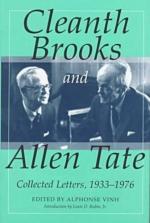
Tate married the writer Caroline Gordon, and they collaborated on some works, including a collection of short stories, House of Fiction. They were divorced, but later remarried, and finally divorced a second time. Tate then married an ex-nun, Helen Heinz.

Tate moved to Monteagle, TN, in 1966, where he remained until his death in 1979. While in Tennessee, he spent his time writing and visiting with old friends from his alma mater Vanderbilt, as well as the University of the South. He also kept in touch with the Sewanee Review, although not directly involved with it. During his final years, he visited various college campuses, giving lectures on literature and politics. He also corresponded regularly with many famous literary friends, creating a wealth of personal papers.

Tate died in Nashville, TN, on Feb. 9, 1979. During his lifetime, he published 20 books and received many literary honors, including the Bollingen Prize for poetry.

This is the complete article, containing 572 words (approx. 2 pages at 300 words per page).

View More Summaries on Allen Tate
More Information
  • View Allen Tate Study Pack
  • Search Results for "Allen Tate"
  • Add This to Your Bibliography
  • More Products on This Subject
    (John) (Orley) Allen Tate
    John Orley Allen Tate was born in Clark County, Kentucky. After an uneven preparatory education, he... more

    (John) (Orley) Allen Tate
    The phrase "man of letters," so often used in praise of Allen Tate, may suggest by its near-obsoles... more


    Ask any question on Allen Tate and get it answered FAST!
    Answer questions in BookRags Q&A and earn points toward
    discounted or even FREE Study Guides and other BookRags products!
    Learn more about BookRags Q&A
    Copyrights
    Allen Tate from Encyclopedia of World Biography. ©2005-2006 Thomson Gale, a part of the Thomson Corporation. All rights reserved.

    Join BookRagslearn moreJoin BookRags


    About BookRags | Customer Service | Report an Error | Terms of Use | Privacy Policy

