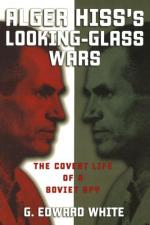
Alger Hiss was a former State Department officer accused of having supplied the Soviet Union with classified information during World War II. Though Hiss denied the accusations that first became public in 1948, he was convicted of two counts of perjury and he served 44 months in prison. Hiss spent the next 50 years seeking to clear his name, blaming the charges on anti-Communist hysteria. Many people embraced him, while others remained convinced that he had been a Soviet spy. The release of Soviet intelligence records in the 1990s appeared to confirm that Hiss had been a foreign agent.
Hiss was born on November 11, 1904 in Baltimore, Maryland. He graduated from Johns Hopkins University in 1926 and Harvard Law School in 1929. Following graduation, Hiss served as law clerk to Supreme Court Justice Oliver Wendell Holmes. He then worked in the U.S. Departments of Agriculture and Justice from 1933 to 1936. Hiss transferred to the State Department in 1936 and quietly rose in prominence during World War II. In 1945, Hiss advised President Franklin D. Roosevelt at the Yalta Conference, where the United States, Great Britain and the Soviet Union decided the shape of the post-war world. The following year, Hiss played a central role in the establishment of the United Nations. In 1946, he became president of the prestigious Carnegie Endowment for International Peace.
In 1948, everything changed for Hiss. Whittaker Chambers, an editor at Time magazine, told investigators that both he and Hiss had spied for the Soviet Union. He alleged that Hiss had joined the Communist party in the 1930s. More troubling, Chambers alleged that Hiss had given him confidential State Departments in 1938 with instruction to deliver them to his Soviet agent. Chambers provided the House Un-American Activities Committee (HUAC) with microfilm of these documents, which he claimed were typed on Hiss's typewriter. California Representative Richard M. Nixon led the investigation of Hiss. Called before HUAC, Hiss denied all the accusations.
A grand jury examined the evidence against Hiss but could not indict him on espionage charges because the statute of limitations had expired on the 1938 espionage allegation. Instead, it indicted Hiss on two counts of perjury for lying to Congress that he did not know Chambers and that he had not given the documents to him. His first trial in 1948 ended in a hung jury, but he was convicted in 1950. Hiss's defense, which he maintained for the rest of his life, was that Chambers was a psychopathic personality and a chronic liar.
After almost four years in prison, Hiss could not practice law because his license had been revoked. He took a job as a salesman and spent all his free time seeking to clear his name. Hiss found many sympathizers, who saw the case as less about Hiss's guilt or innocence and more about the anti-Communist hysteria of the late 1940s and early 1950s. Hiss became a political martyr, yet many people remained convinced that he had lied to Congress about his political past and his espionage activities. After the collapse of the Soviet Union in the 1990s, scholars obtained access to classified Soviet intelligence archives. The documents they uncovered suggested that Hiss had worked for the Soviet Union during the time Chambers had alleged.
Hiss never saw this information, as he died on November 15, 1996 in New York City.
This is the complete article, containing 556 words
(approx. 2 pages at 300 words per page).