BookRags.com Literature Guides Literature
Guides
Criticism & Essays Criticism &
Essays
Questions & Answers Questions &
Answers
Lesson Plans Lesson
Plans
My Bibliography Periodic Table U.S. Presidents Shakespeare Sonnet Shake-Up
Research Anything:        
History | Encyclopedias | Films | News | Create a Bibliography | More... Login | Register | Help


Alexander Grothendieck Biography

Print-Friendly  Order the PDF version  Order the RTF version
About 4 pages (1,291 words)
Alexander Grothendieck Summary

Bookmark and Share Know this topic well? Help others and get FREE products!
Name: Alexander Grothendieck
Birth Date: 1928
Nationality: French
Gender: Male
Occupations: algebraic geometer and analyst

World of Mathematics on Alexander Grothendieck

Alexander Grothendieck has had an influence on the mathematics of the second half of the 20th century well beyond the scale of his publications. Grothendieck started off as an especially prolific contributor to each of the areas to which he turned, including functional analysis, algebraic geometry, and category theory, only to move away from mathematics later in his career. As a result, he has had fewer students to carry on his research tradition than if he had followed a more orthodox path. Nevertheless, one of the chief activities of the mathematicians in several areas has been to recast their field in the terms introduced by Grothendieck.

Grothendieck's early years have been difficult to reconstruct, due to his reluctance to deal in ordinary reminiscences and his distrust of biographers. The generally accepted date and place of his birth are March 28, 1928, and Berlin, but the identity of his parents is less clear. At least one version that Grothendieck has given, as noted by Colin McLarty, indicates that his father was named Morris Shapiro and that he was sentenced to death for attempting to assassinate the Russian Czar in 1905. After Shapiro served a number of years in prison in Siberia, he was released by the Bolsheviks and went to Germany in 1922, about which time he met his future wife. Grothendieck was their first child and took his name from that of the governess who cared for him from 1929 to 1939. In the latter year, his mother took him to France, where he learned for the first time that he was Jewish by ancestry. His father died in the Auschwitz concentration camp and Grothendieck was saved thanks to the cooperation of Protestant and Catholic clergy in Le Chambon sur Lignon in southern France. His mother died in the 1960s.

The story becomes much clearer once Grothendieck entered the French higher education system after the war. He studied at the University of Montpellier and spent a year at the École Normale Supérieure, one of the leading traditional scientific universities in France. At this time France was undergoing a mathematical renaissance, thanks to the pedagogic efforts of the group known under the collective pseudonym of Nicolas Bourbaki. Among those who took part in the grand program of rewriting all of mathematics in the Bourbaki mode were Jean Dieudonné and Laurent Schwartz, both at the University of Nancy. Grothendieck went to work in the area of functional analysis with the two Bourbakists and rapidly produced material sufficient and appropriate for a thesis.

Grothendieck's first conspicuous success was in the area known as functional analysis. This mixed the traditional area of calculus with the more recent developments in topology, the field dealing in properties of geometric configurations, to be able to handle broad ranges of questions. The idea was to replace detailed and lengthy calculations with shorter and more insightful proofs. It is not surprising that such an area attracted Grothendieck, who did not feel that his greatest strength was in long, technical arguments. His contributions came in the area of reconsidering disciplines from new perspectives.

Categorizes the Mathematical World

Grothendieck's most lasting influence came from his work in the area to which he now moved, algebraic geometry. This field had been in existence for many years and could be traced back to French mathematician and philosopher René Descartesin the 17th century. The idea of merging algebra and geometry to enhance the study of both received a new impetus with the accelerated development of abstract algebra in the late nineteenth century. There was a flourishing Italian school of algebraic geometry in the first half of the twentieth century, but it was effectively wiped out by the World War II. American mathematician Oscar Zariski carried on the Italian tradition in the United States, although he felt that he had added a good deal of algebraic sophistication.

Grothendieck was supported during his early investigations into algebraic geometry by the French national center for scientific research. This allowed him plenty of opportunity for travel and he spent part of the 1950s in Brazil and part in Kansas. Perhaps the most fruitful environment he found was at Harvard, where Zariski had settled. As his Harvard colleagues noted, Grothendieck was obsessed by mathematics and worked for many hours at a stretch in an unheated study, emerging with 3000-page manuscripts. On the strength of his energy and imagination, Grothendieck was able to revolutionize mathematics with his research.

One of the chief elements in Grothendieck's approach to mathematics involved the relatively recent field of category theory. Set theory had become an accepted part of the foundations of mathematics, but category theory sought to add a new idea to the basic notions of set and membership--the idea of function. Functions had long been used in mathematics, but category theory built them into the basis of the mathematical universe. One way of looking at the change was that mathematicians began to realize that what was important about the objects of mathematics was how they were connected by functions, not their composition out of basic elements.

Before the work of Grothendieck, category theory had been an active area of research but with limited applications. Grothendieck combined the ideas of category theory with the traditional studies of algebraic geometry to raise the latter to a new level of abstraction. The innovations introduced by Zariski in the previous generation shrank by comparison. As Zariski was quoted in The Unreal Life of Oscar Zariski, "After Grothendieck's great generalization of the field ... what I myself had called abstract turned out to be a very, very concrete brand of mathematics."

In 1959 Grothendieck took a position with the Institut des Hautes Études Scientifiques (IHES), recently established in Paris upon the model of the Institute for Advanced Studies in Princeton, New Jersey. There Grothendieck had the chance to lecture on a regular basis on his work in algebraic geometry and to attract mathematicians from all over the world. Not surprisingly, in 1966 he received the Fields Medal from the International Mathematics Congress, the highest award that the mathematical community can convey. Among the attractions of his work was its applicability to extending a variety of theorems that had originally been established in narrow contexts. Questions about number fields that had required immense amounts of computation to answer could be replaced by conceptually simpler questions about algebraic varieties, and the answers would have wide domains of applicability.

This golden age for algebraic geometry came to an end in 1970. Grothendieck had never been comfortable with playing the role of the "great man" and felt that the adulation of students was not good for him as a human being or as a mathematician. He also moved in a radical direction politically and hoped to be able to galvanize the mathematical community into political action. As a result, he left the IHES and taught at other French universities, particularly Montpellier, from which he retired in 1988. In the meantime, his ideas about category theory continued to supply the fuel for other areas of mathematics, including the foundations. The idea of a topos, a particular kind of category especially useful for analyzing logic, was introduced by Grothendieck for purposes of algebraic geometry. The continued fertility of topos theory adds to the fields indebted to Grothendieck's work during his contributions to algebraic geometric issues.

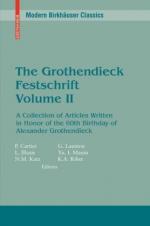
Grothendieck's memoir, Récoltes et Semailles, discusses at length his views on a number of subjects, most of which are unrelated to mathematics. More representative of his career in mathematics is the three-volume set of papers gathered for his 60th-birthday festschrift and published in 1990. The range of contributors includes many of the names of leaders of the mathematical community. His vision of mathematics has led not just to individual results but to a new sense of the powers of the subject.

This is the complete article, containing 1,291 words (approx. 4 pages at 300 words per page).

View More Summaries on Alexander Grothendieck
More Information
  • View Alexander Grothendieck Study Pack
  • Search Results for "Alexander Grothendieck"
  • Add This to Your Bibliography
  • More Products on This Subject
    Alexander Grothendieck
    1928- French Mathematician Alexander Grothendieck is regarded by many as one of the preeminent math... more

    Alexander Grothendieck
    Alexander Grothendieck (born March 28, 1928 in Berlin, Germany) is considered to be one of the great... more


    Ask any question on Alexander Grothendieck and get it answered FAST!
    Answer questions in BookRags Q&A and earn points toward
    discounted or even FREE Study Guides and other BookRags products!
    Learn more about BookRags Q&A
    Copyrights
    Alexander Grothendieck from World of Mathematics. ©2005-2006 Thomson Gale, a part of the Thomson Corporation. All rights reserved.

    Join BookRagslearn moreJoin BookRags


    About BookRags | Customer Service | Report an Error | Terms of Use | Privacy Policy