
BookRags.com Literature Guides Literature Guides Criticism/Essays Criticism/Essays Biographies Biographies My Bibliography Periodic Table U.S. Presidents Shakespeare Sonnet Shake-Up
Research Anything:        
History | Encyclopedias | Films | News | Create a Bibliography | More... Login | Register | Help

Search "Abraham Joshua Heschel"

Biographies Navigation


Abraham Joshua Heschel Biography

Print-Friendly  Order the PDF version  Order the RTF version
About 3 pages (882 words)
Abraham Joshua Heschel Summary

Bookmark and Share
Name: Abraham Joshua Heschel
Birth Date: 1907
Death Date: December 23, 1972
Place of Birth: Warsaw, Poland
Place of Death: New York, New York, United States
Nationality: American
Gender: Male
Occupations: theologian, educator, philosopher

Encyclopedia of World Biography on Abraham Joshua Heschel

Abraham Joshua Heschel (1907-1972) was a Polish-born American theologian, educator, and philosopher who sought to build a modern philosophy of religion on the basis of ancient Jewish tradition. Among other posts, he held the chair of professor of Jewish ethics and mysticism at the Jewish Theological Seminary of America, New York City.

With his birth in Warsaw, Poland, in 1907, Abraham Joshua Heschel entered a family that counted back seven generations of Hasidic rabbis. His father was Rabbi Moshe Mordecai, and his ancestors helped to found the Polish Hasidic movement, a Jewish sect of mystics, in the eighteenth century. Both his father and his mother, Reisel Perlow Heschel, instilled in him a love of learning as he grew up in the orthodox ghetto of Warsaw. As a young man, he wrote poetry, and his collection of Yiddish verse was published years later (1933) in his home city.

Student and Teacher Years

Following a traditional Jewish education in Warsaw, Heschel went to Berlin, where he studied at the university and also taught the Talmud, during 1932-33, at the Hochschule fur die Wissenschaft des Judentums. He earned his PhD degree from Berlin University in 1933 and accepted a fellowship at the Hochschule, graduating the following year. Over the next three years, three published works established him as a scholar and author of note: Maimonides : Eine Biographie, concerning the medieval Jewish philosopher (1935); Die Prophetie, on Hebrew prophesy (1936); and Don Jizchak Abravalel, about the fifteenth-century Jewish statesman of Spain (1937).

In 1937, Heschel went to Frankfurt am Main to teach at the noted Judisches Lehrhaus. But war clouds were gathering in Europe, and he was deported from Nazi Germany in 1938. He returned to Warsaw for a few months of teaching at the Institute of Judaistic Studies, but the Nazi invasion of his homeland forced him to London where he founded the Institute for Jewish Learning.

The United States had not yet entered World War II when Heschel arrived in Cincinnati, Ohio, where he joined the faculty of Hebrew Union College in 1940. Five years later he took the chair of professor of Jewish ethics and mysticism at Jewish Theological Seminary of America in New York City. Heschel, who became an American citizen in 1945, married concert pianist Sylvia Straus in 1946, and they had one daughter, Hannah. He remained at the Jewish Theological Seminary until his death in New York City on December 23, 1972.

Teachings and Published Works

Abraham Heschel wished to construct a modern philosophy of religion on the basis of ancient Jewish tradition and teachings. In traditional Jewish piety, he observed an inner depth of devotion that he sought to convey to twentieth-century humans. "The Jew is never alone in the face of God," he said, "for the Torah is always with him."

Heschel's concern for the piety of the individual involved him in the civil rights demonstrations of the 1960s and early 1970s to end discrimination against blacks in America. He was one of the first religious leaders in the United States to speak out against the escalating war in Vietnam. And he risked the wrath of fellow Jews by meeting with Pope Paul VI at the Vatican in Rome to discuss Jewish feelings concerning Vatican Council II. Some Jewish leaders objected to the trip, but Heschel felt it important that Jewish approval be added, if possible, to some of the Council's decrees, such as the denial of any Jewish guilt in the crucifixion of Jesus.

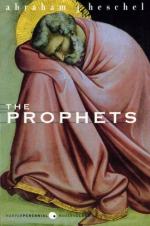
In addition to his teachings, Heschel is well known for his writings. They include: his magnum opus, Man Is Not Alone: A Philosophy of Religion (1951), The Sabbath: Its Meaning for Modern Man (1951), Man's Quest for God: Studies in Prayer and Symbolism (1954), God in Search of Man (1955), The Prophets (1962), Who Is Man" (1965), and The Insecurity of Freedom: Essays on Human Existence (1966). These books provide insights into his existentialist philosophy of Judaism with its central concept based on a "theology of pathos," in which God is a god of pathos, "revealed in a personal and intimate relation to the world.... He is also moved and affected by what happens in the world and reacts accordingly." This divine pathos, in turn, evokes a human response of sympathy for God, by which "man experiences God as his own being"--Heschel's "religion of sympathy."

The element of time occupies an important place in Heschel's theology, since "Time is perpetual innovation, a synonym for continuous creation," and human existence in time is communion with God and a reaction to the continuous action of God. From this concept of time, Heschel derived his theory of human freedom as "a spiritual event." According to Heschel, the individual learns about God not by reason and intellect, but through experience, divine revelation, and sacred deeds, all of which enable the individual to form a relationship--a "leap of action" rather than of faith--with God.

In addition to his scholarly and philosophical writings, Heschel authored several works on Jewish life in eastern Europe. Chief among them is The Earth Is the Lord's: The Inner World of the Jew in East Europe (1950), in which he theorizes that the "golden age" of European Jewish life was in the Jewish culture of eastern Europe. In the 1960s Heschel was active in the movement to aid the Jews of the Soviet Union.

This is the complete article, containing 882 words (approx. 3 pages at 300 words per page).

View More Summaries on Abraham Joshua Heschel
More Information
  • View Abraham Joshua Heschel Study Pack
  • Search Results for "Abraham Joshua Heschel"
  • Add This to Your Bibliography
  • More Products on This Subject
    Heschel, Abraham Joshua
    HESCHEL, ABRAHAM JOSHUA (1907–1972), was a Jewish scholar and philosopher of religion. Born ... more

    Abraham Joshua Heschel
    Abraham Joshua Heschel l (January 11, 1907, Warsaw, Poland - December 23, 1972) was considered by m... more


    Copyrights
    Abraham Joshua Heschel from Encyclopedia of World Biography. ©2005-2006 Thomson Gale, a part of the Thomson Corporation. All rights reserved.

    Join BookRagslearn moreJoin BookRags


    About BookRags | Customer Service | Report an Error | Terms of Use | Privacy Policy

