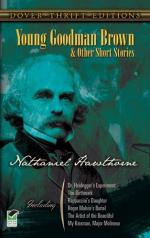
Although Nathaniel Hawthorne called himself "the obscurest man in American letters," his achievements in fiction, both as short-story writer and novelist, offer models fashioned too well for contemporary and later writers to ignore. Even though fame was...
When Nathaniel Hawthorne was born in Salem, Massachusetts, on our most patriotic holiday in 1804, his ancestral roots were already deeply planted in New England. Writing in The Scarlet Letter (1850) of his sentimental affection for the town of his birth,...
In sketches, tales, and romances published in the second third of the nineteenth century, Nathaniel Hawthorne chose mainly American materials, drawing especially on the history of colonial New England and his native Salem in the time of his early America...
"Young Goodman Brown" by Nathaniel Hawthorne Nathaniel Hawthorne's great -great-grandfather, William Hathorne, immigrated to the Massachusetts Bay Colony in 1630. He Settled in Salem, the colony's oldest town, and became one of Salem's most prominent...
"Young Goodman Brown" (1835) is a short story by American writer Nathaniel Hawthorne. The story takes place in Puritan New England, a common setting for Hawthorne's works, and addresses one of his common themes: the conflict between good and evil in...
"If only it were so simple! If only there were evil people somewhere insidiously committing evil deeds, and it were necessary only to separate them from the rest of us and destroy them. But the line dividing good and evil cuts through the heart...
Ray, Goodman and Brown to star for Probation Challenge benefit Ray, Goodman and Brown jet to Chicago to headline the "Probation Challenge Portrait of Achievers" Awards, Dinner and Show of Shows Friday, Aug. 17 at 7 p.m. at the Condesa del Mar, 12220...
In the following essay, Colacurcio examines “Young Goodman Brown” in the context of Puritan theology, faith, and “spectral evidence” of witchcraft and the devil. Colacurcio suggests that Hawthorne uses his story to demonstrate “that witchcraft ‘ended’ the Puritan world”.
In the following essay, Cohen contends that Deodat Lawson's Christ's Fidelity, a work about the Salem witchcraft trials in 1692, inspired Hawthorne to write “Young Goodman Brown.”
In the following essay, Keil focuses on the blurring of masculine and feminine spheres in “Young Goodman Brown” and suggests that the reader needs to take into account historical as well as psychological implications of gender in the tale.
The "everyman" character of "Young Goodman Brown" and his maturation as expressed in the novel's setting and the emblematic characters who surround him. He realizes reality over fairytale characterizations of life and accepting the past.
Get the complete Young Goodman Brown Study Pack, which includes everything on this page. Approximately 1,006 pages (at 300 words per page) in 84 products. (Download a sample literature guide)