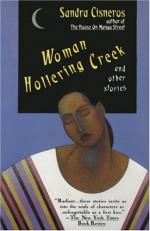
Drawing heavily upon her childhood experiences and ethnic heritage Sandra Cisneros (born 1954) creates characters who are distinctly Hispanic and often isolated from mainstream American culture by emp...
Read more
Sandra Cisneros burst onto the publishing scene with her 1983 work, The House on Mango Street, the warm and human story of a young Chicana who comes of age in a Chicago barrio, fighting obstacles of r...
Read more
With her fiction and poetry Sandra Cisneros creates poignant stories and brings an original twist to universal themes, notably love. Yet, as Jim Sagel in Publishers Weekly pointed out, "Cisneros knows...
Read more

Sandra Cisneros considers herself a poet and a short-story writer, although she has also authored articles, interviews, and book reviews concerning Chicano writers. She began writing at age ten, and s...
Read more
Sandra Cisneros, poet and short-story writer, is best known for The House on Mango Street (1983), a Chicana novel of initiation, which won the Before Columbus American Book Award in 1985. In this lyri...
Read more
In the following essay, Lewis classifies the stories in Woman Hollering Creek into three groups and asserts that the stories in the collection concern minority women who “find themselves confro...
Read more
In the following essay, García contends that Leslie Marmon Silko's story “Yellow Woman” and Cisneros's “Woman Hollering Creek” are “two contempo...
Read more
In the following essay, Doyle examines Cisneros's utilization of the La Llorona myth in her story “Woman Hollering Creek” and argues that the story “charts psychological, l...
Read more
In the following essay, Carroll and Maher maintain that the stories in Woman Hollering Creek traverse artistic and cultural borders in that “her narratives unfold within a temporally variegated...
Read more
In the following essay, Griffin considers how cultural influences shape and limit the lives of the women in Woman Hollering Creek.
In her prefatory poem to My Wicked, Wicked Ways, Sandra Cisneros asks...
Read more
In the following essay, Spencer views “La Fabulosa: A Texas Operetta” as a retelling of the opera Carmen and asserts that by allowing her heroine to live, Cisneros is subverting the trad...
Read more
In the following essay, Phelan utilizes the dialogue form in order to explore the relationship between “Woman Hollering Creek,” Phelan's rhetorical analysis, and the cultural crit...
Read more
In the following essay, Guerra traces the evolution of voice in Chicana literature through an analysis of “Woman Hollering Creek” and Alma Villanueva's poem “Mother, May I....
Read more
In the following essay, Brady examines the representation of space in Woman Hollering Creek, arguing that “Cisneros's stories perform their critique of the production of space in multipl...
Read more
In the following essay, Carbonell investigates the influence of the fertility goddess Coatlicue and the mythical Mexican figure of La Llorona in “Woman Hollering Creek” and Helena Maria ...
Read more
In the following essay, Payant explores the borderland theme in the stories comprising Woman Hollering Creek.
For a writer with quite a small oeuvre—a novella, a volume of poems, and a book of ...
Read more
In the following essay, Fitts discusses Cisneros's representations of three Hispanic female icons in the stories of Woman Hollering Creek: La Malinche in “Never Marry a Mexican;” ...
Read more