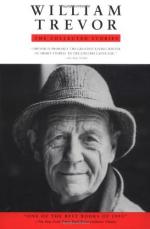
William Trevor (born 1928), whose life and fictional settings were divided between his native Ireland and his adopted England, was a successful novelist, television dramatist, playwright, and, above a...
Read more
William Trevor has established a solid reputation both in Britain and America as an exceptionally sensitive, morally concerned writer whose forte appears to be rendering comic pathos, whether in his n...
Read more
William Trevor is considered one of the masters of the contemporary short story. The author of eleven novels and seven collections of short fiction, he was recognized for his contributions to literatu...
Read more

Critical Essay by John Lucas
William Trevor is an extremely accomplished writer, and Other People's Worlds is as accomplished as anything he's so far written. Trevor has the professional...
Read more
Critical Essay by Patrick Skene Catling
A good short story, like a good poem, exists only in its expression. Its essence is irreducible and immutable. As William Trevor has written (in a review in pra...
Read more
Critical Essay by Terence Winch
William Trevor, like many of the characters in his novels and stories, is something of a con artist. The boring opening to his new novel, Other People's Worlds, ...
Read more
Critical Essay by Jack Beatty
The three aesthetic challenges of [Other People's Worlds] are to establish Julia's innocence on credible grounds, to show it first as weakness and then as s...
Read more
Critical Essay by John Updike
"Other People's Worlds," by William Trevor … is a shorter, more efficient novel than [Iris Murdoch's] "Nuns and Soldiers,"...
Read more
Critical Essay by Michael Garvey
Rarely do verbal precision, intelligence, imagination, and compassion converge to produce a talent as awesome as William Trevor's. His eleventh offering to a bu...
Read more
Critical Essay by Peter Kemp
From his first novel, The Old Boys, onwards, [William Trevor] has specialized in harrying gentility. His books regularly shepherd into view the well-bred and/or well-heele...
Read more
Critical Essay by Anatole Broyard
I liked "Lovers of Their Time," William Trevor's last collection of stories, better than "Beyond the Pale." I still remember with a...
Read more
Critical Essay by Jon Pareles
William Trevor's characters would be perfectly content to lead decorous, uneventful lives. They work in shops or offices, attend bridge socials and lawn parties, q...
Read more
Critical Essay by Ted Solotaroff
William Trevor's reputation has been slow to establish itself in America…. "Other People's Worlds," his most recent novel, received ...
Read more
In the following essay, Gitzen explores the themes of loneliness and self-delusion in Trevor's work.
Since the appearance of his first novel, A Standard of Behavior (1958), William Trevor has p...
Read more
In the essay below, Fitzgerald-Hoyt analyzes "Kathleen's Field" and "Events at Drimaghleen" to support of her argument that Trevor breaks typical stereotypes of Iris...
Read more
In the following excerpt, Morrison discusses Trevor's Irish nationality and recurring themes within his works.
From some perspectives William Trevor might seem to be a British author: he lives ...
Read more
In the following excerpt from her Preface, Paulson argues that Trevor is one of the finest modern short story writers and that he is not appreciated adequately in the United States.
My sense of trage...
Read more
In the following review, Krist argues that if readers give Excursions in the Real World a careful reading, they will learn a great deal about the author.
Any rich and active writing life creates by-pr...
Read more
In the following review of Felicia's Journey, McGrath praises Trevor's ability to create memorable characters and a satisfying resolution to a dramatic story.
William Trevor is an Irishm...
Read more
In the following review, Bowman argues that despite Trevor's romantic depiction of the homeless, Felicia's Journey is well written.
In Britain, William Trevor's 13th novel and 21s...
Read more
In the following review, Maitland faults the conclusion of Felicia's Journey, but still finds the work powerful and engaging.
William Trevor is an eminent British writer, claimed—very pr...
Read more
In the following review, Lesser considers the concepts of truth and self-knowledge in After Rain.
The great novels draw you in entirely, it seems, so that while you are reading them you forget you eve...
Read more
In the following review, Fitzgerald-Hoyt agues that Trevor achieves a coherency in the twelve stories about revelations contained in the collection After Rain.
In the title story of William Trevor...
Read more
In the essay below, Rhodes examines five of Trevor's short stories concerning the Irish troubles and finds that they share similar characters and themes.
William Trevor was born Trevor Cox in M...
Read more
In the following review Towers argues that while some of the stories in Family Sins are skillfully told, the collection does not measure up to Trevor's earlier work.
Readers of William Trevor...
Read more
In the following essay, Larsen explores shared themes in Trevor's two novels Fools of Fortune and The Silence in the Garden.
With the spatial awareness of a sometime sculptor, William Trevor ha...
Read more
In the following review Tillinghast examines Trevor's treatment of Irish culture in The Collected Stories.
American readers of William Trevor's fiction may find themselves at something o...
Read more
In the following review of The Collected Stories, Price argues that Trevor's short story writing is consistently strong but that his novels are better.
The voices of extraordinary writers like ...
Read more
In the review below, Craig praises Excursions in the Real World as an insightful social commentary, but argues that it is not reveal enough about Trevor.
The real world as opposed to the world of fict...
Read more
In the following essay, Hildebidle contrasts Fools of Fortune to "Matilda's England" as he discusses Trevor's views on Ireland and England.
William Trevor has baldly assert...
Read more
In the following essay, Core provides an overview of Trevor's work, discussing recurring themes and Trevor's critical reception.
As a writer one doesn't belong anywhere. Fiction ...
Read more
In the following mixed review, Standen discusses the uneven quality of The Day We Got Drunk on Cake.
William Trevor's The Day We Got Drunk on Cake, comes in a jacket so swinging and irrelevant ...
Read more
O'Faolain is an English novelist and short story writer. In the following review, she examines the tension between reality and fantasy in Trevor's Two Lives.
William Trevor's fict...
Read more
O'Donoghue is an Irish poet, critic and editor. In the following favorable review of The Collected Stories, he discusses the defining characteristics of Trevor's short stories.
Graham Gr...
Read more
In the following mixed assessment of Two Lives and The Collected Stories, Allen derides the pedantic, overly-political nature of Trevor's short fiction set in and around Northern Ireland.
Afi...
Read more
Price is a well-respected American novelist, poet, short story writer, and critic. In the following positive review of The Collected Stories, he examines the scope and major themes of Trevor's ...
Read more
Morrison is an American educator and critic with a special interest in Irish literature. In the following excerpt, she analyzes "The News from Ireland" from a cosmological perspective, m...
Read more
In the following excerpt, Paulson commends Trevor's sensitive and realistic portrayal of gender relations in "The Ballroom of Romance," "Kathleen's Field," an...
Read more
Waugh is an English novelist, journalist, and nonfiction writer. In the following laudatory assessment of The Ballroom of Romance, he examines the characters in Trevor's short stories, assertin...
Read more
Theroux is an American fiction writer, critic, and travel writer who, since 1963, has lived outside the United States, first traveling to Africa with the Peace Corps and later settling in England. Man...
Read more
An English biographer, critic, nonfiction writer, poet, and editor, Ackroyd is known for his novels that focus upon the interaction between artifice and reality and emphasize the ways in which contemp...
Read more
Pritchett, a modern British writer, is respected for his mastery of the short story and for what critics describe as his judicious, reliable, and insightful literary criticism. In the following essay,...
Read more
In the following excerpt, Gitzen offers a thematic analysis of Trevor's early short stories.
Since the appearance of his first novel, A Standard of Behavior (1958), William Trevor has publishe...
Read more
In the following interview, Trevor discusses his background, the creative process, and the influences on and major themes of his fiction.
[Stout]: What did you do after leaving university?
[Trevor]: ...
Read more
Rhodes is an American educator and literary critic with a special interest in Irish literature. In the following excerpt, he explores the theme of secrecy in Trevor's stories, asserting that it...
Read more
In the following essay, Doherty determines the influence of James Joyce's "A Painful Case" on Trevor's "A Meeting in Middle Age."
Many Irish writers have work...
Read more
Critical Essay by Walter Sullivan
[The] story of an evil child is venerable and [William Trevor] brings to his handling of it few approaches that are new. But he does his work with dignity and gives u...
Read more
Critical Essay by Zahir Jamal
[In Lovers of Their Time] Trevor's open, persevering sympathies go out to the unrecognised characters of time; ordinary lives shaped through silt and scythe and th...
Read more
Critical Essay by Tom Paulin
William Trevor is one of the acknowledged masters of the short story. He is an Anglo-Irish writer who now lives in Devon and so he is an exiled member of a disappearing so...
Read more
Critical Essay by V. S. Pritchett
[William Trevor] is one of the finest short story writers at present writing in the Anglo-Irish modes. His people are those who, in the course of their lives, are so ...
Read more
Critical Essay by Benjamin Demott
[Some British authors] abide by conventions of brevity, control, and traditional form without ever sounding like under-reachers. Perhaps the best of these is William ...
Read more
Critical Essay by Josh Rubins
Can a short story do it all? Can it close in on an intense moment of feeling and dig down to illuminate the psychological whys and wherefores and reach out to touch on th...
Read more
In the following essay, Schirmer provides a thematic and stylistic analysis of Trevor's short fiction.
Three years after the appearance of his second novel, The Old Boys, Trevor published his f...
Read more
In the following essay, Morrison investigates the role of evil in several of Trevor's short stories.
Trevor's analysis of the evil permeating human history does not simply link adult suf...
Read more
In the following essay, Fitzgerald-Hoyt explores Trevor's portrayal of middle-class Protestant characters in Ireland in the short story “Lost Ground” and the novella Reading Turge...
Read more
In the following essay, Haughey finds similarities between Trevor's “Two More Gallants” and James Joyce's “Two Gallants,” perceiving the former's story...
Read more
In the following essay, Bonaccorso delineates the role of history in Trevor's stories “Beyond the Pale” and “The News from Ireland.”
What is history? Is it a kind of...
Read more
In the following review, Lasdun surveys the strengths and weaknesses of Trevor's short fiction, deeming the stories comprising After Rain as some of the author's best work.
Leverage is a...
Read more
In the following review, Lively provides a favorable assessment of After Rain.
Short stories take up almost as much space in William Trevor's long list of titles as do novels—After Rain ...
Read more
In the following excerpt, Williams considers Trevor's subtlety in the stories in After Rain.
In William Trevor's twelve stories [After Rain], subtlety is the game, though he might do bet...
Read more
In the following essay, Bonaccorso emphasizes the moral nature of Trevor's short fiction.
In a 1989 Paris Review interview, William Trevor speaks of his fascination with the focusing power of t...
Read more
In the following review, Banville finds parallels between Alice Munro's Selected Stories and Trevor's After Rain.
The short story is the only literary form to have remained largely untou...
Read more
In the following excerpt from a laudatory review of After Rain, Filbin maintains that Trevor “examines human behavior with such a keen eye and fine hand, that one thinks of a Henry James gifted...
Read more
In the following mixed review of Two Lives, O'Faolain claims that Trevor “is not here at the top of his form.”
William Trevor's fictions swing between realism and the escap...
Read more
In the following review, slightly revised by the author in 2003, Binns asserts that some of Trevor's stories in After Rain are among the writer's most imaginative and display a well-wrou...
Read more
In the following essay, Sänger traces the role of Turgenev's work in Trevor's novella Reading Turgenev.
A title such as Reading Turgenev must kindle vastly different expectations ...
Read more
In the following excerpt, McGraw praises the insight and steadiness of Trevor's narrative voice in After Rain.
The characters in William Trevor's After Rain inhabit a world about as far ...
Read more
In the following excerpt, Bell explores the defining characteristics of the stories in After Rain.
Short stories aren't novels—they're shorter. Short stories snatch at life and gi...
Read more
In the following review, Kessler offers a positive assessment of After Rain.
Because he has published twenty-two books—short-story collections, novellas and novels, certainly, but also plays, n...
Read more
In the following excerpt, Curb discusses the pessimistic and dark nature of the stories comprising After Rain.
Writers who thrive on the short-story form and rarely if ever write novels are at their b...
Read more
In the following essay, Clark considers Trevor's use of epiphanies in his stories and argues that they differ significantly from modernist usage of epiphanies.
To read widely in William Trevor&...
Read more
In the following review, Taylor delineates the tragic aspects of the stories in After Rain.
William Trevor is a prolific writer and has won many awards. If you have never read his work, After Rain is ...
Read more
In the following essay, MacKenna examines Trevor's portrayal of the conflict in Northern Ireland in his short fiction.
It is the landscape of the mind which is of importance to a writer; where ...
Read more
In the following favorable review of The Hill Bachelors, Oates characterizes the main thematic concerns of Trevor's short fiction.
Twentieth-century Irish literature has been a phenomenon. No m...
Read more
In the following mixed assessment, Banville deems Two Lives as “more interesting than enthralling.”
Some years ago British television filmed an adaptation of William Trevor's shor...
Read more
In the following review, Murtaugh praises the believability and disturbing nature of the stories in The Hill Bachelors.
The Hill Bachelors gives strong support to the growing consensus that William Tr...
Read more
In the following excerpt, Krist praises the complementary relationship between the novellas Reading Turgenev and My House in Umbria.
While Gordimer's collection [Jump and Other Stories] would c...
Read more
In the following review, Lanters offers a favorable assessment of Two Lives.
The lives of each of the female protagonists who form the focus of the two complementary novels in William Trevor's ...
Read more
In the following essay, Tillinghast discusses the defining characteristics of Trevor's short fiction through an examination of the pieces in Collected Stories.
American readers of William Trevo...
Read more
In the following positive review of Collected Stories, Lanters maintains that Trevor probes both the common and exceptional elements of humanity in his stories.
There are certain unmistakable qualitie...
Read more
In the following excerpt, Prose commends the range and quality of the pieces in Collected Stories.
I assume I am not the only writer who frequently has had the experience of being asked, “What ...
Read more
In the following review, Storey examines the style and major thematic concerns of the pieces in Collected Stories.
From its inception at the turn of the century, the modern Irish short story has been ...
Read more