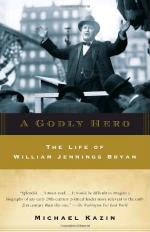
7william Jennings Bryan
Undelivered Closing Statement from the Scopes TrialPublished in 1925
The 1920s was a period of great change in the United States, and the changes made some people uncomfortable...
Read more
William Jennings Bryan
Born March 19, 1860 (Salem, Illinois)Died July 26, 1925 (Dayton, Ohio)
Lawyer and politician
During his long career in law and politics, including three unsuccessful bids for th...
Read more
The American lawyer, editor, and politician William Jennings Bryan (1860-1925) was the Democratic party's presidential nominee three times and became secretary of state. Called the "Great Commoner," B...
Read more
William Jennings Bryan spent a lifetime giving speeches and running for office but is best remembered for his involvement in one of the most publicized legal battles of the twentieth century. Bryan wa...
Read more
One of the most influential figures of his time, William Jennings Bryan has been dubbed the "Boy Orator of the Platte," the "Great Commoner," and the standard bearer of "evangelical populism." While h...
Read more

In the following essay, originally published in the July 14, 1900 issue of the periodical Library, Cather records her personal impressions of Bryan.
When I first knew William Jennings Bryan he was the...
Read more
In the following essay, Jones discusses Bryan's career as an orator.
In July, 1925, Bryan died in his sleep at Dayton, Tennessee, but the music of his voice still haunts our memories. It was my...
Read more
In the following essay, Adler examines Bryan's role in American expansion into the Caribbean.
The rehabilitation of William Jennings Bryan is a marked example of the influence of the New Deal Z...
Read more
In the following essay, Basso examines similarities and differences between Bryan and his contemporary Henry Adams regarding cultural, social, and scientific forces in America at beginning of the twen...
Read more
In the following essay, Glad discusses Bryan's role in the American progressive movement, from the early years of the twentieth century to 1917.
The years between the turn of the century and 19...
Read more
In the following essay, House praises Bryan's talents for oratory.
How great an orator was William Jennings Bryan?1
He was probably the greatest the nation has ever seen. No other ever drew suc...
Read more
In the following essay, Challener examines and evaluates Bryan's years as Secretary of State in the Wilson administration.
The passage of time has been unkind to the reputation of William Jenni...
Read more
In the following essay, Daniels discusses Bryan's ideas about Asian immigration, particularly Japanese, into America.
A little more than a year before he died, William Jennings Bryan wrote out ...
Read more
In the following essay, Smith examines Bryan's religious conservatism and his ideas about the proper application of Christian beliefs to social concerns.
One of the important leaders of the Pro...
Read more
In the following essay, Smith contends that, although Bryan purported to believe unexceptionably in democratic rule by the people, his thoughts on race relations were “inconsistent” and ...
Read more
In the following essay, Worthen traces Bryan's trips to Mexico with his wife, which he believes illuminate Bryan's stance on U.S.-Mexico relations during his time as Secretary of State.
...
Read more
In the following essay, Wildman examines Bryan's early career.
Judge Bryan's farm, about a mile outside of Salem, Illinois, was the show-farm of that section in 1866. It entended for fiv...
Read more
In the following essay, Ogle attempts to explain Bryan's “Americanism”—his belief in the uniqueness of the United States as a purely Christian and democratic nation—...
Read more
In the following essay, Clements discusses the roots and outgrowth of Bryan's Christian-based politics and social beliefs.
When William Jennings Bryan was born, on March 19, 1860, in Salem, Ill...
Read more
In the following essay, Ashby examines Bryan's career in the 1920s, a time of tumultuous change in American culture, economy, and politics, maintaining that Bryan remained more dedicated than e...
Read more
In the following essay, Geer and Rochon argue that L. Frank Baum's children's fantasy The Wonderful Wizard of Oz has political undertones that serve as an allegory for the ideals of the ...
Read more
In the following essay, originally published in the American Mercury magazine in 1924, Masters discusses the political climate in the United States during Bryan's career and Bryan's deve...
Read more
In the following essay, Mencken sarcastically eulogizes Bryan.
Has it been duly marked by historians that the late William Jennings Bryan's last secular act on this globe of sin was to catch fl...
Read more
In the following essay, Merriam discusses Bryan's role as a major American political leader despite personal and professional setbacks.
William Jennings Bryan is a different type of leader from...
Read more
In the following essay, Lippmann refutes Bryan's notions regarding the teaching of evolution.
During the Dayton trial there was much discussion about what had happened to Mr. Bryan. How had a p...
Read more
In the following essay, Seitz considers Bryan's political career.
From the days of Continental currency to the founding of the Federal Reserve Bank in 1915, the United States had been a fertile...
Read more
In the following essay, White traces Bryan's entire career, including his religious convictions.
The Boy Orator of the Platte
William Jennings Bryan was a dramatic and powerful figure in Americ...
Read more
In the following essay, Johnson laments the absence of a great liberal leader like Bryan.
I
Bryan should be living at this hour. Or if not Bryan, then Lord George Gordon, or Cagliostro, or John Brown ...
Read more