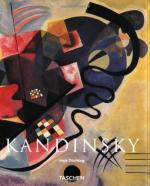
The Russian painter and graphic artist Wassily Kandinsky (1866-1944) was one of the great masters of modern art and the outstanding representative of pure abstract painting that dominated the first ha...
Read more
In the following translation of an 1899 review, Kandinsky assesses the work shown at the 1899 Munich Secession's international exhibit.
Kandinsky's review of the 1899 Munich Secessio...
Read more
In the following essay, Radcliff examines the apocalyptic vision in Kandinsky's seminal essay, Concerning the Spiritual in Art, and compares it to the biblical book of Revelation.
I would li...
Read more
In the following essay, Pester deems Kandinsky and his work an embodiment of the revolutionary ideas spreading throughout Europe during the early twentieth century.
Kandinsky (1866-1944) was one of...
Read more
In the following review, Rasula offers a positive assessment of Kandinsky's Sounds, deeming it "one of the essential books of poetry of the century, whatever one may think of Kandinsky...
Read more
In the following essay, Long determines the influence of occultism and anarchism on Kandinsky's writings and art.
As art historians in recent years have examined the development of modern ar...
Read more
In the following essay, Lipsey provides an overview of the major themes of Kandinsky's seminal essay, contending that "its essential achievement was to identify the new art as a legitima...
Read more
In the following essay, Faherty explores Wallace Stevens's interest in Kandinsky's work.
In June 1952, Stevens wrote to the Irish poet and art historian Thomas McGreevy:
It made K...
Read more
In the following essay, Faherty determines the influence of Kandinsky's theoretical writings on the work of the poet Ezra Pound.
The very first English critic to review Wassily Kandinsky...
Read more
In the following essay, McKay discusses Kandinsky's ethnographic essay "From Materials on the Ethnography of the Sysol and Vechegda Zyrians: The National Deities" and relates it t...
Read more
In the following essay, Everdell investigates Kandinsky 's prolific output during the year 1911-1912.
The tall, narrow roofs of the Promenadenplatz and Maximiliansplatz, which have now disa...
Read more
In the following essay, Williams chronicles Kandinsky' s interest in religious mysticism and theosophy and discusses its influence on his work.
In the early days of the Russian Revolution Bo...
Read more
In the following essay, Selz delineates the major themes of Kandinsky's theoretical writings, in particular his Concerning the Spiritual in Art and "Über die Formfrage. "
...
Read more
In the following essay, Read traces the development of Kandinsky's painting and philosophy of art.
As a painter Kandinsky's achievement was coherent in development, original in style,...
Read more
In the following essay, Millard maintains that although Kandinsky was a great theoretician, he was not a great painter.
Because Kandinsky occupies a particularly prominent place in the development ...
Read more
In the following essay, Mackie explores the role of abstract form in Kandinsky's art and artistic philosophy.
In a very sympathetic article Hilton Kramer once voiced his misgivings (and disa...
Read more
In the following essay, Fineberg traces Kandinsky's relationship with the influential art journal Les Tendances Nouvelles.
1. the History and Character of Les Tendances Nouvelles
The Parisia...
Read more
In the following essay, Long analyzes the purpose and meaning of Kandinsky's On the Spiritual in Art, maintaining that the artist "attempted to resolve the dilemma of how to effectively ...
Read more
In the following essay, Napier provides a stylistic and thematic overview of Kandinsky's poetry.
In 1938, recalling the publication of Klänge, Kandinsky spoke of it as "a small ...
Read more
In the following favorable review of Sounds, Spender considers the relationship between Kandinsky's poetry and his painting.
The coincidence of the exhibition "Kandinsky: The Improvis...
Read more
Many things inspire artists, but one of the most coherent of these is in fact their beliefs. These beliefs shape their interpretations of the world surrounding them. The world surrounding them helps t...
Read more

Perhaps it’s the long-dormant Rolling Stones fan buried within the recesses of my psyche, but the title of Betty Cuningham’s summer-group exhibition rankles: Paint It With Black? Come o...
Read more
Perhaps it’s the long-dormant Rolling Stones fan buried within the recesses of my psyche, but the title of Betty Cuningham’s summer-group exhibition rankles: Paint It With Black? Come o...
Read more
Bill Scott is a radical artist, but not in the sense to which we’ve become accustomed.
Mr. Scott, whose abstract paintings and prints are on display at Hollis Taggart Galleries, doesn’...
Read more