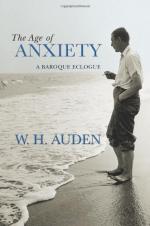
Biography EssayW. H. Auden was a major English poet, probably the most important English-speaking poet born in the twentieth century. Noted especially for native lyrical gifts and highly developed tec...
Read more
The English-born American poet W. H. Auden (1907-1973) was one of the preeminent poets of the twentieth century. His works center on moral issues and evidence strong political, social, and psychologic...
Read more
"America may break one completely, but the best of which one is capable is more likely to be drawn out of one here than anywhere else," W. H. Auden wrote a friend soon after immigrating to the United ...
Read more
No English poet since the seventeenth century made a more promising approach to the theater than young Auden. That he did not develop as a playwright after 1938 may be attributed to the radical transf...
Read more
W.H. Auden was a major English poet, probably the most important English-speaking poet born in the twentieth century. Noted especially for native lyrical gifts and highly developed technical expertise...
Read more
In the following essay, Hynes discusses Auden's emigration to the United States, his preoccupation with history and art, and "New Year Letter" as a reflection of Auden's hi...
Read more
In the following essay, McFarland examines the significance of Roman satiric verse and the conventions of the cena, a Roman banquet, in "Tonight at Seven-Thirty."
Among W. H. Auden...
Read more
In the following essay, France examines Auden's historical perspective and juxtaposition of Latin and Gothic Christianity in his "In Praise of Limestone."
Critics of W. H. Auden...
Read more
In the following essay, Deane explores Auden's theoretical assumptions, linguistic techniques, and open-ended relationship with the reader in "New Year Letter."
In October 1941, t...
Read more
In the following essay, Held discusses the significance of Auden's appropriation of blues music convention in "Refugee Blues."
All art, Walter Pater declared, aspires to the condi...
Read more
In the following essay, Jacobs examines Auden's communitarian sympathies and moral vision. According to Jacobs, "Auden understood both the costs and benefits of choosing to cultivate loc...
Read more
In the following essay, Jenkins provides an overview of Auden's literary career and the significance of his expatriation in the United States.
No episode in the century's English-speakin...
Read more
In the following essay, Berger examines the content, structure, and central themes of "In Time of War."
Auden's poetry of the thirties is suffused by a sense of diffuse crisis, or...
Read more
In the following essay, Caserio discusses Auden's attitudes toward civic allegiance, the significance of his emigration to the United States, and the association of homosexuality with exile.
W....
Read more
Critical Essay by Robert Bloom
The various characteristics that [Randall Jarrell in his essay "Changes of Attitude and Rhetoric in Auden's Poetry," see CLC, Vol. 2] lists in order...
Read more
Critical Essay by James D. Brophy
In a century of the symbolist, surreal, and absurd, W. H. Auden is essentially a poet of the reasonable. "Coming out of me living is always thinking," a...
Read more
Critical Essay by Peter E. Firchow
The usual notion that the earliest Auden is apolitical, as voiced by Jarrell or Spender (e.g., in the famous remark that Auden "came to politics by way of psy...
Read more
Critical Essay by David Perkins
Above all I was charmed in Auden by what to me, when I first read him, seemed the ultimate sophistication, which was not disillusion but instead minimal expectations. M...
Read more
Critical Essay by David Lehman
Ever the schoolboy poet, whose mixed blessing it was to have authored juvenilia of such intellectual force and genius of craft that the best of his last writings must in...
Read more
Critical Essay by Dr. Narsingh Srivastava
Symbolisation of landscape is one of the major structural patterns in the poetry of W. H. Auden. Aware as he has ever been of the inadequacy of the direct sta...
Read more
Critical Essay by Timothy Green
In an essay-review of Loren Eiseley's The Unexpected Universe in 1970, W. H. Auden identifies genuine laughter with the "spirit of Carnival" and in...
Read more
Critical Essay by Edward Callan
The first of Auden's longer works, Paid on Both Sides: A Charade,… is ostensibly an episode in a continuing feud between two families who live some fiftee...
Read more
Critical Essay by Peter Porter
[We should not be tempted] either to believe Auden's own analysis of his creative character, or to divide his output too firmly into the "English" A...
Read more
Critical Essay by Frank Kermode
Auden came close to a point where he no longer understood his own poetry…. [Something] happened that made him close his mind, not to the earliest poetry so much ...
Read more
In If I Could Tell You, a villanelle poem, by W. H. Auden, time is introduced to the reader as an unreliable person. This characteristic of Time given by the speaker is embroidered in the poem through...
Read more