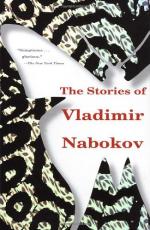
Biography EssayVladimir Nabokov, one of the most important world novelists of the twentieth century, was almost unique in changing languages in mid career, from Russian to English. Not identified with...
Read more
The Russian-born American poet, fiction writer, critic, and butterfly expert Vladimir Nabokov (1899-1977), one of the most highly acclaimed novelists of his time, was noted for his sensuous and lyrica...
Read more
Vladimir Nabokov, a Russian émigré who began writing in English in middle age, is considered one of the most brilliant and inventive writers of the twentieth century. A trilingua...
Read more
It is a paradox that Vladimir Nabokov's life and career dramatically involved him in the most powerful socio-historical currents of the twentieth century: Marxist revolution, exile, politics, the sexu...
Read more
Vladimir Nabokov is one of the most important novelists of the twentieth century--and a thoroughly international one whose work is as carefully read in France, Germany, Japan, and Finland as in his ho...
Read more
Russian American author Vladimir Nabokov wrote novels, short stories, poems, translations, and literary criticism. His novels firmly established him as one of the best stylists of the twentieth centur...
Read more

Critical Essay by R. M. Keils
The best of [Nabokov's] humor is not inflicted upon us. It appears thinly, a condensate, like something in our breath. It is humor that points at something unseen ...
Read more
Critical Essay by James Rother
Can anyone doubt that rather than duplicate the parturitional feat whereby a mountain spews forth a mouse, Nabokov opts for the reverse maternal drama in which a mouse r...
Read more
Critical Essay by W. Walkarput
Andrew Field does not exist. The book recently published under his name, Nabokov: His Life in Part, is in fact a novel written by Vladimir Nabokov. It is the final and m...
Read more
Critical Essay by Robert Martin Adams
Sometimes Nabokov in his authorial person mocks the passive or careless reader with his inattention; more often he silently challenges the alert reader by hiding ...
Read more
Critical Essay by John Updike
Faithful Nabokovians have met Mary before; she sat for her portrait as Tamara in Speak, Memory, lurks near the heart of Lolita, and was deified in Ada. [In Mary], artisti...
Read more
Critical Essay by Donald E. Morton
If one can generalize as far as to say that fiction falls into the two broad categories of realism and romance, Nabokov's work belongs in the latter category....
Read more
Critical Essay by Dean Flower
Vladimir Nabokov's recent novels in English have not won him many converts nor have they discouraged the view that his art is mere artificial gamesmanship of a who...
Read more
Critical Essay by Michael Rosenblum
Nabokov's writing is sophisticated in the way that good music is sophisticated: we have not only to remember the theme, but to be able to recognize it when i...
Read more
Critical Essay by Robert Merrill
[There are two virtual commonplaces] about the art of Vladimir Nabokov: that it is anti-realistic or anti-mimetic, and therefore a deliberate reproach to the Great Tra...
Read more
Critical Essay by Julia Bader
[A] work of art is inevitably a rendering of emotion, observation, and philosophical speculation in aesthetic terms, or at least in an aesthetic realm. In Nabokov'...
Read more
Critical Essay by James Campbell
As novelist, Nabokov fits his own description of the role as a combination of teacher, story-teller and enchanter, and [Lectures on Literature] proves that he was all ...
Read more
Critical Essay by John Simon
Vladimir Nabokov, who appreciated artfully layered constructions and perceived all art as a fusion of layers in the time-and-space-defying eyes of the great writer and goo...
Read more
Critical Essay by Gore Vidal
Professor Vladimir Nabokov's beautiful memoir Speak Memory has now been succeeded by Strong Opinions—a collection of press clippings in which he has preserve...
Read more
Critical Essay by Ronald Wallace
Two basic questions … confront us in Lolita. First, is Humbert Humbert "really" a lover and an artist or a pervert and a fool, or is he some curio...
Read more
Critical Essay by A. L. Rowse
Always rather a hazardous business bringing two prime donne together….
Actually Edmund Wilson and Nabokov come out of the test rather well [in The Nabokov-Wilson L...
Read more
Critical Essay by Michael H. Begnal
One of the most fascinating characteristics of The Gift, the last novel Vladimir Nabokov wrote in Russian, is the slippage which takes place in the narrative point ...
Read more
Critical Essay by Brian Stonehill
As part of his demolition of the then fashionable politico-socio-Marxist readings of Flaubert's Madame Bovary …, Nabokov would tell his students, ...
Read more
Critical Essay by Michael Dirda
In Lectures on Literature Vladimir Nabokov … not only fingers every thread in some half-dozen novels, but also appraises the weave of the narrative and the patte...
Read more
Critical Essay by Daphne Merkin
There are, as one would expect, many dazzling moments in [Lectures on Literature], but the most striking point about them is the industry that went into their making. I...
Read more
Critical Essay by Ellen Pifer
The difficulty of assessing Nabokov's achievement as a novelist writing about people obviously derives from the flagrantly artificial quality of his fiction…...
Read more
In the following essay, Jones examines the parallels between Lolita in Nabokov's novel and Albertine in Marcel Proust's In Search of Lost Time.
“The Poor Woman”—Char...
Read more
In the following essay, originally published in 1986, Kiš pays tribute to Nabokov for writing novels dedicated to literary play rather than social commentary.
Until the scandalous Lolita and it...
Read more
In the following essay, Ermarth examines the tension between reflexive and representational language in Nabokov's fiction and in the theories of Julia Kristeva, the French philosopher of langua...
Read more
In the following essay, Foster defines the importance of “anticipatory memory” in Nabokov's early Russian novels, the ones written before he became familiar with the Proustian pra...
Read more
In the following essay, Toker compares the plot, characters, and situations in the Russian and English versions of King, Queen, Knave.
Lovers and madmen have such seething brains, Such shaping fantasi...
Read more
In the following essay, Alter examines the intersection of past and present, of actual memory and reconstructed scenes in Nabokov's autobiography, Speak, Memory.
In Nabokov's notoriously...
Read more
In the following essay, Buhks discusses Nabokov's ambivalent critique of Dostoevski.
Nabokov's characterisation of Dostoevskii was both harsh and eccentric. With unwavering insistence th...
Read more
In the following essay, Grayson discusses the importance of Nabokov's work as a translator to the development of his work as a novelist.
Où tu vas, j'y serai toujours, Jusques au ...
Read more
In the following essay, Karlinsky examines the sources of two of Nabokov's plays and their similarities to his novels.
It was Vladislav Khodasevich who in 1937 characterized Nabokov as a writer...
Read more
In the following essay, Seifrid argues that visual and thematic elements in Nabokov's fiction correspond to passages in Tolstoy's Anna Karenina.
“A mysl' liubit zanavesku i...
Read more
In the following essay, Foster discusses Nabokov's place on the modernist/postmodernist continuum.
1.
The Library of America's recent publication of Vladimir Nabokov's novels in E...
Read more
In the following essay, Lyons surveys Nabokov's American novels.
The Library of America's recent publication of the American writings of Vladimir Nabokov in three volumes gives occasion ...
Read more
In the following criticism of philosopher Richard Rorty's reading of Nabokov, Stow argues Rorty is, himself, a Nabokovian type.
In 1996, Vladimir Nabokov, an author who continually claimed that...
Read more
In the following review of Stacy Schiff's biography of Vera Nabokov, Maddox outlines the relationship between the Nabokovs, and its significance for Nabokov's career as a writer.
When co...
Read more
In the following essay, Sweeney discusses the role of fairy tale elements in Nabokov's “A Nursery Tale.”
Like most of Vladimir Nabokov's works, the short story “Skaz...
Read more
In the following essay, Morris explores Nabokov's technique of using the play of consciousness as the narrative voice.
Vladimir Nabokov, according to a reliable source present at his bedside, w...
Read more
The following is a British Broadcasting Company transcript of Nabokov's last interview in 1977.
We arrived in February. Wintry laurels and the bare willow trees made the path at the side of the...
Read more
In the following essay, Connolly examines Nabokov's variations of Dostoevskian themes in his fiction.
A writer's relationship to the literary legacy of the past finds expression in a mul...
Read more
In the following essay, Amis argues that the three “black farces,” King, Queen, Knave; Laughter in the Dark; and Despair are precursors to Lolita.
There are several ways in which Nabokov...
Read more
In the following essay, Pifer argues that characters who appear to be doubles of each other in Nabokov's fictions actually are not.
Despite Nabokov's consistent emphasis on the individua...
Read more
In the following essay, Pifer argues that frequent critical charges that Nabokov's novels represent the work of an aesthetic disposition devoid of human concern misrepresent the writer and his ...
Read more
In the following essay, Bruss examines the relation of the narrators to the texts they create in Nabokov's last novels.
Nabokov's last two novels may not measure up to the achievement of...
Read more
In the following essay, Paperno and Hagopian detail the treatment of Nabokov's work in the Soviet Union.
It is perhaps not entirely whimsical to observe that cultural phenomena in the Soviet Un...
Read more
In the following essay, Shute analyzes Nabokov's aversion to Freud.
“All My Books Should Be Stamped Freudians, Keep Out,” wrote Nabokov in 1963,1 and his fiction—as well as...
Read more