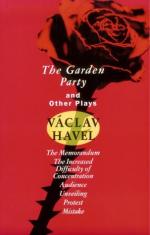
Havel, Vaclav
FORMER PRESIDENT OF CZECHOSLOVAKIA1936–
Vaclav Havel is a Czech intellectual, writer, dramatist, and dissident who became the first president of Czechoslovakia after the yoke of t...
Read more
Biography EssayVaclav Havel has played a major role in the cultural and political life of Czechoslovakia—and, after the breakup of that country in 1993, of the Czech Republic—throughout th...
Read more
A world-renowned playwright and human rights activist, Vaclav Havel (born 1936) became the president of Czechoslovakia in December 1989, a unique position in European history. His literary brilliance,...
Read more
Václav Havel has played a major role in the cultural and political life of Czechoslovakia-and, after the breakup of that country in 1993, of the Czech Republic-throughout the second half of t...
Read more
Critical Essay by Jan Grossman
A great theatre reveals not only itself and its story; it also reveals the viewer's story, and with it his urgent need to confront his own experience with the th...
Read more
Critical Essay by Samuel Beckett
DIRECTOR (D)
HIS FEMALE ASSISTANT (A)
PROTAGONIST (P)
LUKE, IN CHARGE OF THE LIGHTING, OFFSTAGE (L)
Rehearsal. Final touches to the last scene. Bare stage...
Read more
Critical Essay by Paul I. Trensky
The work of Havel epitomizes the state of Czech literature in the middle 1960's, which is characterized by two main features: first, an orientation toward the...
Read more
Critical Essay by Martin Esslin
Havel's cheerfully beaming appearance is deceptive. His plays are very funny, certainly, but there is a core of deep pessimism, even despair in them. They are a...
Read more
Critical Essay by Martin Esslin
[The Garden Party] displays a mixture of hard-hitting political satire, Schweikian humour and Kafkaesque depths which are highly characteristic of Havel's work....
Read more
Critical Essay by The Times Literary Supplement
[The] controlling idea [of The Increased Difficulty of Concentration] could be best summed up by such fashionable sociological terms as "alienat...
Read more
Critical Essay by Jarka M. Burian
[The Increased Difficulty of Concentration] is a more humanly oriented work [than The Memorandum]. The satire is less sharp for its only object is the absurdity of s...
Read more
Critical Essay by Marketa Goetz-stankiewicz
In approaching Havel's brilliant and startling plays it might be useful to become aware of how the main theme of his work, which had been formulated...
Read more
Critical Essay by Marketa Goetz-stankiewicz
[Under their present regime, the Czechs are] faced daily with an official language…. With the "official" language there goes an ...
Read more
In the following review, Howe offers positive assessment of Open Letters. "We turn to Havel," Howe writes, "not for theoretical innovation but for the consolidation of truth....
Read more
In the following essay, Majer examines the influence of totalitarian oppression and imprisonment on Havel's existentialist concept of time, individual identity, and the possibility of meaning i...
Read more
In the following essay, Meche discusses the role of subordinate or victimized women in Havel's drama as a symbolic foil for deficient male protagonists.
Václav Havel's recent r...
Read more
In the following essay, Capps examines Havel's artistic and philosophical development in the context of Czechoslovakian intellectual tradition and contemporary politics.
Though the intellect...
Read more
In the following review, Elshtain offers a positive evaluation of The Art of the Impossible.
President Václav Havel of the Czech Republic is one of the great spokesmen for the "return...
Read more
In the following essay, Ambros examines the interplay of fictional constructs, representations of reality, and dialogue in The Garden Party.
Because the theory of fictional worlds concentrates prim...
Read more
In the following essay, Carey provides an overview of Havel's literary career, major works, and critical reception.
The performance of Vaclav Havel as Czech President since December 1989 has...
Read more
In the following essay, Quinn explores delirium, namely in the form of misunderstanding and confusion, in Havel's dramatic works. According to Quinn, Havel typically incorporates elements of de...
Read more
In the following essay, Carey provides an overview of Havel's creative periods and major dramatic works.
Americans were captivated by the 1989 election of Vaclav Havel, a human rights activi...
Read more
In the following review, Thomas offers positive assessment of Living in Truth and The Vanek Plays. According to Thomas, Havel's dramatic works "are more complex, darker studies of the hu...
Read more
In the following review, Kennan offers favorable assessment of Summer Meditations, praising Havel's courage to "offer to the public so unsparingly an exposure of what one can only call h...
Read more
In the following essay, Skloot considers the literary accomplishment of Havel's drama in relation to the works of Harold Pinter, Tom Stoppard, Eugene Ionesco, and Samuel Beckett.
In the shor...
Read more
In the following review, Knoll offers favorable assessment of Open Letters, Summer Meditations, and Living in Truth. Knoll praises Havel's "literate, profound, and humane essays."...
Read more
In the following essay, which was written in 1985, Havel discusses the experience of having other authors utilize his character Vaněk and coins the term "Vaněk principle" to ...
Read more
Below, Hughes-Hallett characterizes the mood of The Memorandum as one of "weary, witty disenchantment. " Vaclav Havel's The Memorandum is set in the kind of office in which not on...
Read more
When the three Vaněk plays were staged off-Broadway in 1983, they were given the collective title A Private View. In the following review of that presentation, Simon declares "Protest...
Read more
The following is a highly favorable assessment of the off-Broadway production of A Private View. Oliver asserts: "The performance of these plays, in the impeccable translation of Vera Blackwell...
Read more
In this review of A Private View, Sauvage praises "Interview" and "Protest" but severely censures "Private View," stating: "The play is bad, and made w...
Read more
In the evaluation below of A Private View, Brustein argues that Havel has made Vaněk the spokesman for his own views, and in so doing has "created for himself an insoluble problem: how to...
Read more
In this review of A Private View, Hughes offers a moderately favorable assessment of the play.
The first portion of the Czech dissident's three-play evening [A Private View] is entitled ...
Read more
The following interview was first published in 1986. Havel surveys his career and discusses the origins of several of his plays.
How many plays have you written by now? Could you give us a bibliogr...
Read more
Carey places Havel's drama in three major phases: "the early absurdist comedies; the Vaněk morality plays; and the psychological-prison plays."
Americans were captivated ...
Read more
In the essay below, Goetz-Stankiewicz traces the dance metaphor through Havel's plays.
At fifty-three the Czech playwright Václav Havel has arrived at a crossroad in his life that he ha...
Read more
In this essay, which was written in the interim between Havel's terms as President of Czechoslovakia and of the Czech Republic, Skloot explores the political nature of Havel's plays.
...
Read more
In the following evaluation of a recent British production of The Memorandum, Kingston praises the play but finds its absurdist elements dated.
Written and produced in 1965 when its author, Vaclav ...
Read more
In this review, Billington admires the irony in The Memorandum as well as the play's "brutally logical satire on the use of language to enforce conformity."
Vaclav Havel'...
Read more
Hemmings argues that the subject matter of The Memorandum is still current: "the use of language or jargon to obscure meaning has by no means vanished, " she maintains.
One problem fa...
Read more
In the following, Taylor offers a favorable assessment of The Memorandum.
At the start of Vaclav Havel's The Memorandum, the managing director of a company is seen desultorily sorting throug...
Read more
19 January 2006
English (Advanced)
Module One
Critical Study Of Text
Rory Halliday
Great Speech's That Echo Into
The Future Of Today
The Speech's that continue to echo through the archives of...
Read more