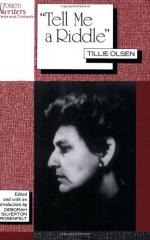
Olsen, Tillie (1913—)
Tillie Olsen has given voice to constituencies that have traditionally been unrepresented in literature, particularly working-class women. Influenced by her socialist pare...
Read more
Biography EssayTillie Olsen is a feminist and working-class author who began writing in the 1930s. Robert Coles commented in The Nation, "Everything Tillie Olsen has written has become almost immedi...
Read more
Tillie Olsen (born 1913) is widely regarded as one of the most important women writers in America. Although her reputation was built on a relatively small body of work, she is recognized for her skill...
Read more
Tillie Olsen writes about people who, because of their class, sex, or race, have been denied the opportunity to express and develop themselves. In a strongly emotional style, she tells of their dreams...
Read more
Tillie Olsen, feminist and working-class writer,grew up in Wyoming and Nebraska, areas which have not often been the childhood homes of America's Jewish authors. This might explain why, despite the fa...
Read more
Long recognized as a feminist and a working-class writer, and more recently as a Jewish writer, Tillie Olsen has rarely been considered a writer of the American West. This may be because she deals wit...
Read more
Critical Essay by Catharine R. Stimpson
Olsen's compelling gift is her ability to render lyrically the rhythms of consciousness of victims [in Yonnondio: From the Thirties]. Imaginative, affect...
Read more
Critical Essay by Peter Ackroyd
[Yonnondio] is a conventional story, as stories go, but the plot is in fact the least important element of the novel. This is not because it is incomplete (the book has...
Read more
Critical Essay by Robert Coles
[Tillie Olsen] is, has been for decades, a feminist—unyielding and strong-minded, but never hysterical or shrill. Her essays reveal her to be brilliant, forceful ...
Read more
Critical Essay by Margaret Atwood
Tillie Olsen's is a unique voice. Few writers have gained such wide respect based on such a small body of published work…. Among women writers in the Un...
Read more
Critical Essay by Phoebe-lou Adams
In examining the failure of various talented writers (mostly women) to produce the amount or quality of work warranted by their apparent ability, Ms. Olsen blames, i...
Read more
Critical Essay by Nolan Miller
There is a good reason for [Tillie Olsen's] low production. For more than forty years she has been a wife and mother, a family wage-earner at dull and time-sappin...
Read more
Critical Essay by David Dillon
[Silences] is a book about the relationships between literature and circumstances as well as a commentary on the mysterious workings of the creative imagination…....
Read more
In the following essay, O'Connor praises Olsen's short stories, for the power of their scenes of everyday life.
Tillie Olsen writes about anguish. One character thinks: "It is a l...
Read more
In the following essay, Bauer remarks on the themes of hope and despair within the mother-daughter relationship in "I Stand Here Ironing."
"I stand here ironing" begins the...
Read more
In the following essay, Wolfe compares "I Stand Here Ironing" with "Hey Sailor, What Ship?" as she explores Olsen's concept of universal hope.
Trying to define Tilli...
Read more
In the following essay, Pfaelzer discusses the ways in which Olsen uses language and silence in Tell Me a Riddle to represent Eva's journey from alienation to engagement.
Logos, the expressed w...
Read more
In the following essay, Kloss examines the daughter's emotional deprivation in "I Stand Here Ironing."
Few modern short stories move readers to feel as much compassion toward the ...
Read more
In the following review of Tell Me a Riddle, Fisher praises Olsen's efforts as a feminist writer.
You won't find her in Who's Who … nor is her name going to be listed in th...
Read more
In the essay below, Rose explores Olsen's philosophy on writing and suggests that Olsen, a renowned feminist, is as powerful at depicting men as she as at depicting women.
Tillie Olsen was born...
Read more
In the following review, Oates contends that Silences suffers from omissions, uneven tone, and faulty logic.
The highest art appears to contain an entire world in miniature: entering it, one experienc...
Read more
In the following essay, Culver discusses Olsen's views on self-fulfillment and motherhood.
And if a blight kill not a tree but it still bear fruit, let none say that the fruit was in consequenc...
Read more
In the following essay, Gelfant addresses the protagonist's need to find meaning and self-renewal during the Depression in Olson's short story "Requa."
No one has written s...
Read more
In the essay below, Kamel discusses the elements which are common within Olsen's writings.
Ellen Moers observes the consistent and fervent penchant for women writers, themselves rendered invisi...
Read more
In the following essay, Lyons argues that while Judaism shapes Olsen's work, her writing is most influenced by her experiences as a woman.
That Tillie Olsen's work is radically perfectib...
Read more
In the following essay, Staub traces Olsen's focus on self-articulation and the freedom it brings.
Tillie Olsen's only novel, Yonnondio: From the Thirties, written between 1932 and 1937 ...
Read more
From the beginning of time itself the battle between mother and daughter has existed. In Tillie Olsen's "I Stand Here Ironing," the battle between mother and daughter is not the "norm." It's actually ...
Read more
In the short story "I Stand Here Ironing" by Tillie Olsen, the reader is introduced to a mother living in the midst of the Great Depression dealing with angst and anxiety towards her daughter Emily. B...
Read more