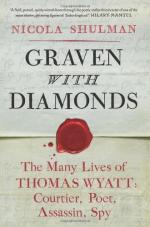
The English poet and diplomat Sir Thomas Wyatt (1503-1542) is chiefly remembered for his 200 songs, many of them intended for lute accompaniment. He also introduced the sonnet and terza rima into Engl...
Read more
No poet represents the complexities of the court of Henry VIII better than Sir Thomas Wyatt. Skilled in international diplomacy, imprisoned without charges, at ease jousting in tournaments, and adept ...
Read more
In the following poems, Surrey pays homage to his friend Wyatt. The first three derive from undated manuscripts; the fourth was printed in 1542 under the title An excellent Epitaffe of syr Thomas Wyat...
Read more
In the essay which follows, Southall explores how the precarious life at court influenced Wyatt's poetry.
Writing in these pages nearly twenty-five years ago, I argued against D. W. Harding...
Read more
In the following essay, Waller argues that in “Whoso list to hunt” “male selfhood” is achieved through the “denigration and exclusion” of women.
I. an Observa...
Read more
In the excerpt below, Hinely places Wyatt's psalms at the center of the canon of his works and explores their thematic relation to his secular lyrics.
Critics in general, perhaps discouraged by...
Read more
In the following essay, Holahan argues that Wyatt's translations of Petrarch's works altered them from private love poems to public declarations of allegiance.
My Lord, I see I must be y...
Read more
In the essay below, Hobson contends that Wyatt employed concealment and evasion in his poetry as necessary means to present difficult truths.
Truth is a crucial term in the poetry of Sir Thomas Wyatt....
Read more
In the following essay, Heale explores how proverbs influenced Wyatt's verse, particularly the poem “A spending hand.”
Wyatt's third satire, ‘A spending hand’...
Read more
In the essay below, Watkins investigates the many levels on which Wyatt's works engaged Chaucer's.
For more than four hundred years, critics have honored Wyatt as the first representativ...
Read more
In the essay which follows, Simpson contends that Wyatt and Surrey were writers operating within specific literary traditions, rather than the radical innovators they are often depicted to be.
Thomas ...
Read more
In the following excerpt, which was originally published in Tottel's Songs and Sonettes, written by the ryght honorable Lorde Henry Haward late Earle of Surrey, and other, the printer credits W...
Read more
In the essay below, originally published in the second volume of Nott's 1815-16 edition of The Works of Henry Howard Earl of Surrey and of Sir Thomas Wyatt the Elder, the critic charges that Wy...
Read more
In the excerpt below, Muir analyzes the canon of Wyatt's poetry, concluding that his original lyrics are his finest writings.
(1) the Manuscripts
Some account of the manuscripts, apart from a r...
Read more
In the following essay, Daalder examines the numerous appearances of the word “liberty” throughout Wyatt's works and maintains that the word is charged with “a profound emo...
Read more
In the following excerpt, Greenblatt analyzes the “intimate relationship between Wyatt's poetry and the forces that shape his identity,” notably politics, religion, and sexuality....
Read more
In the following essay, Kay analyzes the Chaucerian elements in Wyatt's “They flee from me,” in an effort to understand the effect of the poem on its original audience.
Wyatt...
Read more
In the essay below, Daalder explores the influence of Seneca on Wyatt, arguing that “Wyatt is the first major Senecan among Renaissance writers in England.” The first part of this essay,...
Read more
In the following essay, Wyatt's metrics are defended.
In his pioneer essay on "The Fifteenth-Century Heroic Line,"1 C. S. Lewis demonstrated that much fifteenth-century verse, lon...
Read more
In the following essay, Rosen commentds Wyatt's use of narrative time as an artistic reflection of the features of sixteenth-century England.
In the last fifteen years critics have tended to fi...
Read more
The following essay points to the complex and subtle patterns of repetition and refrain in Wyatt's poetry as proof of his lyrical mastery.
It is no longer necessary to be defensive in writing a...
Read more
In the following essay, Glaser argues that Wyatt's choice of Petrarchan sonnets realistically reflects the moral beliefs of the late Renaissance period.
Every student of English literature know...
Read more
In the following essay, Merwin reevaluates Wyatt's work and life, bestowing credit where he believes it has been lacking.
What we hear when we read the poems of Sir Thomas Wyatt, some four and ...
Read more
In the following essay, Wyatt's conflicting attitudes toward the court are examined as a key to understanding his work.
In 1548, six years after Sir Thomas Wyatt's death, his good friend...
Read more
In the following essay, stability of mind is described as the "thing" Wyatt seeks.
In an article first published in Essays in Criticism1 and later incorporated in his book The Courtly Ma...
Read more
In the essay that follows, Wyatt's lyrics are read as literal expressions of his relationship to his lady as well as of his position in the court.
Wyatt's love lyrics establish a relatio...
Read more
In the following review of Muir and Thomson's updated edition of Wyatt's Collected Poems, the reviewer discusses newly discovered poems from the Blage manuscript.
Since Professor Muir di...
Read more
In the following essay, various attitudes toward love are explored in Wyatt's poetry.
In this article, I should like to explore the variety of Wyatt's attitudes to love. Wyatt differs fr...
Read more
In the following essay, Wyatt's entire oevre is appraised highly as springing from the poetic centre of a man in the midst of turmoil.
Fie fro the pres and dwelle with sothefastnesse.Suffise t...
Read more
In the following essay, Wyatt's satires are seen as disparate portraits of courtly life.
Critical studies of Sir Thomas Wyatt's three verse epistles or satires have customarily found in ...
Read more
In the following essay, Kamholtz argues that the interplay between politics and love in Wyatt's poetry expresses the limits of Henry VW's court.
Wyatt's "He is not ded that...
Read more
What part do the conditions of Court life play in the poetry of Wyatt, Surrey or any other Sixteenth century poet? Sir Thomas Wyatt the Elder
Sir Thomas Wyatt the Elder's life revolved around King He...
Read more
A Bitter Sweet Ending
After reading the poem "Is It Possible", by Thomas Wyatt, it was obvious that the narrator is revisiting his desire to love, and where it begun and ended. Love is a difficult th...
Read more