Economist Thomas Robert Malthus advocated controlling population growth to avoid food shortages.
Malthus, Thomas Robert
Economist 1766-1834
Thomas Robert Malthus, English economist and demograp...
Read more
Thomas Robert Malthus
1766-1834
English Economist
Thomas Malthus was one of the most important English economic theorists of the early nineteenth century. He is best known for his influential work, An...
Read more
Malthus, Thomas Robert English Classical Economist and Clergyman (1766–1834)
Thomas Robert Malthus is best remembered for his 1798 treatise titled An Essay on the Principle of Population as it ...
Read more
Malthus, Thomas Robert(1776–1834)
Thomas Robert Malthus, the English economist and moral philosopher, is most famous for his contributions to population studies. In his Principles of Political ...
Read more
The English economist Thomas Robert Malthus (1766-1834) was of the classical school and was the first to direct attention to the danger of overpopulation in the modern world.Thomas Malthus was born at...
Read more
Thomas Robert Malthus, sometimes called "England's first political economist," occupies an important place between the Scottish Adam Smith and David Ricardo in the history of economics, but his claim ...
Read more
Recent scholars have given Thomas Robert Malthus a central role in the creation of the new Poor Law of 1834, viewing him as one of the most influential thinkers in the rise of liberal capitalism. Alth...
Read more
Thomas Robert Malthus was born at his family's country home in Wotton, Surrey, on February 13, 1766. He was raised in a wealthy family, the sixth child of seven born to Daniel and Henrietta Malthus. H...
Read more
Thomas Robert Malthus was born in 1766 southwest of London in Surrey. Malthus had an enormous impact on scholars of biology, human populations and economics. He entered Jesus College at Cambridge in 1...
Read more
Thomas Robert Malthus had an enormous impact on scholars of biology, human populations and economics. Malthus was born southwest of London in Surrey. He entered Jesus College at Cambridge in 1784 and ...
Read more



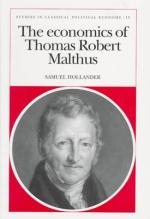
 Malthus, Thomas Robert
 Thomas Robert Malthus
 Malthus, Thomas Robert English Classical Economist and Clergyman (1766-1834)
 Malthus, Thomas Robert (1776-1834)
 Thomas Robert Malthus
 Thomas Robert Malthus
 Thomas Robert Malthus
 Thomas Robert Malthus
 Thomas Robert Malthus
